

Automotive Seats Are Becoming Intelligent Systems Rather Than Conventional Interior Components
The global automotive industry is undergoing a transformation that extends well beyond electric powertrains, autonomous driving technologies and connected vehicle software.
One of the most important changes is taking place inside the vehicle cabin.
Automotive seats, traditionally designed primarily for occupant support, comfort and safety, are evolving into sophisticated systems integrating electronics, sensors, thermal management, lightweight structures and sustainable materials.
This transition is creating new opportunities for automotive seating manufacturers, component suppliers and technology developers.
Modern vehicle seats increasingly incorporate powered adjustment, heating, ventilation, massage functions, memory settings and occupant detection technologies.
At the same time, electric vehicle manufacturers are reconsidering conventional interior layouts to improve space utilization, passenger comfort and energy efficiency.
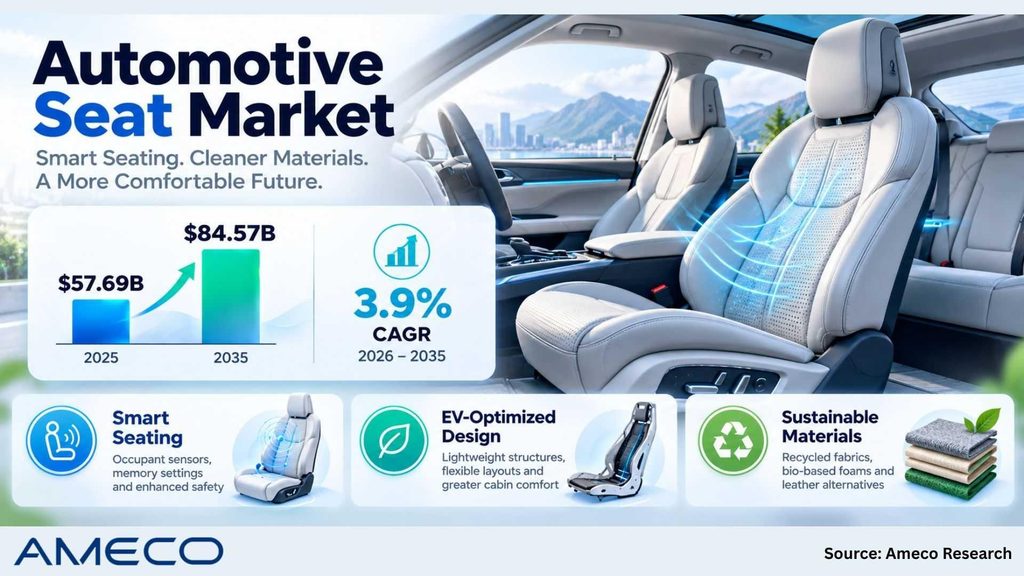
According to Ameco Research, the global Automotive Seat Market was valued at USD 57.69 billion in 2025 and is projected to reach USD 84.57 billion by 2035, expanding at a 3.9% CAGR during 2026–2035.
Although the market’s growth rate is more moderate than that of emerging automotive technologies, its transformation is strategically important.
Automotive seats are increasingly becoming platforms for differentiation, enabling manufacturers to improve vehicle comfort, safety, functionality and perceived value.
The next competitive advantage in automotive seating may come not from producing more seats, but from integrating more intelligence, functionality and value into every seat.
Automotive Seat Market Size Could Exceed USD 84 Billion by 2035
The global Automotive Seat Market is projected to increase from USD 57.69 billion in 2025 to USD 84.57 billion by 2035.
The forecast reflects steady global vehicle production, increasing demand for premium interior features and continued innovation in automotive seating systems.
Several structural developments are supporting this growth.
First, automakers are incorporating advanced comfort technologies into a broader range of vehicle models.
Features once reserved for luxury vehicles are increasingly appearing in mid-range passenger cars, SUVs and electric vehicles.
Second, electric vehicle adoption is creating demand for lighter and more flexible seating systems.
Third, vehicle safety requirements are encouraging the integration of occupant sensors, airbags and advanced restraint technologies.
Fourth, sustainability initiatives are accelerating the development of recycled upholstery, bio-based materials and more environmentally responsible manufacturing processes.
These factors are changing the composition of automotive seating revenue.
While conventional seat structures and upholstery remain essential, electronics, thermal systems and advanced materials are becoming increasingly important sources of value.
The market is therefore evolving from a largely mechanical component industry into a more technologically integrated automotive supply chain.
Electric Vehicles Are Redefining Automotive Seat Design
Electric vehicle adoption is one of the most significant forces influencing the Automotive Seat Market.
Unlike conventional internal combustion engine vehicles, many electric vehicles use dedicated platforms that provide greater flexibility in interior packaging.
The absence of a traditional transmission tunnel and differences in powertrain architecture can create opportunities for more spacious passenger cabins.
Automakers are using these opportunities to explore new seating configurations.
Potential innovations include thinner seat structures, extended seat tracks, adjustable seating positions and more flexible cabin arrangements.
Lightweight construction is another important consideration.
Reducing vehicle weight can help improve energy efficiency and driving range.
Automotive seating manufacturers are therefore developing structures that balance strength, safety, comfort and mass.
However, weight reduction must not compromise occupant protection.
Seat frames, mounting systems, restraint components and integrated airbags must continue to satisfy applicable safety requirements.
The growing adoption of electric vehicles is also increasing the importance of seat-level thermal comfort.
This creates opportunities for manufacturers that can integrate energy-efficient heating and ventilation technologies into lightweight seating systems.
Heated and Ventilated Seats Are Moving Into Mainstream Vehicles
One of the most commercially significant trends in the Automotive Seat Market is the expanding availability of thermal comfort features.
Heated and ventilated seats were historically associated with premium passenger vehicles.
Today, these features are becoming increasingly common in mid-range cars, SUVs and electric vehicles.
Consumer expectations are changing as buyers place greater emphasis on comfort, convenience and personalized cabin experiences.
Thermal comfort technologies can also offer energy-management benefits.
In electric vehicles, heating or cooling occupants directly may reduce the need for certain whole-cabin temperature adjustments under suitable conditions.
This can be particularly relevant because cabin climate control consumes energy that could otherwise support vehicle operation.
However, the actual energy savings depend on vehicle design, weather conditions and how the systems are used.
Automotive suppliers are responding by developing integrated seat heating and ventilation systems.
In February 2025, General Motors announced the introduction of Lear’s ComfortMax seating technology in selected vehicles.
The technology was described as providing heating and cooling performance up to 40% faster while potentially reducing component count by as much as 50%, depending on the application.
This development highlights how seating innovation can improve comfort while simplifying system integration.
Smart Automotive Seats Are Creating New Revenue Opportunities
Automotive seating systems are becoming increasingly connected to vehicle electronics.
Modern seats can incorporate multiple sensors and electronic control systems.
These technologies enable functions such as occupant detection, position monitoring, memory adjustment and seatbelt-related alerts.
More advanced systems may also support posture monitoring, personalized comfort settings and integrated vehicle safety functions.
This creates opportunities for collaboration between seating manufacturers, semiconductor suppliers, sensor developers and automotive software companies.
Smart seating can also contribute to vehicle personalization.
For example, a vehicle may automatically adjust seating positions based on stored driver preferences.
Connected vehicle systems can coordinate seat adjustment with mirrors, steering-wheel position and other cabin settings.
In premium vehicles, seating systems may become part of broader wellness and comfort experiences.
However, the integration of electronics introduces additional engineering challenges.
Manufacturers must consider electrical reliability, software integration, cybersecurity, maintenance and long-term component durability.
The commercial opportunity therefore extends beyond adding electronic features.
It involves developing reliable seating platforms that can support increasingly complex vehicle architectures.
Occupant Safety Is Becoming More Closely Integrated With Seat Technology
Safety remains one of the most important requirements in automotive seat design.
Vehicle seats play a critical role in maintaining occupant positioning and supporting restraint systems during collisions.
Modern automotive seating systems may incorporate side airbags, seatbelt components, occupant detection sensors and specialized structural elements.
As manufacturers explore more flexible seating layouts, safety engineering becomes increasingly complex.
Greater seat recline, movement or rotation can change occupant positioning relative to conventional restraint systems.
This creates new requirements for seat structures and integrated safety technologies.
Automakers and suppliers must ensure that innovative seating configurations meet applicable crashworthiness and occupant-protection standards.
Advanced occupant sensing is also becoming increasingly important.
Sensors can help vehicle systems determine whether a seat is occupied and support appropriate safety-system responses.
Child-presence detection and rear-occupant monitoring are additional areas of development.
These technologies illustrate why automotive seats should increasingly be viewed as safety-critical electronic systems rather than purely mechanical products.
Lightweight Automotive Seats Could Improve EV Efficiency
Vehicle lightweighting is becoming an important priority across the automotive industry.
For electric vehicles, reducing unnecessary mass can support energy efficiency and potentially improve driving range.
Automotive seats represent an opportunity for weight optimization because they combine structural frames, cushions, upholstery, mechanisms and electronics.
Manufacturers are exploring advanced materials and improved structural designs to reduce weight without compromising performance.
Potential approaches include high-strength steel, aluminum components, optimized foam structures and composite materials in suitable applications.
Integrated seat architectures can also reduce component duplication.
For example, redesigning adjustment mechanisms or combining certain structural functions may help simplify seat assemblies.
However, lightweight materials are not automatically more sustainable or economical.
Their benefits must be evaluated against manufacturing costs, durability, repairability and environmental impact.
Successful lightweight seating systems must achieve an appropriate balance between weight, safety, comfort and commercial feasibility.
Sustainable Automotive Seating Materials Are Gaining Importance
Sustainability is becoming an increasingly important consideration in automotive interior design.
Vehicle manufacturers are evaluating the environmental impact of materials throughout the product lifecycle.
This includes raw material sourcing, manufacturing, durability and end-of-life management.
Automotive seating suppliers are responding with new upholstery and cushioning materials.
Recycled polyethylene terephthalate fabrics, commonly known as recycled PET, are being used in selected automotive interior applications.
Bio-based foams and recycled foam components are also attracting interest.
Synthetic leather alternatives provide additional options for manufacturers seeking animal-free interiors.
However, environmental performance varies considerably between materials.
A synthetic material is not necessarily more sustainable simply because it does not contain animal-derived components.
Manufacturers must consider production emissions, chemical composition, durability and recyclability.
Another emerging priority is design for disassembly.
Seats that can be separated into individual material streams may be easier to recycle at the end of their useful lives.
This could become increasingly important as automakers face more demanding sustainability and circular-economy expectations.
Fabric Remains the Leading Automotive Seat Material by Volume
The Automotive Seat Market includes fabric, leather and other upholstery materials.
According to Ameco Research, fabric remains the leading material category by volume.
Its widespread use reflects affordability, durability and suitability for mass-market passenger vehicles.
Fabric upholstery is commonly used in compact cars, sedans, SUVs and commercial vehicles.
Leather and synthetic leather remain important in premium vehicle interiors.
These materials are associated with comfort, appearance and perceived luxury.
However, the market is becoming more diverse.
Automakers are introducing recycled fabrics, synthetic leather alternatives and other innovative materials to meet changing consumer expectations.
Material selection increasingly depends on vehicle positioning, sustainability objectives and cost considerations.
The long-term opportunity lies in developing materials that combine attractive design with durability, comfort and environmental performance.
Powered and Ventilated Seats Are Among the Fastest-Growing Technologies
Automotive seating technologies can be categorized into standard seats, powered seats, ventilated seats and other advanced seating systems.
Standard seats continue to account for substantial demand, particularly in entry-level passenger vehicles.
However, powered and ventilated seats are among the fastest-growing technology categories identified by Ameco Research.
Powered seats allow occupants to adjust seating positions using electric motors.
These systems can support height adjustment, recline, lumbar positioning and memory functions.
Ventilated seats improve thermal comfort by circulating air through or around seating surfaces.
The increasing adoption of these technologies reflects growing consumer demand for convenience and comfort.
Automakers are also using seating features to differentiate vehicle trims.
This creates opportunities for suppliers to increase the value of seating systems without necessarily relying on higher vehicle production volumes.
As advanced features become more affordable, their adoption could expand further across mainstream vehicle categories.
Passenger Vehicles Dominate the Automotive Seat Market
Passenger vehicles account for the largest share of automotive seating demand.
This reflects the substantial global production volume of passenger cars, SUVs and other personal transportation vehicles.
The segment also benefits from increasing demand for premium interior features.
Automakers are offering more sophisticated seating configurations across different vehicle price categories.
Commercial vehicles represent another important market.
Trucks and buses require seating systems designed for durability, ergonomics and extended operating periods.
Commercial vehicle drivers may spend many hours seated during daily operations.
As a result, seating comfort and adjustability are important considerations.
Specialized suspension seats and ergonomic support systems can help address the demands of commercial transportation.
The commercial vehicle segment therefore presents opportunities for manufacturers specializing in durable and application-specific seating technologies.
Asia-Pacific Leads the Global Automotive Seat Market
Asia-Pacific represents the largest regional Automotive Seat Market.
The region’s leadership reflects its substantial vehicle manufacturing capacity and extensive automotive supply chain.
China, Japan, India and South Korea are important contributors.
China is particularly significant because of its large domestic automotive market and rapidly developing electric vehicle industry.
The growth of Chinese automakers is also influencing supplier relationships.
Global seating manufacturers are increasingly competing with domestic Chinese suppliers for vehicle programs.
Japan and South Korea maintain established automotive manufacturing ecosystems supported by major original equipment manufacturers and component suppliers.
India offers long-term opportunities through increasing vehicle production, rising demand for passenger vehicles and expanding automotive manufacturing capabilities.
The region’s competitive landscape is becoming increasingly dynamic as global and local suppliers pursue new vehicle platforms.
China’s Automotive Manufacturers Are Reshaping Supplier Competition
The rise of Chinese automotive manufacturers is influencing the global seating supply chain.
Chinese automakers are expanding their domestic presence and increasing participation in international markets.
This creates opportunities for seating suppliers that can meet requirements for cost, speed, design and technology integration.
At the same time, domestic Chinese suppliers are becoming more competitive.
Global automotive seating companies are responding through localized manufacturing, partnerships and product development.
According to Ameco Research, Adient reported that approximately 70% of its new business wins in China were associated with local automakers.
This illustrates the growing importance of Chinese vehicle manufacturers within global seating supplier strategies.
The competitive implications extend beyond China.
As Chinese automakers expand internationally, seating suppliers may need to establish manufacturing and engineering capabilities closer to new vehicle assembly locations.
Localization is therefore becoming an important strategic consideration.
North America Benefits From Premium SUVs and Pickup Trucks
North America represents an important Automotive Seat Market due to its large passenger vehicle industry and strong demand for SUVs and pickup trucks.
These vehicles often incorporate larger seating systems and advanced comfort features.
Powered adjustment, heating, ventilation and premium upholstery are important differentiators in many vehicle categories.
The region also benefits from established automotive manufacturing operations and major seating suppliers.
However, the market faces challenges involving production costs, trade policies and supply-chain localization.
Automakers increasingly seek suppliers capable of supporting regional vehicle manufacturing programs.
This creates opportunities for seating manufacturers with established production facilities and engineering capabilities.
The expansion of electric vehicle platforms could also influence future seating requirements.
Europe Is Advancing Premium and Sustainable Seating Technologies
Europe is an important market for advanced automotive seating systems.
The region benefits from established premium vehicle manufacturers and a strong automotive engineering ecosystem.
European automakers have historically emphasized interior quality, occupant comfort and safety.
Sustainability is also becoming an increasingly important consideration.
Manufacturers are exploring recycled upholstery, alternative materials and improved component recyclability.
The transition toward electric mobility is creating additional opportunities for lightweight and flexible seating designs.
However, European suppliers face competitive pressure from changing vehicle production patterns and international manufacturers.
Cost efficiency and technology differentiation will remain important.
India’s Automotive Seat Market Offers Long-Term Growth Opportunities
India represents an important emerging opportunity within the global Automotive Seat Market.
The country’s automotive manufacturing industry includes domestic and international vehicle manufacturers.
Growing passenger vehicle demand and increasing consumer interest in comfort features are supporting opportunities for seating suppliers.
SUVs and premium passenger vehicles are becoming more important within the market.
This can increase demand for powered adjustment, ventilation and higher-quality upholstery.
India’s electric vehicle industry also creates opportunities for lightweight seating systems and energy-efficient thermal comfort technologies.
However, price sensitivity remains an important market consideration.
Manufacturers must balance advanced features with affordability.
Domestic suppliers may benefit from increasing localization and partnerships with international automotive seating companies.
India’s long-term potential will depend on vehicle production growth, technology adoption and the competitiveness of its automotive supply chain.
Leading Companies in the Automotive Seat Market
The Automotive Seat Market is characterized by competition among established global Tier 1 suppliers and regional manufacturers.
Adient is a major automotive seating supplier with extensive manufacturing and engineering operations.
The company supplies complete seating systems and components to leading automakers.
Lear Corporation is an important competitor in automotive seating and electrical systems.
Its ComfortMax technology demonstrates the growing importance of integrated thermal comfort.
Forvia, including its Faurecia operations, participates in automotive interiors and seating technologies.
Toyota Boshoku supplies automotive interior systems and seating products, particularly within Japanese automotive manufacturing networks.
Magna International participates in automotive seating systems and related vehicle technologies.
TS Tech supplies seating systems to major automotive manufacturers.
Grammer specializes in automotive interior components and commercial vehicle seating.
Other companies profiled by Ameco Research include Tachi-S, NHK Spring, Gentherm and Isringhausen.
Competition increasingly involves technology integration, cost efficiency, product quality and manufacturing localization.
Suppliers capable of delivering advanced comfort and safety technologies at competitive prices may gain an advantage.
Automotive Seating Suppliers Are Facing New Business Model Challenges
Automotive seating is a complex manufacturing industry.
Suppliers must coordinate product development, material sourcing, manufacturing and delivery with vehicle production schedules.
Seats are also highly customized for specific vehicle platforms.
This creates substantial engineering and operational requirements.
Automakers expect suppliers to meet strict quality standards while controlling costs.
The addition of electronics and advanced comfort technologies introduces further complexity.
Suppliers must increasingly manage relationships with semiconductor manufacturers, sensor developers and software providers.
At the same time, global vehicle production patterns are changing.
The rise of Chinese automakers, localization requirements and trade uncertainty can influence manufacturing strategies.
These developments may encourage seating suppliers to expand regional production capabilities and diversify customer relationships.
Where Are the Most Attractive Automotive Seat Market Opportunities?
The automotive seat market’s transformation creates opportunities across several technology and material categories.
Smart Seating Electronics
Occupant sensors, electronic adjustment systems and connected seating functions could increase the technological value of automotive seats.
Thermal Comfort Systems
Heated, ventilated and massage seating technologies are expanding into a broader range of passenger vehicles.
Lightweight EV Seating
Electric vehicle platforms create opportunities for optimized seat structures and integrated components.
Sustainable Upholstery
Recycled fabrics, bio-based foams and alternative upholstery materials are becoming more important.
Integrated Safety Systems
Seat-mounted airbags, occupant sensing and advanced restraint integration create opportunities for specialized suppliers.
Manufacturing Localization
Changing global vehicle production patterns create opportunities for suppliers with regional manufacturing capabilities.
Each opportunity has different commercial characteristics.
Electronics suppliers may benefit from increasing technology content per seat.
Material suppliers may gain from sustainability requirements.
Complete seating manufacturers must integrate these technologies while maintaining cost and quality competitiveness.
What Could Slow Automotive Seat Market Growth?
Despite the positive outlook, the industry faces several challenges.
Vehicle production volatility: Automotive seating demand depends heavily on vehicle manufacturing volumes.
Raw material costs: Steel, foam chemicals, leather and other materials can experience price fluctuations.
Pricing pressure: Automakers continuously seek cost reductions from component suppliers.
Technology integration: Advanced electronics increase engineering and testing requirements.
Safety compliance: Seating systems must satisfy strict occupant-protection requirements.
Supply-chain disruptions: Manufacturing operations depend on complex international supplier networks.
Competitive pressure: Regional suppliers and emerging automotive manufacturers are changing industry dynamics.
Sustainability costs: New materials and manufacturing processes may require additional investment.
These challenges highlight the importance of operational efficiency and technology differentiation.
Automotive Seat Market Outlook: Intelligence and Comfort Will Drive Future Value
According to Ameco Research, the global Automotive Seat Market is projected to increase from USD 57.69 billion in 2025 to USD 84.57 billion by 2035, reflecting a 3.9% CAGR.
The forecast is supported by global vehicle production, growing demand for advanced comfort features and continued innovation in vehicle interiors.
However, the industry’s most important transformation may involve the changing role of the automotive seat.
Several developments are becoming increasingly important.
Conventional seating to smart seating: Electronics and sensors are expanding the functional capabilities of vehicle seats.
Luxury comfort to mainstream adoption: Heated, ventilated and powered seats are becoming available across more vehicle categories.
Traditional vehicle platforms to EV-specific interiors: Electric vehicles are encouraging lightweight structures and flexible cabin layouts.
Conventional upholstery to sustainable materials: Manufacturers are exploring recycled fabrics and alternative materials.
Mechanical components to integrated safety systems: Automotive seats are becoming more closely connected to occupant-protection technologies.
These developments suggest that the future of automotive seating will be defined by a combination of comfort, safety, efficiency and technological integration.
For automakers, seating systems offer opportunities to differentiate vehicle interiors.
For suppliers, the transition creates demand for new engineering capabilities and advanced components.
For investors and industry participants, it highlights opportunities across electronics, thermal systems, lightweight materials and sustainable manufacturing.
The next generation of automotive seats will do more than support passengers. They will increasingly contribute to vehicle intelligence, safety, energy efficiency and the overall driving experience.
Automotive Seat Market Statistics
| Market indicator | Statistics |
| Global market size, 2025 | USD 57.69 billion |
| Global market forecast, 2035 | USD 84.57 billion |
| CAGR, 2026–2035 | 3.9% |
| Largest regional market | Asia-Pacific |
| Leading vehicle category | Passenger vehicles |
| Leading upholstery material by volume | Fabric |
| Fast-growing seating technologies | Powered and ventilated seats |
| Key EV-related opportunity | Lightweight and flexible seating |
| Important comfort technologies | Heating, ventilation and massage |
| Emerging safety technologies | Occupant sensing and integrated restraints |
| Sustainability opportunities | Recycled fabrics, bio-based foams and alternative upholstery |
Frequently Asked Questions
What is the Automotive Seat Market?
The Automotive Seat Market includes seating systems, structures, upholstery, adjustment mechanisms and associated technologies used in passenger and commercial vehicles.
How big is the global Automotive Seat Market?
The global Automotive Seat Market was valued at USD 57.69 billion in 2025 and is projected to reach USD 84.57 billion by 2035.
What is the expected CAGR of the Automotive Seat Market?
The automotive seat market is projected to grow at a 3.9% CAGR during 2026–2035.
Which region dominates the Automotive Seat Market?
Asia-Pacific is the largest regional market, supported by substantial automotive manufacturing activity in China, Japan, India and South Korea.
How are electric vehicles changing automotive seats?
Electric vehicles are creating demand for lightweight seat structures, flexible cabin layouts and energy-efficient thermal comfort technologies.
What are smart automotive seats?
Smart automotive seats integrate electronics, sensors and automated adjustment systems to improve comfort, personalization and occupant safety.
Which automotive seating technologies are growing rapidly?
Powered and ventilated seating systems are among the fastest-growing technologies identified by Ameco Research.
Who are the leading companies in the Automotive Seat Market?
Major companies include Adient, Lear Corporation, Forvia, Toyota Boshoku, Magna International, TS Tech and Grammer.