


AI Is Moving Beyond the Cloud—and Edge AI Software Is Becoming a Critical Technology Layer
Artificial intelligence is entering a new phase of commercialization as businesses increasingly move AI processing closer to where data is generated.
For years, the development of artificial intelligence has been closely associated with centralized cloud infrastructure, large data centers and high-performance computing systems.
However, the rapid expansion of connected devices, industrial automation, intelligent cameras, autonomous systems and AI-enabled consumer electronics is changing where AI workloads are executed.
Enterprises increasingly require artificial intelligence systems capable of processing information locally, responding in real time and operating with reduced dependence on continuous cloud connectivity.
This transition is creating substantial opportunities for the global Edge AI Software Market.
According to updated estimates from Acumen Research and Consulting, the global Edge AI Software Market was valued at USD 2.45 billion in 2025 and is projected to reach USD 33.85 billion by 2035, expanding at a CAGR of approximately 30.0% during 2026–2035.
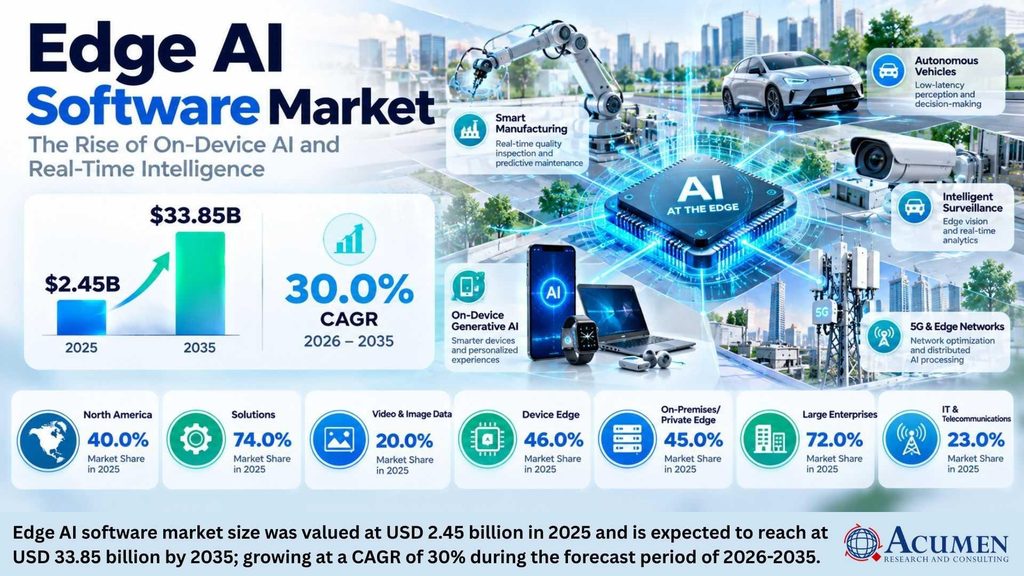
The forecast reflects increasing adoption of AI inference platforms, machine learning optimization tools, edge orchestration software and intelligent applications deployed across distributed computing environments.
Edge AI Software Market Statistics
| Market indicator | 2025 statistics |
| Global Edge AI Software Market size | USD 2.45 billion |
| Global market forecast, 2035 | USD 33.85 billion |
| CAGR, 2026–2035 | Approximately 30.0% |
| Leading region | North America — 40.0% |
| Leading offering | Solutions — 74.0% |
| Leading individual data type | Video and image data — 20.0% |
| Leading edge location | Device edge — 46.0% |
| Leading deployment model | On-premises/private edge — 45.0% |
| Leading enterprise size | Large enterprises — 72.0% |
| Leading industry vertical | IT and telecommunications — 23.0% |
Source: Acumen Research and Consulting. Market figures and segment shares reflect the updated 2025 baseline and 2026–2035 forecast supplied for this article. Shares are measured within their respective segmentation dimensions and must not be added together.
North America accounted for approximately 40.0% of the global market in 2025, while solutions represented 74.0% of total revenue.
Device-edge deployments accounted for 46.0%, demonstrating the growing importance of AI software running directly on cameras, smartphones, sensors, industrial equipment and other connected devices.
These figures highlight a fundamental transformation in enterprise AI infrastructure.
The next phase of AI adoption will not be defined solely by how powerful centralized models become, but also by how efficiently intelligence can be deployed, managed and executed across billions of connected endpoints.
Edge AI Software Market Size and Forecast: USD 2.45 Billion in 2025 to USD 33.85 Billion by 2035
The global Edge AI Software Market is projected to expand from USD 2.45 billion in 2025 to USD 33.85 billion by 2035, representing an increase of approximately 13.8 times over the forecast period.
This growth reflects the transition of edge AI from specialized pilot projects toward broader enterprise deployment.
Several developments are supporting market expansion.
First, the proliferation of connected devices is generating substantial volumes of data outside centralized computing environments.
Second, advances in AI model optimization are making sophisticated inference capabilities more practical on resource-constrained hardware.
Third, organizations are seeking lower-latency decision-making for industrial automation, intelligent surveillance, robotics and telecommunications.
Fourth, growing data governance requirements are encouraging local processing of sensitive information.
Finally, the expansion of AI-enabled consumer devices is creating demand for software capable of deploying and updating models across heterogeneous hardware platforms.
Unlike the broader Edge AI Market, which may include processors, accelerators, devices and supporting infrastructure, the Edge AI Software Market focuses on software revenue associated with enabling, optimizing, deploying and managing artificial intelligence workloads at the edge.
This distinction is essential for accurate market sizing.
As hardware capabilities improve, software will play an increasingly important role in determining how effectively organizations utilize distributed AI infrastructure.
Why Is Edge AI Software Becoming So Important?
Traditional cloud-based AI architectures require data to be transmitted to centralized infrastructure for processing.
Although this approach remains effective for many applications, it can introduce challenges involving latency, connectivity, bandwidth costs and data governance.
Edge AI software addresses these limitations by enabling AI inference closer to the source of information.
For example, an industrial camera equipped with edge AI software can identify manufacturing defects locally without transmitting every video frame to a remote data center.
Similarly, an intelligent traffic monitoring system can analyze vehicle movements near the camera, transmitting selected events or aggregated information rather than continuous raw footage.
A telecom operator can deploy AI software across distributed network infrastructure to support localized analytics and operational decisions.
These applications demonstrate why edge AI is becoming increasingly relevant.
The commercial value of edge AI software is not limited to reducing latency.
It can also improve operational resilience, optimize network traffic and support data processing requirements that would be difficult to satisfy through cloud-only architectures.
However, edge AI does not eliminate the need for centralized infrastructure.
Many organizations will continue using cloud platforms for model training, large-scale analytics, centralized governance and workload coordination.
The emerging architecture is therefore increasingly hybrid, combining centralized intelligence with distributed execution.
On-Device Generative AI Is Opening a New Growth Opportunity
One of the most important emerging developments in the Edge AI Software Market is the expansion of on-device generative artificial intelligence.
Generative AI applications have traditionally depended on substantial cloud computing resources.
However, improvements in model compression, quantization and hardware acceleration are making smaller models more practical for local execution.
This is creating opportunities across smartphones, personal computers, industrial devices, vehicles and embedded systems.
On-device generative AI can support functions such as text summarization, voice interaction, document processing and context-aware assistance.
Local execution may improve responsiveness and reduce the amount of information that must be transmitted to external servers.
However, the performance of on-device AI depends on model size, available memory, processing capabilities and power constraints.
Large or complex requests may still require cloud-based processing.
The commercial opportunity for software vendors lies in enabling AI models to run efficiently across diverse hardware architectures.
This includes runtime software, inference engines, model conversion tools, optimization frameworks and device management platforms.
As more manufacturers introduce AI-capable products, the demand for interoperable edge AI software could increase significantly.
Edge AI Agents Could Reshape Distributed Enterprise Automation
AI agents are emerging as another important development in the evolution of edge computing.
An AI agent can use models, software tools and contextual information to perform tasks or support decisions.
When agent capabilities are deployed at the edge, they may enable more localized and context-aware automation.
For example, an industrial edge AI agent could analyze machine data, identify an abnormal operating condition and recommend an appropriate maintenance response.
A logistics facility could use edge AI to coordinate information from cameras, sensors and equipment management systems.
A smart building could use local AI systems to optimize lighting, ventilation and equipment operation.
However, fully autonomous edge AI agents remain an emerging area.
Organizations must address challenges involving reliability, security, model limitations and human oversight.
For many industrial applications, AI agents will initially support operators rather than independently control safety-critical processes.
The opportunity for edge AI software vendors involves developing secure, manageable frameworks that allow organizations to deploy intelligent automation without compromising operational control.
Edge AI Solutions Dominated With 74% Market Share in 2025
By offering, the Edge AI Software Market is segmented into solutions and services.
Solutions accounted for approximately 74.0% of global market revenue in 2025, making them the leading offering category.
This dominance reflects enterprise demand for software platforms that support AI inference, model optimization, deployment and lifecycle management.
Edge AI solutions may include inference runtimes, machine learning frameworks, model compression tools, orchestration platforms and monitoring software.
These technologies provide the foundation for deploying AI applications across distributed devices and infrastructure.
The services segment includes consulting, integration, implementation, maintenance and other professional support activities.
Services are particularly important because enterprise edge AI deployments frequently involve multiple hardware platforms, network architectures and operational environments.
For example, a manufacturer deploying AI across dozens of production facilities may require software integration, model customization, security configuration and ongoing performance monitoring.
As adoption expands, demand for specialized implementation and management services could increase.
Nevertheless, solutions are expected to remain central to the market because software platforms provide the core functionality required to operate distributed AI workloads.
Video and Image Data Led the Market With 20% Share in 2025
By data type, video and image data represented the largest individual category, accounting for approximately 20.0% of Edge AI Software Market revenue in 2025.
This reflects the growing adoption of computer vision across industrial, commercial and public infrastructure applications.
Computer vision enables machines to interpret visual information and identify objects, patterns or events.
In manufacturing, edge AI software can analyze images to detect defects and support automated quality inspection.
In retail, visual analytics can assist with inventory monitoring, customer-flow analysis and operational efficiency.
In transportation, edge-based vision systems can support traffic monitoring and infrastructure management.
In security applications, intelligent cameras can identify specified events and generate alerts without continuously transmitting all footage to centralized systems.
Processing visual data locally can reduce bandwidth requirements and improve response times.
However, the dominance of video and image data does not mean visual workloads account for most of the market.
At 20.0%, the category leads individually within a diversified data landscape that also includes audio, text, sensor, telemetry and other forms of information.
This diversification is important because future edge AI applications will increasingly combine multiple data types.
For example, an industrial robot may process visual information, equipment telemetry and operator commands within a single intelligent workflow.
Device Edge Accounted for 46% of the Market in 2025
By edge location, device-edge deployments dominated the Edge AI Software Market with a 46.0% share in 2025.
Device edge refers to AI processing performed directly on the device generating or collecting information.
Examples include smartphones, industrial cameras, smart sensors, connected appliances, embedded controllers and intelligent medical equipment.
The increasing availability of AI-capable processors is expanding the range of applications that can run directly on these devices.
Device-edge AI offers several advantages.
It can reduce dependence on continuous network connectivity, enable rapid local decisions and limit the transmission of sensitive information.
For example, an intelligent camera may perform object detection directly on the device rather than sending continuous video streams to a remote server.
Similarly, industrial equipment can analyze sensor data locally to identify abnormal conditions.
Other edge locations include gateways, local servers and network-edge infrastructure.
These environments remain important when workloads require more computing power than individual devices can provide.
The distinction between device edge and other edge locations is architectural: it identifies where AI computation occurs, rather than how the software is commercially deployed.
This separation is important for maintaining consistent market segmentation.
On-Premises and Private Edge Deployment Led With 45% Share
By deployment model, on-premises/private edge accounted for approximately 45.0% of global Edge AI Software Market revenue in 2025.
The category’s leadership reflects enterprise requirements for security, operational control and localized processing.
Organizations in manufacturing, healthcare, financial services and other sensitive industries frequently require greater control over data and infrastructure.
Private edge environments allow organizations to manage AI workloads within dedicated facilities or controlled computing systems.
This can support internal security policies and operational requirements.
However, on-premises deployment does not necessarily mean that every workload runs directly on an endpoint device.
A private edge environment may include local servers, gateways and other infrastructure supporting multiple connected devices.
Cloud-managed edge deployment and hybrid deployment models are also important.
Cloud-managed architectures can simplify centralized software updates and fleet management.
Hybrid approaches combine local inference with centralized training, analytics and orchestration.
As enterprise deployments become more complex, hybrid edge-cloud architectures are likely to play an increasingly important role.
The market opportunity lies in providing software that supports consistent model management across these different environments.
Large Enterprises Represented 72% of Market Revenue in 2025
By enterprise size, large enterprises dominated the Edge AI Software Market with approximately 72.0% share in 2025.
This reflects their greater investment capacity, established digital infrastructure and ability to implement AI across multiple operating locations.
Large manufacturers may deploy edge AI across numerous factories.
Telecommunications companies may integrate AI into distributed network operations.
Retail organizations may use intelligent analytics across extensive store networks.
These deployments often require substantial software integration, cybersecurity controls and ongoing maintenance.
Large enterprises are generally better positioned to manage these requirements.
However, small and medium-sized enterprises represent an important long-term opportunity.
The availability of preconfigured edge AI applications, subscription-based software and simplified deployment tools could reduce adoption barriers.
For smaller organizations, the ability to implement edge AI without building extensive internal machine learning teams may be particularly valuable.
Software vendors that simplify deployment, monitoring and maintenance could therefore expand their addressable customer base.
IT and Telecommunications Led With 23% Market Share
By industry vertical, IT and telecommunications accounted for approximately 23.0% of global Edge AI Software Market revenue in 2025.
The segment’s leadership reflects substantial investments in distributed computing, network automation and AI-enabled infrastructure management.
Telecommunications networks are increasingly complex.
Operators must manage growing data traffic, distributed infrastructure and changing service requirements.
Edge AI software can support network analytics, traffic optimization, anomaly detection and operational automation.
The expansion of 5G infrastructure has also increased interest in multi-access edge computing.
This architecture places computing resources closer to users and connected devices.
AI software deployed within these environments can support applications requiring low latency and localized processing.
However, the commercial success of telecom edge AI depends on deployment economics, interoperability and clearly defined use cases.
Beyond telecommunications, manufacturing, automotive, healthcare, retail and transportation represent important industry opportunities.
The diversity of applications suggests that edge AI software will become relevant across a broad range of enterprise environments.
Industrial Edge AI Is Transforming Manufacturing Operations
Manufacturing is one of the most commercially promising applications for edge AI software.
Industrial facilities generate substantial volumes of operational data through machinery, sensors, cameras and automation systems.
Processing this information locally can support faster decisions and reduce dependence on remote connectivity.
Predictive maintenance is an important application.
Edge AI software can analyze equipment signals to identify unusual patterns that may indicate developing faults.
Computer vision is another significant use case.
Manufacturers can deploy AI-enabled inspection systems to detect defects during production.
Other applications include process monitoring, equipment utilization analysis and worker-safety monitoring.
However, industrial AI deployment requires careful integration with existing operational technology.
Manufacturing systems often include equipment from multiple vendors and different technology generations.
Software interoperability, reliability and cybersecurity are therefore essential.
Successful deployments typically require collaboration between AI developers, industrial automation providers and manufacturing operators.
The long-term opportunity is substantial because edge AI can extend intelligent automation to production environments where continuous cloud connectivity is impractical.
Healthcare Edge AI Is Creating New Opportunities for Medical Devices
Healthcare represents another important application area for edge AI software.
Connected medical devices, imaging equipment and patient monitoring systems generate substantial volumes of information.
Local AI processing can support applications where rapid analysis or data handling requirements make edge deployment attractive.
Potential use cases include medical image preprocessing, device-level monitoring, signal analysis and clinical workflow support.
However, healthcare applications require particularly careful consideration of accuracy, privacy and regulatory requirements.
AI software used for clinical decisions may be subject to medical device regulations and validation requirements.
Edge deployment alone does not establish clinical reliability or regulatory compliance.
Nevertheless, advances in embedded computing and AI optimization could expand opportunities for intelligent medical devices.
The commercial potential is particularly relevant for software vendors capable of combining efficient inference with strong security, validation and lifecycle management.
North America Dominated the Edge AI Software Market With 40% Share
North America accounted for approximately 40.0% of the global Edge AI Software Market in 2025.
Based on the USD 2.45 billion global market estimate, this represents approximately USD 980 million in regional revenue.
The region’s leadership is supported by strong AI investment, established software ecosystems and advanced computing infrastructure.
The United States is home to major semiconductor companies, cloud providers, enterprise software developers and AI research organizations.
These capabilities support innovation across edge AI frameworks, inference software and deployment platforms.
North American enterprises are also adopting AI across manufacturing, telecommunications, retail and healthcare.
Demand for data governance, operational efficiency and intelligent automation further supports market development.
However, the region faces challenges involving deployment costs, software interoperability and enterprise security.
Continued growth will depend on converting AI experimentation into scalable, commercially valuable applications.
Asia-Pacific Is Emerging as a Major Edge AI Software Growth Opportunity
Asia-Pacific is positioned to become an increasingly important region for edge AI software adoption.
The region benefits from extensive electronics manufacturing, industrial automation and connected device production.
China, Japan, South Korea, India and Taiwan contribute to the development of AI-capable hardware and software ecosystems.
China’s manufacturing scale and connected infrastructure create opportunities for computer vision, industrial AI and intelligent device applications.
Japan and South Korea have established strengths in robotics, electronics and industrial automation.
Taiwan plays an important role in the global semiconductor and computing supply chain.
India presents opportunities through expanding digital infrastructure, telecommunications investment and enterprise AI adoption.
The growth of AI-enabled smartphones, smart factories and connected infrastructure could support regional demand.
However, the pace of adoption will vary across countries depending on infrastructure readiness, regulatory conditions and enterprise investment.
Asia-Pacific’s long-term opportunity is linked to its combination of hardware manufacturing capabilities and expanding software adoption.
Europe Is Focusing on Industrial AI, Data Governance and Edge Computing
Europe represents an important market for edge AI software, particularly in industrial applications.
The region has established manufacturing, automotive and industrial automation industries.
These sectors provide opportunities for localized AI processing, machine vision and predictive maintenance.
European organizations also place considerable emphasis on data governance and security.
This can support interest in private edge infrastructure and controlled AI deployment environments.
The European Union’s evolving AI regulatory framework is another important consideration.
Software vendors operating in regulated applications must account for applicable requirements involving transparency, risk management and oversight.
For industrial enterprises, edge AI can support modernization while maintaining greater control over operational data.
However, market expansion will depend on investment economics, integration capabilities and the availability of reliable solutions.
Leading Companies Shaping the Edge AI Software Ecosystem
The Edge AI Software Market includes semiconductor software ecosystems, cloud platforms, enterprise software companies and specialized AI developers.
NVIDIA supports edge AI deployment through software platforms and development tools designed for accelerated AI inference.
Intel provides AI optimization and inference technologies, including OpenVINO, supporting deployment across compatible computing environments.
Qualcomm supports on-device AI development through software tools and technologies designed for its hardware platforms.
Google participates through TensorFlow Lite and related technologies supporting machine learning deployment on compatible devices.
Microsoft offers cloud and edge computing technologies that can support distributed AI development and management.
Amazon Web Services provides edge and IoT software services that support applications operating outside centralized cloud environments.
IBM participates in enterprise AI and hybrid infrastructure technologies relevant to distributed deployment.
Arm contributes software tools and development technologies supporting AI applications on Arm-based devices.
Hailo provides AI acceleration technology and associated software tools for edge inference applications.
The competitive landscape also includes open-source projects, industrial automation suppliers and specialized software vendors.
Competition is increasingly influenced by model compatibility, inference performance, hardware support, deployment simplicity and software lifecycle management.
The market is unlikely to be defined by a single software platform.
Instead, different vendors may lead across consumer devices, industrial systems, telecom infrastructure and enterprise applications.
Model Optimization Is Becoming a Critical Competitive Differentiator
One of the biggest challenges in edge AI is executing sophisticated models on devices with limited computing resources.
Unlike large data centers, edge devices may operate under strict constraints involving memory, power consumption and processing capacity.
Software optimization is therefore essential.
Quantization reduces the numerical precision used to represent model parameters and calculations.
Pruning removes selected model components to reduce computational requirements.
Knowledge distillation can transfer useful capabilities from a larger model into a smaller model.
Hardware-aware compilation and runtime optimization can improve performance on specific processors.
These techniques can make AI applications more practical at the edge.
However, optimization may involve trade-offs involving accuracy, latency and model capabilities.
Software developers must evaluate performance under realistic operating conditions.
As AI-capable devices become more widespread, the ability to deploy models efficiently across heterogeneous hardware platforms could become a major source of competitive advantage.
Edge AI Model Management Could Become a High-Value Software Category
Deploying an AI model to a single device is relatively straightforward compared with managing thousands of models across distributed enterprise infrastructure.
Large-scale edge AI deployments require capabilities for provisioning, updating, monitoring and securing software.
Organizations must track model versions, detect performance degradation and maintain compatibility with changing hardware.
They may also need to monitor model drift as operating conditions evolve.
Remote software updates can reduce maintenance requirements, but they introduce security and reliability considerations.
For example, an unsuccessful update across industrial equipment could disrupt operations.
As a result, edge AI software platforms increasingly need controlled deployment processes, rollback capabilities and monitoring tools.
These requirements create opportunities for model lifecycle management and orchestration software.
The importance of these capabilities is likely to increase as enterprises move from isolated edge AI applications toward organization-wide deployments.
What Are the Biggest Challenges Facing the Edge AI Software Market?
Despite strong growth prospects, several challenges could influence adoption.
Hardware fragmentation: Edge AI software must operate across processors, accelerators and devices with different capabilities.
Model limitations: Complex AI models may exceed the memory and processing capacity of certain edge devices.
Cybersecurity risks: Distributed devices can create additional attack surfaces requiring protection.
Deployment complexity: Enterprise environments frequently combine multiple vendors and legacy systems.
Model maintenance: Organizations must update, monitor and validate models across geographically distributed infrastructure.
Integration costs: Software implementation may require substantial engineering and operational resources.
Data governance: Organizations must manage privacy, security and regulatory requirements.
Return on investment: Enterprises need measurable operational benefits to justify large-scale deployments.
These challenges create opportunities for software vendors that can simplify implementation and provide reliable lifecycle management.
Edge AI Software Market Outlook: From Cloud-Centric AI to Distributed Intelligence
The global Edge AI Software Market is projected to grow from USD 2.45 billion in 2025 to USD 33.85 billion by 2035, at approximately 30.0% CAGR.
The forecast reflects increasing demand for real-time intelligence, on-device inference and distributed enterprise AI applications.
Several developments are expected to shape the industry’s future.
Cloud-only AI to hybrid AI: Organizations will increasingly combine centralized computing with local inference.
Large models to optimized models: Smaller and more efficient models will expand the range of practical edge applications.
Isolated AI applications to managed fleets: Enterprises will require software capable of operating AI across thousands of devices.
Reactive monitoring to intelligent automation: Edge AI will support more advanced industrial and operational decision-making.
Hardware-focused innovation to software differentiation: Model optimization, orchestration and lifecycle management will become increasingly important.
The market’s development will depend not only on improvements in AI hardware but also on software that makes distributed intelligence accessible, secure and economically practical.
For enterprises, edge AI offers opportunities to improve operational responsiveness and reduce dependence on centralized processing.
For technology suppliers, it creates demand for inference engines, model optimization tools, orchestration platforms and industry-specific applications.
For investors and market participants, it highlights the emergence of a substantial software opportunity at the intersection of artificial intelligence, connected devices and distributed computing.
The future of AI will not exist exclusively inside massive data centers. Increasingly, intelligence will operate wherever decisions need to be made—and edge AI software will provide the technology layer that makes this possible.
Frequently Asked Questions
What is the Edge AI Software Market?
The Edge AI Software Market includes software platforms, inference engines, optimization tools and related services that enable artificial intelligence workloads to operate on connected devices and distributed edge computing infrastructure.
How big is the global Edge AI Software Market?
The global Edge AI Software Market was valued at USD 2.45 billion in 2025 and is projected to reach USD 33.85 billion by 2035.
What is the expected CAGR of the Edge AI Software Market?
The market is projected to grow at approximately 30.0% CAGR during 2026–2035.
Which region dominates the Edge AI Software Market?
North America dominated the global market with approximately 40.0% revenue share in 2025.
Which offering segment leads the market?
Solutions accounted for approximately 74.0% of the Edge AI Software Market in 2025.
What is the difference between edge AI software and edge AI hardware?
Edge AI software enables model deployment, optimization, inference and management, while edge AI hardware provides the processing and physical infrastructure required to execute workloads.
Why is device-edge AI important?
Device-edge AI enables information to be processed directly on connected devices, potentially reducing latency, network dependence and data transmission requirements.
Which industry leads Edge AI Software Market adoption?
IT and telecommunications represented the largest industry vertical, accounting for approximately 23.0% of market revenue in 2025.
How will generative AI influence the Edge AI Software Market?
Advances in small language models, model compression and on-device inference could expand demand for software that enables generative AI to run efficiently on local hardware.
What are the biggest opportunities for edge AI software providers?
Major opportunities include on-device generative AI, industrial computer vision, telecom network automation, edge AI model management, AI agents and hybrid edge-cloud orchestration.