

Imagine cruising down the Mumbai-Pune Expressway in your brand-new, top-of-the-line SUV. You are streaming a high-definition podcast via Apple CarPlay, your navigation system is pulling real-time traffic data from the cloud, and your advanced driver-assistance system (ADAS) is gently nudging the steering wheel to keep you centered in your lane. Suddenly, the infotainment screen goes pitch black. The steering stiffens, overriding your manual inputs, and the brakes engage sharply without any physical warning.
This isn’t a mechanical failure. It’s a cyberattack.
Welcome to the era of the connected vehicle, where the car is essentially a high-performance computer on wheels, and the hacker’s playground has shifted from desktop servers and corporate networks to the fast lane.
As India aggressively adopts smart mobility, with everything from electric two-wheelers to luxury sedans boasting permanent internet connectivity, automotive cybersecurity has moved from a niche IT concern to a boardroom emergency. The stakes are no longer just about data privacy or stolen passwords; they are about human life, physical safety, and the integrity of national infrastructure. For the Indian automotive sector, securing the connected car is no longer optional; it is the absolute baseline for survival.
The Attack Surface: What Exactly Can Be Hacked?
To understand the vulnerability of modern vehicles, we have to look past the leather seats, horsepower figures, and aerodynamic chassis. A contemporary car contains upward of 100 million lines of software code.
To put that immense digital footprint into perspective, that is significantly more code than a Boeing 787 Dreamliner or an F-35 fighter jet. This software ecosystem runs on dozens of specialized microcomputers known as Electronic Control Units (ECUs), all networked together through an internal communication nervous system called the CAN (Controller Area Network) bus.
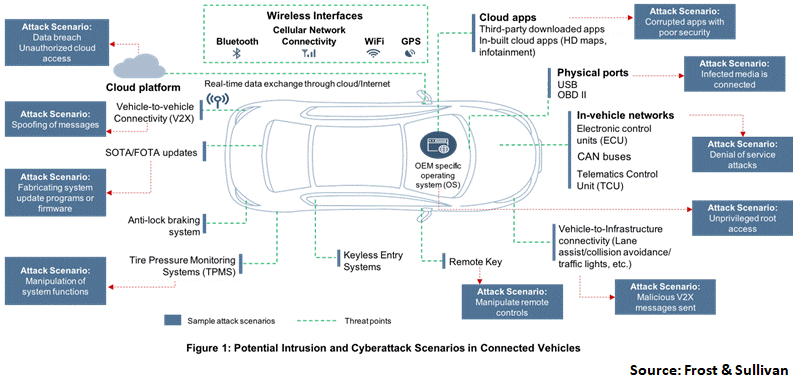
Caption: The expanding attack surface of a modern connected vehicle. Source: Frost & Sullivan / Cybersecurity regulations transform the Connected Car Ecosystem
As visualized above, the attack surface of a modern car is alarmingly broad. Hackers no longer need physical access to a vehicle with a crowbar and a wire-cutter to wreak havoc. They can exploit digital vulnerabilities through a myriad of entry points:
- Wireless Interfaces: Wi-Fi, Bluetooth, and high-speed cellular networks connect the car to the outside world. A compromised Bluetooth connection on a driver’s smartphone can provide a malicious actor with a backdoor into the vehicle’s infotainment system, which, in older or poorly segmented architectures, is not completely isolated from critical engine and braking functions.
- Telematics and OTA Updates: Over-the-air (OTA) updates are a fantastic convenience, allowing manufacturers to patch software and add features without requiring a trip to the service center. However, if an organized hacking syndicate spoofs the manufacturer’s backend server, they could potentially push malicious, customized firmware directly to the engine control modules of thousands of vehicles simultaneously.
- Sensors and ADAS: Modern safety relies on Radar, LiDAR, and high-definition cameras feeding crucial environmental data to the car’s brain. Manipulating this data—a technique known as “sensor spoofing”—can trick the vehicle’s autopilot into seeing obstacles that aren’t there, triggering emergency braking on a clear highway, or worse, ignoring real physical barriers.
- V2X Communication: Vehicle-to-Everything (V2X) technology allows cars to talk to each other (V2V) and to city infrastructure (V2I), like smart traffic lights and toll gates. While this promises to optimize traffic flow and reduce collisions, it also creates a massive, interconnected mesh network. A single compromised node—perhaps a poorly secured smart streetlamp could act as a vector to disrupt an entire urban traffic grid.
The Indian Scenario: A Perfect Storm of Connectivity
India currently finds itself at a fascinating and perilous tipping point. We are experiencing rapid 4G and 5G penetration, with the 5G user base surpassing 365 million. Automakers are actively capitalizing on this connectivity boom, offering bespoke connected-service bundles, remote engine start, and geo-fencing as standard features, even in mass-market hatchbacks targeted at Tier-2 and Tier-3 cities.
The Indian connected vehicle market is exploding, currently valued in the billions and projected to grow at a blistering pace to reach astronomical figures over the next decade. Fleet operators are increasingly relying on deep telematics to monitor fuel efficiency and driver behavior, while everyday commuters demand seamless smartphone integration as a non-negotiable lifestyle feature.
But this rapid digitization comes with a glaring blind spot. Until very recently, cybersecurity was often treated as an afterthought in automotive manufacturing, a bolt-on feature implemented late in the design cycle rather than a foundational engineering principle. The prevailing industry attitude was that sophisticated automotive cyberattacks were largely a Western problem, something that happened to autonomous vehicles in California, not to manual-transmission compacts in Gurugram.
That illusion is rapidly shattering. The deep integration of domestic and global automotive supply chains means that a vulnerability discovered in a third-party microchip manufactured overseas can directly and immediately compromise a vehicle assembled in Chennai. Furthermore, as India pushes aggressively toward a massive Electric Vehicle (EV) transition, the charging infrastructure itself introduces entirely new threat vectors. A hacked, internet-connected public EV charging station could theoretically inject malware into a vehicle’s battery management system (BMS) during a routine charging session.
The Regulatory Shield: Enter AIS 189
Realizing the immense gravity of the situation, the Indian government and local regulatory bodies have stepped heavily on the brakes, demanding structural, top-down reform. The absolute game-changer in this space is AIS 189, India’s stringent standard for an organizational Automotive Cybersecurity Management System (CSMS).
If you are a decision-maker in the automotive industry, AIS 189 is the acronym dominating your strategy meetings. Aligned closely with the global UNECE R155 standard, AIS 189 is not just a polite recommendation or a set of best practices; it is actively becoming a de facto market access requirement for the subcontinent. In simple, uncompromising terms: if an Original Equipment Manufacturer (OEM) cannot definitively prove their vehicle architecture is secure against cyber threats, that vehicle will not receive type approval. It simply won’t be allowed on Indian roads.
What makes AIS 189 so exceptionally rigorous?
- Full-Lifecycle Security Integration: The standard mandates that security protocols are embedded from the initial conceptual design phase right through to the vehicle’s eventual decommissioning in a scrapyard. Automakers cannot just build a car, run a penetration test once, and forget about it. Security is now a continuous, monitored lifecycle.
- Mandatory Threat Analysis and Risk Assessment (TARA): Automakers must conduct exhaustive, documented risk assessments. AIS 189 includes a highly specific, normative threat catalogue (Annexure D), and testing agencies like ARAI (Automotive Research Association of India) and ICAT use this exact catalogue directly to evaluate a vehicle’s defenses. There is zero room for skipped steps, informal coverage, or assumptions. Every potential threat category must be mathematically and practically accounted for.
- Strict Supply Chain Accountability: In a massive shift, automakers are now held entirely responsible for the security posture of their entire supply chain. If a Tier-2 supplier provides a vulnerable Bluetooth module, the primary OEM takes the regulatory hit. This is forcing manufacturers to fundamentally rewrite their supplier contracts to include binding cybersecurity evidence formats.
However, achieving compliance is a monumental operational challenge rather than just a technological one. The sheer variety of vehicles, trim variants, and legacy electronic architectures currently traversing Indian roads makes certification a “humongous task” for both OEMs and testing agencies.
It is not just about having the right firewall code; it is about proving to an auditor that you possess a functioning, 24/7 Vehicle Security Operations Centre (VSOC) actively monitoring threats in post-production vehicles.
Building the “Suraksha Chakra” (Security Circle)
While AIS 189 serves as a robust and necessary starting line, cybersecurity experts argue that static regulation alone cannot serve as a permanent shield against dynamic, highly motivated adversaries. Hackers do not care about compliance certificates; they care about exploiting zero-day vulnerabilities before patches are deployed.
To truly secure Indian mobility on a national scale, the entire automotive ecosystem needs to build what industry leaders have dubbed a “Suraksha Chakra”—a comprehensive, multi-layered defense and intelligence strategy:
- Automotive Sectoral CERT: India requires a dedicated Computer Emergency Response Team specifically tailored for the auto industry. This rapid-response unit would coordinate containment efforts during large-scale cyber incidents affecting connected fleets.
- India-Specific Threat Repository: The industry needs a centralized, shared database where competing companies can safely and anonymously report vulnerabilities, near-misses, and successful breaches. As threats evolve daily, what is considered a safe architecture today might be critically vulnerable tomorrow.
- Information Sharing and Analysis Center (ISAC): A collaborative, high-trust platform is essential for automakers, Tier-1 suppliers, and specialized cybersecurity firms to pool their threat intelligence without compromising proprietary trade secrets or brand reputation. The mindset must shift from corporate secrecy to collective defense.
The overarching goal here is not to halt the rollout of connectivity. We cannot roll back the clock, and the profound benefits of connected cars, from predictive engine maintenance to automated emergency crash response are far too significant to ignore. The objective is to build unshakeable, verified trust in the connected ecosystem.
AI at the Edge and Quantum Defense
As we look toward 2030 and beyond, the cybersecurity landscape will experience seismic shifts. Automakers are beginning to deploy Machine Learning and Artificial Intelligence at the “edge”, meaning the AI algorithms run directly inside the vehicle’s onboard computer rather than relying on a cloud connection. This edge-based intelligence allows the vehicle to autonomously detect anomalous behavior (such as a sudden, inexplicable network command instructing the brakes to disengage) and block it in milliseconds, even if the car is driving through a cellular dead zone.
Simultaneously, the most forward-thinking players in the industry are already preparing for the looming era of quantum computing. A sufficiently powerful quantum computer could theoretically crack the traditional encryption keys currently used to secure over-the-air updates and vehicle-to-cloud communications. To counter this existential threat, manufacturers are actively exploring post-quantum cryptographic libraries to future-proof their next generation of vehicle platforms.
The New Standard of Automotive Excellence
For decades, the Indian consumer judged cars almost exclusively by their zero-to-sixty times, their real-world fuel economy (“Kitna deti hai?”), and the plushness of their interiors. Today, those mechanical and aesthetic metrics tell only half the story. The true, definitive mark of automotive excellence in the 21st century is digital resilience.
As Indian roads become exponentially smarter and our daily vehicles transform into rolling data centers, cybersecurity serves as the invisible digital seatbelt protecting us from unseen collisions. Securing this ecosystem requires massive financial investment, profound cultural shifts within legacy automakers, and uncompromising regulatory oversight. But the payoff will be a safe, secure, and seamlessly connected mobility infrastructure.
The engine of the future runs purely on code. It is time we made absolutely sure that code is bulletproof.