

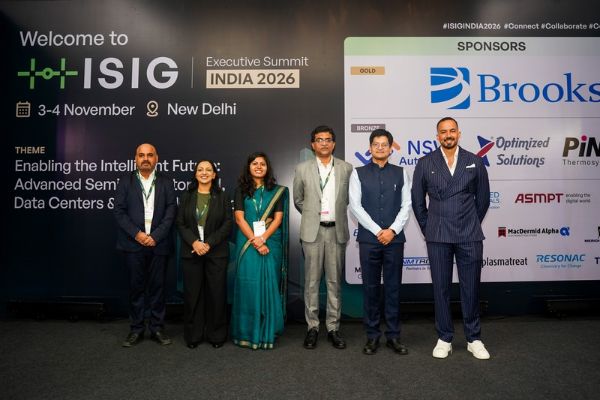
The ISIG Executive Summit India 2026 concluded at The LaLiT, New Delhi, after two days that brought together senior executives, global technology leaders, researchers, investors and government stakeholders to chart India’s next phase in the global semiconductor ecosystem. Held under the theme ‘Enabling the Intelligent Future: Advanced Semiconductors, AI, Data Centers and Power Electronics,’ it was the first ISIG Executive Summit to take place in India.
On the second day, the summit welcomed Amitesh Kumar Sinha, Additional Secretary, Government of India, and CEO of the India Semiconductor Mission (ISM) at the Ministry of Electronics and Information Technology (MeitY), who set out India’s progress from policy design to execution.
“India’s semiconductor strategy is moving from policy design to ecosystem development, with early manufacturing projects already underway,” said Amitesh Kumar Sinha. “We have 12 approved manufacturing projects, and five of them have already begun commercial production.”
Speaking about the next phase of India’s programme, he added: “Semicon 2.0 is about building the broader ecosystem, including design companies, materials, chemicals, gases and equipment, alongside manufacturing, R&D and talent.”
He also underlined the importance of international collaboration: “India’s market, talent pool and government incentives are important advantages, but global technology partnerships and resilient supply chains will be essential.”
Across the two days, the summit’s keynotes and panels explored advanced packaging and outsourced semiconductor assembly and test (OSAT), power electronics and wide-bandgap technologies such as silicon carbide (SiC) and gallium nitride (GaN), the implications of AI and data-centre demand, and the development of India’s domestic design, materials, equipment and supply-chain ecosystem. Speakers and participants included leaders from UCLA, Georgia Institute of Technology, imec, Infineon, Mitsubishi Electric, Renesas, Nexperia, Navitas, Marvell, Sandisk, GlobalFoundries, Yole Group and AT&S, alongside Indian companies, research institutions and government representatives.
Government participation across the summit included the India Semiconductor Mission, the Semiconductor Laboratory (SCL), representatives from the governments of Madhya Pradesh and Tamil Nadu, and Invest India, underlining the growing collaboration between industry and government in building India’s semiconductor capabilities.
During the summit, ISIG also signed a Memorandum of Understanding with the Government of Bihar for strategic cooperation in developing the state’s semiconductor and electronics ecosystem.
“This first India edition showed what becomes possible when global industry, investors and government are in the same room,” said Dr. Shalu Agarwal, General Manager of India and Head of Power Semiconductor at ISIG. “India’s opportunity in advanced packaging and power electronics is real, and our role is to connect it with the technology, capital and partnerships that will help it scale.”
The summit is part of ISIG’s sold out 2026 global series, which has sold out across the United States, Taiwan, Korea and Europe this year, with the China edition in November. ISIG will return to India for its next edition on 30 November to 1 December 2027.