While the transition to Battery Electric Vehicles (BEVs) has seen a shift in pace, 48V systems are emerging as the dominant trend for addressing power shortages in 12V systems across all vehicle types. This shift is particularly evident in electrified platforms, where the adoption of 48V vehicle architectures is rapidly accelerating. Within these architectures, ignition-off standby current has emerged as a critical system-level design constraint.
ABLIC (hereinafter “ABLIC”), renowned for its specialized expertise in ultra-low-power analog design, is expanding its 48V power portfolio to meet the stringent microamp-level (µA) standby current requirements of next-generation automotive domains.
48V Is No Longer a Niche — It Is an Architectural Shift
The transition from 12V to 48V vehicle architectures is driven by the rapidly increasing electrical power demand across modern vehicle platforms. As advanced driver assistance systems (ADAS), automated driving functions, and software-defined vehicle (SDV) architectures expand, the number and performance of computing, sensing, and communication subsystems continue to grow.
Designing these systems within traditional 12V architectures presents significant limitations. As power demand increases, thicker wiring harnesses are required, increasing vehicle weight, material cost, and packaging complexity.
To address these constraints, the automotive industry is increasingly adopting 48V architectures. By increasing system voltage, vehicles can deliver the same power with lower current, enabling lighter wiring harnesses and more scalable electrical system architectures. Moving to 48V reduces current to roughly one-quarter of that required at 12V for the same power level, improving efficiency while enabling lighter wiring and more flexible system packaging. However, this shift introduces new power management challenges.
In today’s vehicle platforms, a growing number of electronic control units (ECUs) and communication gateways remain powered even when the vehicle is in the ignition-off state. As the number of these always-on domains increases, their cumulative standby current becomes a critical system-level design consideration.
Standby Current: A Hidden Constraint in 48V Design
For 48V architectures in particular, minimizing standby current is essential for maintaining battery charge during extended parking periods while supporting increasingly complex vehicle electronics.
In current vehicle architectures, total ignition-off current can reach tens of milliamps, while individual ECUs are often assigned microamp-level budgets. Even minor reductions at the component level can translate into measurable system-level benefits.
In this context, ABLIC’s 48V strategy focuses on ultra-low standby power technology. Drawing on its long-standing expertise in low-power analog circuit design, microamp-level optimization is being extended across multiple device categories. These include LDO regulators with ultra-low operating current, DC-DC converters engineered for high efficiency under light-load conditions, and voltage monitoring ICs tailored for 48V environments.
By expanding this technology across these power functions, ABLIC aims to support 48V architectures that improve ignition-off efficiency while meeting the evolving demands of highly connected and software-defined vehicle platforms.
Expanding a 48V Power Portfolio
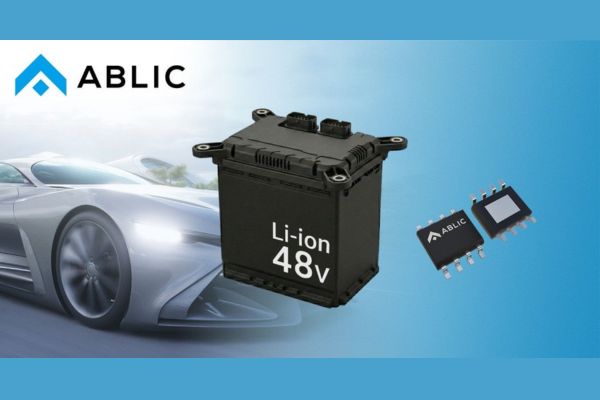
ABLIC’s S-19230/1 Series automotive LDO regulators represent the company’s first step into the 48V auxiliary battery domain. The series was designed to meet both standby and reliability requirements in 48V-based ECU’s, featuring a 2.0 µA (typ.) operating current,, an 80V absolute maximum rating, integrated open-loop protection in versions with adjustable output voltage, and AEC-Q100 qualification.
ABLIC integrates protection mechanisms, such as open-loop protection in adjustable LDOs, to suppress output overvoltage in the event of an external resistor failure. Embedding such safeguards at the device level reduces the need for additional protection circuitry and enhances overall system robustness. For platform architects focused on long-term reliability, predictable fault behavior can simplify system validation and help mitigate risk across vehicle programs.
This launch, however, marks only the beginning of a broader 48V initiative. ABLIC is now extending its ultra-low standby power expertise into additional categories, such as DC-DC converters optimized for high efficiency under light-load conditions, where conventional switching regulators often experience diminished performance. ABLIC is also developing 48V battery monitoring ICs engineered to detect voltage thresholds directly at 48V rails, reducing reliance on large resistor dividers and minimizing external component count.
This expanding portfolio supports a cohesive 48V power platform focused on low standby consumption and system robustness, addressing the evolving requirements of next-generation vehicle architectures.
 |
Positioning Within the Evolving 48V Ecosystem
The global 48V landscape remains in transition, with operating voltage ranges and implementation strategies continuing to evolve across regions and vehicle segments. As vehicle architectures become increasingly connected and software-defined, ignition-off current is emerging as a measurable indicator of platform efficiency.
Within this environment, power management components must deliver high input-voltage tolerance suitable for 48V systems while also maintaining ultra-low standby consumption and predictable fault behavior. Microamp-level improvements that once appeared incremental are now shaping vehicle parking performance and overall energy management strategies.
Within the growing 48V ecosystem, ABLIC emphasizes ultra-low standby power as a defining capability. Microamp-level optimization in regulators, converters, and monitoring functions helps support vehicle platforms designed for extended parking durations, reduced auxiliary battery drain, and more advanced electronic architectures.
As 48V architectures continue to mature, this emphasis on ultra-low standby power aligns with automotive OEM efforts to balance efficiency, reliability, and system cost across next-generation vehicle platforms.