

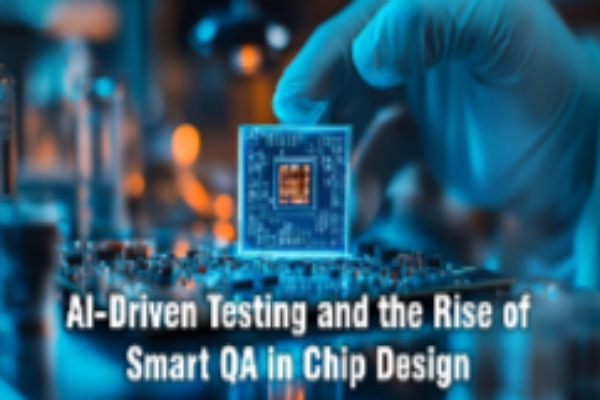
Testing Is No Longer an Afterthought
The semiconductor industry is going through a period of rapid change. Chips today are expected to deliver higher performance, lower power consumption and greater reliability, while supporting complex applications such as artificial intelligence, cloud computing, 5G networks and automotive systems. At the same time, design complexity has grown sharply.
A modern advanced chip can contain tens of billions of transistors, and even a small design flaw can affect yield, reliability or system performance. However, traditional testing and quality assurance (QA) methods were built for a different era. Industry data shows that only around 14 per cent of chips achieve first-pass silicon success, pointing to the growing mismatch between design ambition and testing capability.
This reality is forcing a shift in mindset. Testing can no longer be treated as a final checkpoint after design completion. It must evolve into an intelligent, continuous process that starts early and adapts quickly. Artificial intelligence is emerging as a key enabler of this transformation.
Why AI Is Well Suited for Chip Testing
Semiconductor testing generates massive amounts of data across multiple stages, including simulation, verification, wafer inspection and manufacturing. Traditional rule-based tools struggle to analyse this data at scale or extract deeper insights.
AI excels in this environment. Machine learning models can process large, diverse datasets and identify patterns that may not be visible through conventional analysis. Recent studies show that AI-based defect detection can improve wafer inspection accuracy by up to 90 per cent. Yield prediction accuracy has improved by roughly 30 per cent, while test data analysis time has been reduced by more than 50 per cent.
These improvements directly impact cost, speed and reliability. Faster analysis enables earlier corrections, while better predictions reduce surprises late in the development cycle.
From Reactive Testing to Predictive Quality
Traditional testing approaches are largely reactive. Issues are identified after they occur, often during late-stage testing or after silicon fabrication. AI-driven testing changes this model by enabling predictive quality assurance.
By learning from historical design errors, manufacturing variations and test outcomes, AI systems can identify areas of risk early in the design and verification stages. Engineers can then focus on these high-risk zones before the chip is manufactured.
This predictive capability reduces the likelihood of silicon respins, which are expensive and can delay product launches by months. Industry estimates suggest that AI-driven automation can reduce semiconductor time-to-market by close to 25 per cent, offering a strong competitive advantage in fast-moving markets.
Addressing Edge Cases and Rare Failures
One of the biggest challenges in chip testing is identifying rare or extreme failure conditions. These issues may only appear under specific combinations of voltage, temperature, workload or timing. Traditional testing methods often struggle to cover all such scenarios.
AI is particularly effective at analysing large numbers of test combinations and uncovering hidden edge cases. This capability is becoming increasingly important as chips are deployed in mission-critical applications such as automotive systems, industrial automation and data centres, where failures can have serious consequences.
By expanding test coverage and prioritising the most critical scenarios, AI-driven testing improves both reliability and confidence in final silicon.
Improving Hardware Security Through AI
Security is now a core requirement in chip design. As more intelligence moves closer to the hardware layer, chips themselves have become targets for malicious attacks. Traditional testing methods are not always sufficient to identify subtle security threats embedded in complex designs.
AI-based security testing tools can analyse design behaviour and identify abnormal patterns that may indicate hardware vulnerabilities. Recent research suggests that AI techniques can detect malicious hardware modifications, such as hardware trojans, with accuracy levels approaching 97 per cent.
As security threats grow more sophisticated, intelligent testing will play a central role in ensuring trust in semiconductor products.
Reducing Verification Effort Without Reducing Quality
Verification remains one of the most time-consuming and resource-intensive stages of chip development. In many projects, it accounts for nearly 70 per cent of total design effort. Engineers spend significant time writing test cases, managing coverage and analysing simulation results.
AI-powered verification tools are helping reduce this burden. These tools can automatically generate test scenarios, improve coverage efficiency and highlight areas that require deeper human review. Instead of replacing engineers, AI allows teams to focus on higher-value work, such as architecture decisions and complex debugging.
The result is a verification process that is both faster and more effective, without compromising quality.
Challenges in AI Adoption
Despite its benefits, AI-driven testing is not without challenges. Data quality remains a key concern. AI models require large, accurate datasets to perform well, and creating realistic defect libraries takes time and collaboration across the ecosystem.
Explainability is another issue. AI models do not always clearly explain how they reach conclusions, which means results must be carefully validated. Human expertise remains essential to ensure that AI-driven insights are physically meaningful and reliable.
There is also a talent gap. The industry needs professionals who understand both semiconductor engineering and AI, and such skills are still in short supply. Addressing this gap will be critical for wider adoption.
The Economic Case for Smart QA
Investment in AI-enabled semiconductor tools is rising steadily. Analysts estimate that global spending on AI in chip design and testing will reach several hundred million dollars by 2026. At the same time, demand for AI-capable chips continues to grow across sectors.
As production volumes increase, even small improvements in yield and test efficiency can deliver significant cost savings. Companies that embed AI into their QA strategies are better positioned to manage complexity, control costs and scale reliably.
Testing Becomes Part of the Design Lifecycle
AI-driven testing is changing how chips are developed. Testing is no longer a separate stage that follows design. Instead, it is becoming part of a continuous feedback loop that connects design, verification and manufacturing.
This integrated approach enables faster learning, better optimisation of power and performance, and more consistent results across product generations. It also helps organisations respond more quickly to market and technology shifts.
Conclusion
AI-driven testing is redefining quality assurance in semiconductor design. As chips become more complex and expectations continue to rise, smart QA is no longer optional; it is essential.
The future of the semiconductor industry will depend not only on innovation in architecture and process technology, but on how intelligently quality is assured. Chips of the future will not just be designed smarter; they will be tested smarter, from the very beginning.