

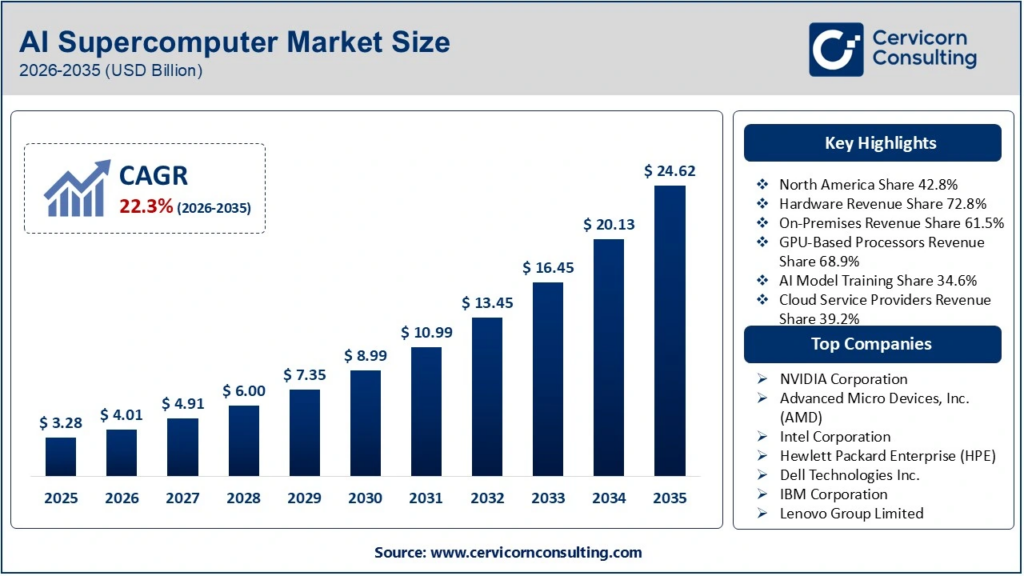
According to Cervicorn Consulting, the global AI supercomputer market size reached at USD 3.28 billion in 2025 and is projected to record USD 24.62 billion by 2035 with a CAGR of 22.3% from 2026 to 2035.
The global AI Supercomputer Market is witnessing remarkable growth as enterprises, governments, research organizations, and hyperscale cloud providers accelerate investments in next-generation artificial intelligence infrastructure. AI supercomputers provide the massive computational power required to train large language models (LLMs), generative AI applications, autonomous systems, scientific simulations, digital twins, and advanced analytics.

Growing adoption of AI across healthcare, finance, automotive, aerospace, cybersecurity, and manufacturing is driving demand for high-performance computing (HPC) platforms capable of processing enormous datasets with exceptional speed and efficiency. Continuous advancements in GPUs, AI accelerators, high-speed networking, liquid cooling technologies, and energy-efficient architectures are further strengthening market expansion. Industry analysts expect sustained double-digit growth through the forecast period as AI infrastructure spending continues to rise globally.
AI Supercomputer Market Overview
Artificial Intelligence has transformed computing requirements beyond conventional data centers. Modern AI models require thousands of interconnected GPUs, ultra-fast storage systems, advanced networking fabrics, and intelligent workload orchestration. AI supercomputers combine these technologies into unified platforms capable of supporting large-scale AI training and inference.
Governments worldwide are investing heavily in sovereign AI initiatives, while cloud service providers continue expanding AI data center capacity to meet increasing enterprise demand. Research institutions are also adopting AI supercomputers for climate modeling, drug discovery, genomics, astrophysics, and advanced engineering simulations.
The emergence of exascale computing, AI-optimized processors, high-bandwidth memory (HBM), and custom AI chips is reshaping the competitive landscape and creating new opportunities across the global AI ecosystem.
Report Highlights
- North America emerged as the leading regional market, accounting for 42.8% of global revenue, driven by extensive investments in hyperscale AI infrastructure, cutting-edge semiconductor technologies, and strong government and private-sector initiatives supporting AI innovation.
- Hardware remained the dominant component category, capturing 72.8% of the market, primarily due to rising demand for high-performance GPUs, AI accelerators, advanced networking solutions, and next-generation cooling systems required for AI supercomputing.
- On-Premises deployment led the market with a 61.5% share, as organizations increasingly favored dedicated AI infrastructure to ensure enhanced security, superior computing performance, data privacy, and regulatory compliance.
- GPU-Based processors accounted for 68.9% of the overall market, supported by their exceptional parallel processing capabilities for training large language models (LLMs), generative AI applications, and complex deep learning workloads.
- AI Model Training represented the largest application segment with a 34.6% market share, fueled by growing investments in foundation model development, enterprise AI implementation, and high-performance scientific computing.
- Cloud Service Providers held 39.2% of the global market, driven by continuous expansion of hyperscale AI data centers, AI cloud infrastructure, and increasing adoption of AI-as-a-Service (AIaaS) solutions by enterprises worldwide.
AI Supercomputer Market Dynamics
Market Driver
Rapid Expansion of Generative AI and Large Language Models
The explosive adoption of generative AI applications has significantly increased demand for AI supercomputing infrastructure. Organizations require enormous computational resources for training foundation models, supporting real-time inference, and deploying enterprise AI solutions at scale.
Increasing investments by hyperscalers, research laboratories, and governments in AI infrastructure continue to accelerate market growth. Recent announcements around AI data center expansion, sovereign AI projects, and custom AI silicon further reinforce long-term demand.
Market Restraint
High Infrastructure Investment and Power Consumption
Deploying AI supercomputers requires substantial capital investment in GPUs, networking, storage, cooling systems, and specialized facilities. Operational costs, including electricity consumption and maintenance, remain significant challenges for many organizations.
Supply chain constraints for advanced semiconductor components and increasing energy requirements may also limit rapid deployment, particularly in developing economies.
Market Opportunity
Growing Investments in Sovereign AI Infrastructure
Countries are prioritizing domestic AI capabilities through investments in national AI supercomputers and digital infrastructure. These initiatives aim to strengthen technological independence, support academic research, and accelerate innovation across strategic industries.
The expansion of AI cloud services, edge AI infrastructure, and custom AI processors is expected to generate substantial opportunities for hardware manufacturers, cloud providers, semiconductor companies, and software vendors throughout the forecast period.
Market Challenge
Scalability and Energy Efficiency
As AI models continue to grow in complexity, organizations face increasing challenges in balancing computational performance with energy efficiency. Managing heat dissipation, optimizing resource utilization, reducing operational costs, and ensuring sustainable AI infrastructure remain critical concerns for industry participants.
Market Trends
- Growing deployment of GPU-based AI supercomputers
- Rising adoption of custom AI accelerators and ASICs
- Expansion of sovereign AI computing initiatives
- Increasing implementation of liquid cooling technologies
- Integration of high-bandwidth memory (HBM) for faster AI workloads
- Rising investments in AI cloud infrastructure
- Development of exascale AI computing systems
- Increasing focus on sustainable and energy-efficient data centers
- Growing demand for AI inference infrastructure
- Adoption of high-speed networking technologies including InfiniBand and advanced Ethernet fabrics
Segmental Insights
By Component
- Hardware
- Software
- Services
Hardware dominates the market owing to increasing investments in AI processors, GPUs, networking equipment, storage infrastructure, and advanced cooling systems. Meanwhile, software platforms enabling AI workload management, orchestration, and optimization are witnessing rapid adoption.
By Deployment
- On-Premises
- Cloud
Cloud deployment is expected to experience the fastest growth due to increasing adoption of AI-as-a-Service, scalable infrastructure, and reduced upfront capital expenditure.
By End User
- Government
- Research Institutions
- Healthcare
- BFSI
- Automotive
- Manufacturing
- Telecommunications
- Aerospace & Defense
- IT & Cloud Service Providers
- Others
Cloud service providers and research organizations represent major contributors owing to extensive investments in AI model development and scientific computing.
Regional Insights
- North America: North America dominates the AI Supercomputer Market due to significant investments by hyperscale cloud providers, semiconductor manufacturers, AI startups, and government research programs. Strong technology ecosystems and advanced data center infrastructure continue to support regional leadership.
- Europe: Europe is expanding rapidly through sovereign AI initiatives, digital transformation programs, and increasing investments in AI research infrastructure across public and private sectors.
- Asia-Pacific: Asia-Pacific is projected to register the fastest CAGR owing to increasing semiconductor manufacturing capabilities, government AI policies, expanding cloud infrastructure, and rising enterprise AI adoption across China, Japan, South Korea, and India.
- LAMEA: Growing investments in digital infrastructure, smart cities, and AI research initiatives are gradually strengthening market opportunities across Latin America, the Middle East, and Africa.
The leading companies in the AI supercomputer market are NVIDIA Corporation, Advanced Micro Devices, Inc. (AMD), Intel Corporation, Hewlett Packard Enterprise (HPE), Dell Technologies Inc., IBM Corporation, Lenovo Group Limited, Super Micro Computer, Inc., Fujitsu Limited, Atos SE, Cisco Systems, Inc., and Eviden.