
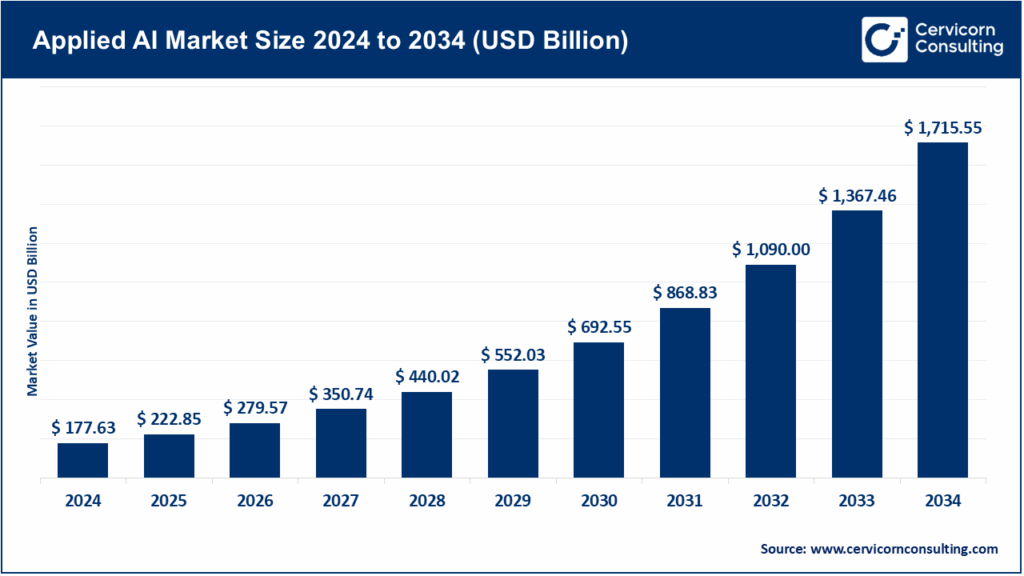
Cervicorn Consulting forecasts, the global applied AI market was valued at USD 177.63 billion in 2024 and is projected to reach approximately USD 1,715.55 billion by 2034, growing at a CAGR of 25.46% between 2025 and 2034. The rapid expansion of this market is driven by the increasing need for businesses to make faster and smarter decisions. Unlike traditional automation, applied AI leverages machine learning and data-driven insights to address real-world challenges across industries such as finance, retail, and manufacturing. This enables organizations to enhance efficiency, reduce operational costs, and deliver improved customer experiences.
With the growing adoption of edge computing and the rising accessibility of advanced AI tools, applied AI has become a core enabler of digital transformation across industries. As demand for intelligent systems continues to rise, applied AI is emerging as an essential driver of innovation and growth.
Applied AI Market Report Highlights
- By Region: North America held the largest share in 2024, accounting for 36.8% of global revenue.
- By Component: Hardware dominated with 48.2% share in 2024, fueled by the strong demand for AI chips (GPUs, TPUs, FPGAs) in data centers and edge devices.
- By Technology: Machine learning accounted for 42.1% of revenue in 2024, serving as the backbone for most AI solutions, from analytics to personalization.
- By Deployment Mode: Cloud-based deployment led the market with 63.7% share in 2024, supported by its scalability and cost-effectiveness in AI model implementation.
- By Application: Predictive analytics represented 36.8% share in 2024, widely adopted for forecasting in finance, supply chain management, and marketing.
- By Industry Vertical: Healthcare contributed 37.6% of revenue in 2024, with AI playing a crucial role in diagnostics, imaging, and hospital operations.
Applied AI Market Regional Analysis
The applied AI market is segmented into four major regions: North America, Europe, Asia-Pacific, and LAMEA (Latin America, Middle East, and Africa). Below is an in-depth overview of each region.
Why is North America leading the applied AI market?
The North America applied AI market was valued at USD 65.37 billion in 2024 and is expected to reach approximately USD 631.32 billion by 2034.
North America—including the U.S., Canada, and Mexico—benefits from advanced digital infrastructure, a large tech ecosystem, and widespread enterprise adoption of AI across healthcare, manufacturing, government, and financial services.
- The U.S. leads the region with heavy R&D investments, robust startup activity, and global leadership in AI innovation.
- Canada supports growth through strong university-industry partnerships and immigration policies that attract top AI talent.
- Mexico and other regional players are investing in new data centers and upskilling initiatives to expand AI capabilities.
In April 2023, Microsoft opened a new AI data center region in Canada, delivering sovereign cloud services with low latency. This highlighted the region’s commitment to AI infrastructure development and digital sovereignty, reinforcing North America’s dominance in the global market.
What are the driving factors of Europe’s applied AI market?
The Europe applied AI market was valued at USD 50.09 billion in 2024 and is projected to reach nearly USD 483.79 billion by 2034.
Europe’s growth is driven by its strong regulatory frameworks, focus on “trustworthy AI”, and a balanced mix of public sector programs and private innovation. The region benefits significantly from EU funding initiatives, national AI strategies, and academia-industry collaborations.
In August 2024, Germany announced a €200 billion (~USD 219 billion) national AI strategy, focusing on AI infrastructure, research, and industrial adoption. This record-level funding demonstrated Europe’s intent to accelerate AI capabilities while ensuring ethical and secure deployment, reinforcing its position as a global hub for reliable AI innovation.
Why is Asia-Pacific the fastest-growing applied AI market?
The Asia-Pacific applied AI market stood at USD 43.34 billion in 2024 and is expected to exceed USD 418.59 billion by 2034, making it the fastest-growing regional market.
This region includes China, Japan, India, South Korea, Australia, New Zealand, Taiwan, and others, each at different stages of AI adoption:
- China leads in manufacturing automation and smart city projects.
- India focuses on AI in services, agriculture, healthcare, and education.
- Japan and South Korea are advancing in robotics, autonomous systems, and industrial AI.
In January 2025, India launched its National AI Strategy 2.0, committing INR 50,000 crore (~USD 6 billion) toward AI adoption in agriculture, healthcare, and education. This initiative underscores Asia-Pacific’s rapid move toward scaling applied AI across emerging and mature economies, making the region a key driver of global AI growth.
LAMEA Applied AI Market Trends
The LAMEA applied AI market was valued at USD 18.83 billion in 2024 and is projected to reach around USD 181.85 billion by 2034.
This region—covering Latin America, the Middle East, and Africa—is currently in the early stages of AI adoption. Growth is driven by:
- Public sector initiatives in healthcare, education, and government services.
- Investments in digital banking, telecom, and agriculture.
- Efforts to integrate AI into smart city and fintech projects.
In March 2025, the UAE’s Ministry of Artificial Intelligence launched the “AI 4 All” initiative, partnering with universities to implement AI pilots in healthcare and public services. This milestone signaled the region’s intent to bridge infrastructure gaps and accelerate AI adoption, positioning LAMEA as an emerging market with strong future potential.
Applied AI Market Segmental Analysis
Component Analysis
Hardware: The hardware segment includes AI-specific processors such as GPUs, TPUs, and ASICs designed to handle complex machine learning computations. In May 2024, Intel launched its Gaudi2 AI accelerator, aimed at large-scale AI functions in data centers. This move directly challenged NVIDIA’s dominance in the AI chip market. Major cloud providers began testing Gaudi2 for enterprise workloads, highlighting the growing demand for flexible and high-performance AI infrastructure.
Software: Software comprises platforms, libraries, and frameworks that enable the development, training, and monitoring of AI models. In November 2023, Hugging Face released AutoTrain 2.0, a no-code model training tool that allows users to fine-tune AI models without programming knowledge. Widely adopted by legal and life sciences startups, this innovation made AI development more accessible to non-technical teams, signaling a shift toward simplified AI solutions.
Services: Services include consulting, integration, training, and AI support that help businesses adopt and scale AI systems effectively. In February 2025, Accenture acquired APTIO’s AI advisory division to enhance its enterprise AI capabilities, particularly for telecom and BFSI clients. This acquisition emphasized the rising demand for specialized AI expertise, positioning service providers as critical enablers of end-to-end AI implementation.
Technology Analysis
Machine Learning (ML): ML uses algorithms that learn from data to make decisions and predictions. In June 2022, Google introduced the Vertex AI Workbench to streamline ML workflow integration, from notebooks to deployment. Widely adopted in healthcare and retail, it accelerated experimentation and scaling, reinforcing ML as a key competitive advantage.
Natural Language Processing (NLP): NLP enables machines to interpret, generate, and analyze human language in text and speech. In January 2025, Meta launched LLaMA-2, an open-weight large language model (LLM) for enterprise AI applications. It was adopted for chatbots and legal document processing, allowing companies to host models privately without relying on the cloud. The release accelerated enterprise-focused NLP innovations.
Computer Vision: Computer vision allows AI systems to interpret visual data from images and videos. In October 2024, Microsoft launched Custom Vision for Enterprises, a no-code visual model training platform. Manufacturers adopted it for defect detection and shelf monitoring, reducing reliance on external developers. The platform gained traction in consumer goods and logistics, reflecting the demand for accessible vision solutions.
Deployment Mode Analysis
On-Premises: On-premises deployment involves running AI infrastructure locally within an organization’s environment. In March 2023, Siemens implemented on-premises AI modules in factories for real-time defect detection and process control. This reduced production errors while ensuring data privacy, making it especially vital for industries with high-security needs.
Cloud: Cloud deployment delivers AI tools and models through remote servers, offering scalability and flexibility. In August 2024, AWS launched Bedrock, a service enabling businesses to access foundation models via managed APIs. Medium-sized firms used it to build chatbots, document summarization tools, and analytics workflows without heavy infrastructure investment. Post-launch, cloud-based AI adoption grew rapidly due to its cost-effectiveness and ease of integration.
Industry Vertical Analysis
Healthcare: The healthcare sector dominates the applied AI market, leveraging AI for clinical diagnosis, medical imaging, treatment planning, and administrative automation. In September 2023, PathAI raised $160 million to expand its pathology AI platform for early cancer detection. Widely adopted in U.S. hospitals, the system improved diagnostic accuracy and decision-making, driving strong confidence in AI-powered life sciences.
BFSI (Banking, Financial Services, and Insurance): AI in BFSI is used for fraud detection, credit scoring, compliance, and personalized banking services. In April 2025, JP Morgan Chase acquired AI startup Venules for $200 million to boost real-time fraud analytics. The platform improved transaction monitoring and compliance, reducing false positives while strengthening AI-driven risk management.
Retail & E-commerce: AI supports retail and e-commerce through demand forecasting, recommendation engines, and visual search. In November 2022, Walmart piloted camera-based checkout systems, cutting checkout time by 40%. The system scanned items directly as they were placed in carts, enhancing customer throughput and operational efficiency. Other major retailers soon adopted similar AI-powered solutions.
Application Analysis
Predictive Analytics: Predictive analytics uses AI to forecast trends, behaviors, and events based on historical data. In July 2024, Palantir launched BridgeAI, a risk modeling tool for supply chain prediction. Manufacturers adopted it to forecast delays and optimize inventory with minimal manual oversight, making predictive analytics an essential tool for logistics and operations management.
Image & Speech Recognition: This segment involves analyzing visual and audio data for classification and transcription. In December 2023, Adobe integrated speech recognition into Creative Cloud for automated video captioning, significantly reducing editing time. The feature gained rapid adoption among media agencies, establishing AI as a core tool in creative workflows.Autonomous Systems: Autonomous systems leverage AI to operate vehicles, drones, and machines without human control. In June 2025, Waymo received regulatory approval to launch driverless ride-hailing services in Los Angeles. This milestone boosted confidence in self-driving technologies, marking a key step in the real-world deployment of autonomous AI systems.