


Artificial Intelligence Sensor Market Snapshot
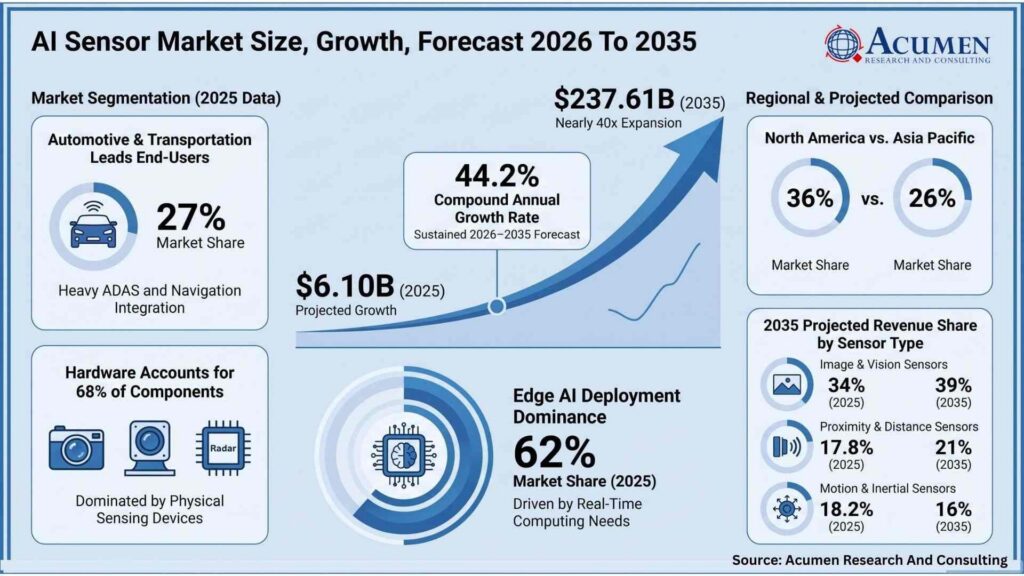
According to Acumen Research And Consulting, the global Artificial Intelligence Sensor Market was valued at USD 6.10 Billion in 2025 and is projected to reach USD 237.61 Billion by 2035, expanding at an impressive CAGR of 44.2% during the forecast period from 2026 to 2035. The market is witnessing substantial growth due to the rapid integration of artificial intelligence into sensing technologies across industries including automotive, healthcare, consumer electronics, manufacturing, aerospace, and smart cities. The increasing demand for intelligent automation, real-time data analytics, and edge computing continues to accelerate the adoption of AI-enabled sensors worldwide.
Key Takeaways
- Market size reached USD 6.10 Billion in 2025.
- Expected to attain USD 237.61 Billion by 2035.
- Forecast CAGR stands at 44.2% (2026–2035).
- North America accounted for 36.0% of global revenue in 2025.
- Asia-Pacific is expected to register the fastest CAGR of 50.8%.
- Growing adoption of AI-powered automation and IoT ecosystems is fueling market expansion.
- Edge AI, autonomous vehicles, industrial automation, and smart healthcare remain major application areas.
Artificial Intelligence Sensor Market Overview
The Artificial Intelligence Sensor Market has emerged as one of the fastest-growing segments within the broader intelligent technology ecosystem. AI sensors combine advanced sensing capabilities with machine learning algorithms, enabling devices to process data locally, recognize patterns, and make intelligent decisions without relying extensively on cloud computing.
Unlike conventional sensors, AI-powered sensors analyze environmental data in real time, significantly improving operational efficiency, predictive maintenance, safety, and automation. Their ability to continuously learn from collected data makes them essential components in next-generation intelligent systems.
Industries are increasingly investing in AI sensors to enhance productivity while minimizing operational costs. Manufacturing companies utilize intelligent sensors for predictive maintenance and quality inspection, healthcare providers employ AI-enabled biosensors for patient monitoring, and automotive manufacturers integrate sophisticated sensor arrays into advanced driver assistance systems (ADAS) and autonomous vehicles.
The rapid expansion of Industry 4.0 initiatives, combined with increasing digital transformation across enterprises, continues to strengthen the demand for AI-integrated sensing solutions globally.
Artificial Intelligence Sensor Market Size Analysis
The Artificial Intelligence Sensor Market demonstrates remarkable growth potential over the next decade. According to Acumen Research estimates, global revenue is anticipated to increase from USD 6.10 Billion in 2025 to approximately USD 237.61 Billion by 2035, reflecting a robust CAGR of 44.2% during the forecast period.
Several technological and economic factors contribute to this exponential expansion:
- Rising deployment of AI at the edge
- Increasing investments in industrial automation
- Expansion of connected IoT ecosystems
- Growing demand for autonomous mobility
- Rapid adoption of smart healthcare technologies
- Advancements in semiconductor and MEMS technologies
- Increasing use of computer vision and image sensors
As organizations continue embracing intelligent automation, AI sensors are becoming critical infrastructure for enabling autonomous decision-making and real-time analytics across diverse environments.
Artificial Intelligence Sensor Market Trends
Growing Adoption of Edge AI
One of the strongest trends shaping the Artificial Intelligence Sensor Market is the transition toward edge intelligence. Instead of transmitting raw sensor data to centralized cloud servers, modern AI sensors perform data processing directly on the device.
This approach offers several advantages:
- Lower latency
- Enhanced privacy
- Reduced bandwidth consumption
- Faster decision making
- Improved operational reliability
Edge AI is particularly valuable for autonomous vehicles, robotics, industrial automation, healthcare monitoring, and smart surveillance systems where immediate responses are critical.
Expansion of Smart Manufacturing
Manufacturers worldwide are integrating AI-powered sensors into production environments to improve operational efficiency and reduce equipment downtime.
Smart factories leverage intelligent sensors to monitor machine health, detect anomalies, optimize production lines, and improve product quality through continuous real-time monitoring.
Predictive maintenance powered by AI sensors enables manufacturers to identify potential equipment failures before they occur, minimizing costly disruptions and extending equipment life.
Increasing AI Adoption Across Consumer Electronics
Consumer electronics manufacturers continue integrating AI-enabled sensors into smartphones, wearable devices, home automation systems, and augmented reality products.
Features such as facial recognition, gesture control, environmental sensing, voice interaction, and intelligent energy management increasingly rely on advanced AI sensor technologies.
As consumer demand for personalized and connected experiences grows, manufacturers continue investing heavily in intelligent sensing solutions.
Artificial Intelligence Sensor Market Dynamics
Market Driver
Rising Demand for Intelligent Automation
The growing adoption of intelligent automation across industries remains the primary growth driver for the Artificial Intelligence Sensor Market.
Organizations are increasingly implementing AI-enabled sensors to automate repetitive tasks, improve workplace safety, enhance asset monitoring, and optimize operational efficiency.
Industrial facilities now depend on intelligent sensing systems capable of detecting temperature fluctuations, pressure variations, vibration patterns, equipment wear, and environmental changes while automatically initiating corrective actions.
The proliferation of autonomous systems across manufacturing, logistics, transportation, and healthcare continues creating significant opportunities for AI sensor providers.
Market Restraint
High Development and Deployment Costs
Despite strong market potential, high implementation costs remain one of the major barriers to adoption.
Developing AI-enabled sensing systems requires advanced semiconductor technologies, AI processors, sophisticated software algorithms, high-performance hardware, and extensive integration efforts.
Small and medium-sized enterprises often face challenges in adopting these technologies due to budget constraints and limited technical expertise.
Market Opportunity
Expansion of Smart Cities and Connected Infrastructure
The rapid development of smart cities presents substantial growth opportunities for AI sensor manufacturers.
Governments and municipalities are investing in intelligent infrastructure capable of monitoring traffic, air quality, public safety, utilities, waste management, and energy consumption.
AI-powered sensors enable real-time decision-making that enhances urban efficiency while supporting sustainability initiatives.
Artificial Intelligence Sensor Market Segmentation Analysis
The Artificial Intelligence Sensor Market is expanding rapidly as intelligent sensing technologies become increasingly essential across industries. Market growth is driven by advances in machine learning, edge computing, Internet of Things (IoT), robotics, and autonomous systems. As organizations seek real-time data processing and predictive capabilities, AI-enabled sensors are being adopted across a broad range of applications.
By Sensor Type
Image Sensors Lead Market Adoption
Image sensors represent one of the most significant segments within the Artificial Intelligence Sensor Market. AI-powered image sensors are widely used in autonomous vehicles, industrial inspection, surveillance systems, consumer electronics, and medical imaging.
Unlike conventional imaging devices, AI-enabled image sensors can process visual information directly at the edge, enabling features such as object recognition, facial identification, defect detection, and gesture recognition with minimal latency. Their ability to reduce cloud dependency while improving response times makes them highly attractive for real-time applications.
Pressure Sensors
AI-integrated pressure sensors are increasingly deployed across manufacturing facilities, automotive systems, healthcare devices, and industrial equipment. These sensors continuously monitor pressure conditions, identify abnormal operating patterns, and support predictive maintenance strategies that reduce operational downtime.
Temperature Sensors
Temperature sensors enhanced with artificial intelligence are becoming indispensable in industrial automation, smart buildings, energy management, and healthcare. AI algorithms enable continuous monitoring, anomaly detection, and intelligent control, improving both operational efficiency and safety.
Motion and Position Sensors
Motion, proximity, and position sensors continue to gain importance across robotics, smart manufacturing, logistics automation, and consumer electronics. AI capabilities allow these sensors to accurately detect movement patterns, optimize navigation, and improve the performance of autonomous systems.
By Technology
Machine Learning-Based Sensors
Machine learning has become the foundation of modern AI sensor technology. These intelligent sensors continuously analyze collected data, identify recurring patterns, and improve prediction accuracy over time. Their adaptive capabilities make them particularly valuable in predictive maintenance, industrial automation, quality control, and healthcare diagnostics.
Computer Vision
Computer vision technologies are significantly enhancing the capabilities of AI sensors. By combining advanced imaging hardware with deep learning algorithms, computer vision sensors can recognize objects, interpret scenes, monitor manufacturing processes, and support autonomous navigation.
The growing demand for automated inspection systems, intelligent surveillance, and self-driving vehicles continues to accelerate investment in computer vision-enabled sensing solutions.
Natural Language Processing Integration
Although less common than vision-based applications, Natural Language Processing (NLP) is increasingly integrated into AI-enabled consumer electronics and smart home ecosystems. Voice-enabled sensors improve human-machine interaction, allowing devices to interpret spoken commands and deliver more intuitive user experiences.
By Application
Automotive
The automotive sector represents one of the fastest-growing application areas for AI-powered sensors. Advanced Driver Assistance Systems (ADAS), autonomous driving technologies, driver monitoring systems, collision avoidance, and intelligent parking solutions all rely on sophisticated AI sensor platforms.
As vehicle manufacturers accelerate investments in connected and autonomous mobility, demand for intelligent sensing technologies is expected to grow substantially.
Healthcare
Healthcare providers are increasingly adopting AI-enabled sensors for patient monitoring, wearable medical devices, diagnostic equipment, and remote healthcare solutions. Intelligent biosensors enable continuous monitoring of vital signs while supporting early disease detection and personalized treatment approaches.
The expansion of digital healthcare and telemedicine further strengthens the outlook for AI sensor adoption in the medical sector.
Industrial Automation
Industry 4.0 initiatives continue to drive strong demand for AI sensors across manufacturing environments. Intelligent sensors monitor machine performance, detect equipment failures, optimize production efficiency, and improve product quality through continuous real-time analysis.
Industrial facilities increasingly rely on predictive maintenance systems powered by AI sensors to reduce maintenance costs and maximize equipment uptime.
Consumer Electronics
Smartphones, wearable devices, smart speakers, augmented reality devices, and home automation products increasingly incorporate AI-powered sensing technologies. Consumers expect devices capable of understanding context, recognizing gestures, optimizing energy usage, and delivering personalized experiences.
The rapid evolution of connected consumer electronics is expected to remain a major contributor to market growth.
Artificial Intelligence Sensor Market Regional Analysis
North America
North America accounted for 36.0% of the global Artificial Intelligence Sensor Market revenue in 2025, making it the leading regional market.
The region benefits from:
- Strong AI research and development investments
- Advanced semiconductor manufacturing capabilities
- High adoption of industrial automation
- Significant deployment of autonomous vehicle technologies
- Growing healthcare digitalization
- Extensive presence of leading technology companies
The United States continues to drive regional growth through innovation in artificial intelligence, robotics, smart manufacturing, aerospace, and defense applications.
Asia-Pacific
Asia-Pacific is projected to register the fastest CAGR of 50.8% during the forecast period.
Several factors contribute to this exceptional growth:
- Rapid industrialization
- Expansion of smart manufacturing initiatives
- Increasing semiconductor production
- Rising adoption of IoT technologies
- Government support for AI innovation
- Growing investments in robotics and automation
- Expanding consumer electronics manufacturing
Countries including China, Japan, South Korea, and India are making significant investments in AI infrastructure, creating substantial opportunities for AI sensor manufacturers.
Europe
Europe continues to represent an important regional market driven by advanced manufacturing, automotive innovation, healthcare modernization, and increasing investments in Industry 4.0 technologies.
The region’s emphasis on sustainability, smart infrastructure, and digital transformation is expected to encourage broader deployment of intelligent sensing solutions across industrial and commercial sectors.
Latin America
Latin America is gradually adopting AI-enabled sensing technologies across manufacturing, healthcare, transportation, and smart infrastructure projects. As digital transformation initiatives expand throughout the region, demand for intelligent sensors is expected to increase steadily.
Middle East & Africa
The Middle East & Africa region is witnessing growing investments in smart cities, industrial automation, energy infrastructure, and digital healthcare. These developments are creating new opportunities for AI sensor providers as governments and enterprises adopt intelligent technologies to improve operational efficiency and public services.
Competitive Landscape
The Artificial Intelligence Sensor Market is characterized by continuous innovation, strategic partnerships, product development, and increasing investments in artificial intelligence technologies. Market participants are focused on enhancing sensor accuracy, reducing power consumption, improving edge computing capabilities, and expanding AI processing functionality.
Companies are also investing in research and development to introduce intelligent sensing platforms capable of supporting autonomous decision-making across industrial, automotive, healthcare, and consumer applications.
Key competitive strategies include:
- Development of next-generation AI-enabled sensors
- Integration of edge AI processing capabilities
- Expansion of semiconductor manufacturing capacity
- Strategic collaborations with automotive and industrial OEMs
- Investments in machine learning and computer vision technologies
- Product portfolio diversification
- Geographic expansion into emerging markets
As demand for real-time intelligence continues to grow, competition is expected to intensify, with companies differentiating themselves through innovation, performance, and application-specific solutions.
Artificial Intelligence Sensor Market Future Outlook (2026–2035)
The future of the Artificial Intelligence Sensor Market is expected to be shaped by continuous advancements in artificial intelligence, semiconductor technologies, edge computing, and intelligent connectivity. As organizations increasingly prioritize automation and data-driven decision-making, AI-powered sensors will play a critical role in enabling autonomous systems capable of processing vast amounts of information in real time.
The next decade is likely to witness widespread deployment of AI sensors across industries that require high-speed analytics, predictive capabilities, and intelligent automation. The convergence of AI, the Internet of Things (IoT), 5G connectivity, robotics, and cloud-edge architectures will further accelerate innovation and create new opportunities for sensor manufacturers.
Several long-term trends are expected to influence market expansion:
Expansion of Edge AI Processing
One of the most significant developments will be the continued shift toward edge AI. Rather than transmitting raw data to centralized cloud platforms, AI sensors equipped with embedded processors will perform analytics locally, reducing latency and bandwidth requirements while improving data privacy and operational reliability.
Industries such as autonomous transportation, industrial robotics, healthcare monitoring, and smart surveillance are expected to benefit substantially from edge intelligence.
Growing Adoption of Autonomous Systems
The increasing commercialization of autonomous vehicles, drones, warehouse robots, agricultural equipment, and industrial automation systems will significantly boost demand for intelligent sensors capable of supporting real-time environmental awareness and decision-making.
AI-enabled sensing technologies will become essential for enabling safe navigation, obstacle detection, predictive maintenance, and adaptive control.
Increasing Demand for Smart Healthcare
Healthcare providers are rapidly embracing digital transformation through remote patient monitoring, wearable medical devices, AI-assisted diagnostics, and connected healthcare infrastructure.
Intelligent biosensors capable of continuously monitoring physiological parameters while delivering real-time insights are expected to become increasingly important in preventive healthcare and personalized medicine.
Smart Cities and Intelligent Infrastructure
Governments worldwide continue investing in smart city initiatives that rely heavily on intelligent sensing technologies.
Applications include:
- Intelligent traffic management
- Environmental monitoring
- Smart street lighting
- Public safety systems
- Energy optimization
- Water management
- Waste monitoring
AI-powered sensors help municipalities improve operational efficiency while supporting sustainability and digital governance initiatives.
Emerging Technologies Transforming the Artificial Intelligence Sensor Market
Technological innovation remains the foundation of long-term market growth. Several emerging technologies are expected to redefine the capabilities of AI-powered sensors.
TinyML and Ultra-Low Power AI
TinyML enables machine learning models to operate on microcontrollers with minimal power consumption. This advancement allows intelligent sensors to perform complex analytics without requiring cloud connectivity, making them suitable for battery-powered IoT devices and remote deployments.
Neuromorphic Computing
Neuromorphic chips are designed to mimic the structure and functionality of the human brain. When integrated with AI sensors, these processors offer faster decision-making while significantly reducing energy consumption, making them attractive for robotics, autonomous vehicles, and edge AI applications.
Advanced MEMS Technologies
Continuous innovation in Micro-Electro-Mechanical Systems (MEMS) is improving sensor accuracy, durability, miniaturization, and cost efficiency. These advancements support broader deployment across smartphones, wearables, healthcare devices, automotive systems, and industrial automation.
AI-Powered Computer Vision
Computer vision continues to evolve rapidly with improvements in deep learning algorithms and imaging technologies. AI-powered vision sensors are increasingly used for quality inspection, facial recognition, autonomous navigation, medical imaging, and intelligent surveillance.
Competitive Landscape
The Artificial Intelligence Sensor Market is characterized by intense technological competition and continuous product innovation. Companies operating in this market are focused on enhancing AI processing capabilities, improving sensor accuracy, reducing power consumption, and developing application-specific intelligent sensing solutions.
Manufacturers are increasingly investing in research and development to introduce next-generation sensors capable of supporting edge intelligence, autonomous systems, and advanced industrial automation.
Common competitive strategies include:
- Expansion of AI-enabled sensor portfolios
- Investment in semiconductor innovation
- Development of low-power edge AI processors
- Strategic collaborations with automotive manufacturers
- Partnerships with industrial automation providers
- Integration of machine learning and computer vision capabilities
- Geographic expansion into emerging markets
- Acquisition of AI software and hardware companies
As AI adoption accelerates across industries, companies that successfully combine advanced sensing technologies with intelligent analytics are expected to strengthen their market position.
Analyst View
The Artificial Intelligence Sensor Market is entering a transformative growth phase driven by the rapid convergence of AI, edge computing, IoT, and automation technologies. Organizations across industries increasingly recognize the value of intelligent sensors in enabling real-time analytics, predictive maintenance, and autonomous decision-making.
The market’s projected expansion reflects the growing demand for AI-enabled sensing solutions capable of improving operational efficiency, reducing costs, and enhancing safety across diverse applications.
North America is expected to maintain its leadership position through continued investments in AI innovation and advanced manufacturing, while Asia-Pacific is anticipated to emerge as the fastest-growing regional market due to accelerating industrialization, semiconductor production, and government support for digital transformation initiatives.
As technological barriers continue to decline and AI hardware becomes more accessible, intelligent sensors are expected to become a standard component of connected devices, industrial equipment, transportation systems, healthcare technologies, and smart infrastructure.
The Artificial Intelligence Sensor Market is poised for remarkable growth over the coming decade, supported by rapid technological advancements and increasing adoption of intelligent automation across industries. Rising investments in edge AI, industrial IoT, autonomous mobility, and digital healthcare are expected to accelerate demand for advanced sensing solutions capable of delivering real-time intelligence and predictive insights.
According to Acumen Research And Consulting, the industry is projected to grow from USD 6.10 Billion in 2025 to USD 237.61 Billion by 2035, reflecting a robust CAGR of 44.2% during the forecast period. This strong trajectory highlights the increasing importance of AI-enabled sensors in transforming manufacturing, healthcare, automotive, consumer electronics, aerospace, and smart city ecosystems.
As organizations continue embracing data-driven operations and intelligent automation, AI-powered sensors will remain at the forefront of innovation, enabling smarter, safer, and more efficient systems worldwide.
Frequently Asked Questions (FAQs)
1. What is the Artificial Intelligence Sensor Market?
The Artificial Intelligence Sensor Market comprises sensors integrated with AI capabilities that can process, analyze, and interpret data in real time. These sensors are widely used in automotive, healthcare, manufacturing, consumer electronics, robotics, and smart infrastructure.
2. What is the current size of the Artificial Intelligence Sensor Market?
The global Artificial Intelligence Sensor Market was valued at USD 6.10 Billion in 2025.
3. What is the forecast for the Artificial Intelligence Sensor Market?
The market is projected to reach USD 237.61 Billion by 2035, growing at a CAGR of 44.2% during 2026–2035.
4. What factors are driving market growth?
Key growth drivers include increasing adoption of edge AI, expansion of IoT ecosystems, industrial automation, autonomous vehicles, smart healthcare technologies, and rising demand for real-time data processing.
5. Which region dominates the Artificial Intelligence Sensor Market?
North America accounted for the largest market share in 2025, supported by strong investments in AI research, advanced manufacturing, and technology innovation.
6. Which region is expected to witness the fastest growth?
Asia-Pacific is projected to register the fastest CAGR through 2035 due to rapid industrialization, semiconductor manufacturing, and increasing adoption of AI technologies.
7. Which industries are the primary users of AI sensors?
Major end-use industries include automotive, healthcare, industrial manufacturing, consumer electronics, aerospace and defense, logistics, and smart city infrastructure.
8. How do AI sensors differ from conventional sensors?
Unlike traditional sensors that only collect data, AI-enabled sensors analyze information locally using machine learning algorithms, enabling faster decision-making, predictive analytics, and autonomous operation.
9. What role does edge AI play in AI sensors?
Edge AI allows sensors to process data directly on the device rather than relying on cloud computing, reducing latency, improving privacy, and enabling real-time responses.
10. What are the future opportunities in the Artificial Intelligence Sensor Market?
Future opportunities include advancements in autonomous vehicles, robotics, healthcare monitoring, smart factories, precision agriculture, environmental monitoring, and intelligent urban infrastructure.