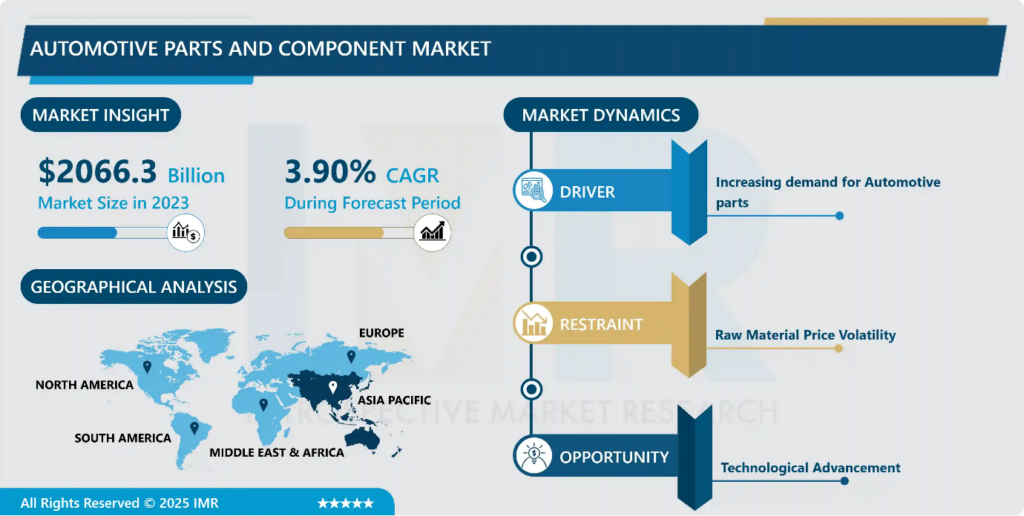
The global Automotive Parts and Components Market is projected to grow from approximately USD 2066.3 billion in 2023 to USD 2844.52 billion by 2032, expanding at a CAGR of 3.9% during the forecast period. Growth is supported by sustained global vehicle production, rising aftermarket demand, and increasing integration of advanced electronic and safety components.
Automotive parts and components form the backbone of the automotive value chain, encompassing powertrain systems, electronics, interiors, exteriors, chassis, and safety components. With over 90 million vehicles produced globally each year, the demand for both OEM and replacement components remains consistently strong, ensuring long-term market stability.
Quick Insights
- Market Size (2023): USD 2066.3 Billion
- Forecast Size (2032): USD 2844.52 Billion
- CAGR (2024–2032): 3.9%
- Largest Region: Asia-Pacific (~42% market share)
- Key Segments: Powertrain, Electronics, Interiors & Exteriors
- Major Players: Bosch, Denso, Magna International, Continental AG, ZF Friedrichshafen
- Core Driver: Global vehicle parc growth and production volumes
- Key Opportunity: Electrification and smart component integration
- Primary Challenge: Supply chain volatility and raw material costs
Revenue Breakdown & Market Segmentation
| Segment Category | Key Insights |
|---|---|
| Base Year | 2023 – USD 2066.3 Billion |
| Forecast Year | 2032 – USD 2844.52 Billion |
| CAGR | 3.9% |
| By Component | Driveline & Powertrain, Electronics, Interiors & Exteriors, Chassis, Lighting, Seating |
| By Application | OEM, Aftermarket |
| By Vehicle Type | Passenger Vehicles, Commercial Vehicles, Off-Highway Vehicles |
| By Region | Asia-Pacific, Europe, North America, MEA, South America |
The OEM segment dominates due to strong automotive manufacturing ecosystems, while the aftermarket segment continues to grow steadily due to aging vehicle fleets and replacement demand.
What’s Driving Growth? What Trends Are Reshaping the Market?
Why does this mature market continue to expand globally?
- Rising vehicle production: Increasing global automotive output drives consistent component demand.
- Growing vehicle parc: Longer vehicle lifespans boost aftermarket consumption.
- Electrification shift: EVs require new categories of components such as battery systems and power electronics.
- Advanced safety & electronics: Integration of ADAS, sensors, and ECUs is increasing component value per vehicle.
- Localization trends: Governments are promoting domestic manufacturing to strengthen supply chains.
Regional & Segment Analysis
- Asia-Pacific dominates the market, accounting for the largest share due to high vehicle production in China, Japan, and India.
- Europe focuses on premium vehicles and advanced component technologies.
- North America is driven by strong aftermarket demand and large vehicle parc.
Segment Insights:
- Powertrain components remain dominant, but electronics and EV-related components are the fastest-growing.
- Passenger vehicles account for the majority share due to high production volumes.
- Aftermarket segment is gaining traction due to increasing average vehicle age globally.
Latest Industry Developments
- Leading suppliers such as Bosch and Denso are investing heavily in EV components and semiconductor technologies.
- Magna International and ZF Friedrichshafen are expanding into e-mobility systems and integrated vehicle platforms.
- Increasing focus on lightweight materials, modular components, and digital manufacturing is reshaping production processes.
- Tier-1 suppliers are transitioning toward software-integrated systems and smart mobility solutions.
Challenges & Cost Pressures
- Raw material volatility: Fluctuations in steel, aluminum, and semiconductor costs impact margins.
- Supply chain disruptions: Global logistics and geopolitical factors affect component availability.
- Low-margin pressure: High competition among suppliers limits profitability.
- EV transition risks: Traditional component manufacturers face disruption due to electrification.
Case Study: Component Value Shift in Electric Vehicles
A global automotive OEM transitioned from traditional internal combustion vehicles to electric models, resulting in a significant increase in demand for electronic components and battery systems, while reducing reliance on conventional engine parts. This shift highlights how electrification is redefining the value distribution within the automotive component ecosystem.