


The data center cable market is witnessing robust expansion as global digital infrastructure scales rapidly to support cloud computing, artificial intelligence (AI), 5G networks, and hyperscale data centers. As data consumption surges across industries, demand for high-speed, low-latency, and highly reliable connectivity solutions is accelerating the adoption of advanced cabling systems worldwide.
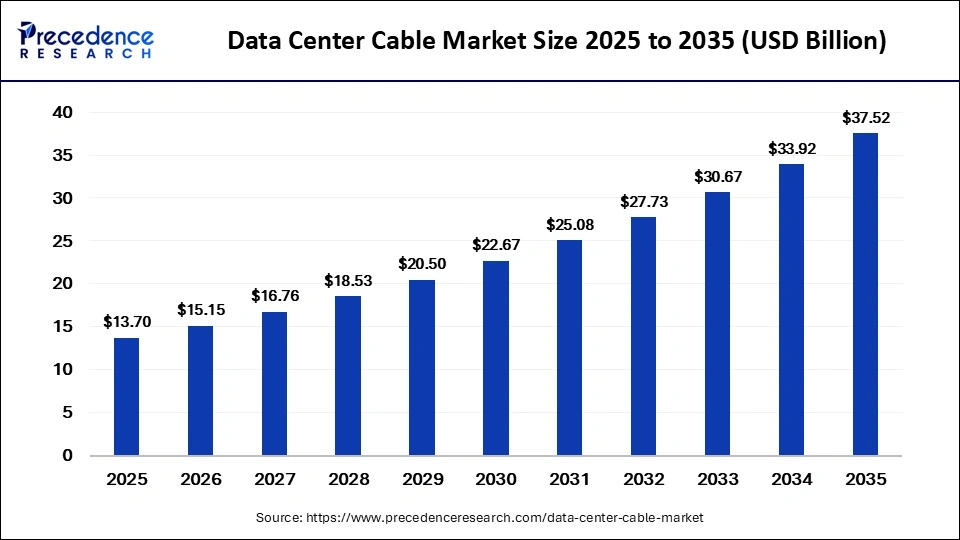
According to industry estimates, the global data center cable market is projected to grow from approximately USD 13.70 billion in 2025 to around USD 37.52 billion by 2035, expanding at a CAGR of about 10.60% during 2026–2035.
Market Overview: The Physical Backbone of Digital Infrastructure
Data center cables form the critical physical layer that connects servers, storage systems, networking switches, and power infrastructure inside modern data centers. These include fiber optic cables, copper cables, active optical cables (AOC), and direct attach cables (DAC), all designed to ensure seamless data transmission across complex computing environments.
With the rapid shift toward cloud-native applications, edge computing, and AI-driven workloads, data centers are evolving into ultra-dense computing hubs, requiring highly efficient and scalable cabling architectures.
Key Growth Drivers
1. Explosion of Hyperscale Data Centers
Hyperscale facilities operated by cloud giants are expanding globally, each requiring thousands of kilometers of structured cabling to support server-to-server and inter-rack communication.
2. Rising AI and High-Performance Computing (HPC) Demand
AI workloads require massive data throughput between GPUs, storage clusters, and networking systems, driving demand for high-bandwidth fiber optic and low-latency copper solutions.
3. Transition to 400G, 800G, and Beyond Networks
Next-generation network architectures are replacing legacy systems, pushing adoption of advanced optical fiber and high-density cabling systems capable of handling extreme data loads.
4. Growth of Edge Data Centers
Edge computing deployments are increasing rapidly to support IoT, autonomous systems, and real-time analytics, creating new demand for compact and efficient cabling infrastructure.
Market Segmentation Insights
By Cable Type
- Fiber optic cables dominate due to high bandwidth and long-distance performance
- Copper cables remain widely used for short-range connectivity
- AOC and DAC solutions are gaining traction for high-density environments
By Application
- Server-to-switch connectivity remains the largest segment
- Switch-to-switch communication is expanding with spine-leaf architectures
- Data center interconnect (DCI) is growing rapidly for multi-site cloud operations
By Data Center Type
- Hyperscale data centers lead the market
- Colocation facilities show steady growth
- Edge data centers are the fastest-growing segment
By End-Use Industry
- IT and cloud service providers dominate demand
- Telecommunications and BFSI sectors follow closely
- Healthcare, retail, and government sectors are expanding adoption
Regional Outlook
- North America leads the market due to strong hyperscale infrastructure and early adoption of advanced networking technologies
- Asia-Pacific is the fastest-growing region, driven by massive digital transformation, data localization policies, and cloud expansion
- Europe maintains steady growth with strong emphasis on energy efficiency and sustainable data center design
Emerging Trends
The market is evolving rapidly due to several key trends:
- Shift toward high-speed fiber architectures (400G/800G/1.6T networks)
- Increasing deployment of AI-optimized data center infrastructure
- Adoption of liquid cooling systems influencing cable design layouts
- Growing use of pre-terminated and modular cabling solutions
- Integration of smart monitoring systems for cable management
Industry Challenges
Despite strong growth, the market faces several constraints:
- Volatility in raw material prices, especially copper and optical glass
- Complex installation and maintenance in high-density environments
- Increasing design complexity for AI-scale infrastructure
- Supply chain disruptions affecting specialty components
Future Outlook
The data center cable market is set to remain a foundational pillar of global digital infrastructure. As AI, cloud computing, and edge technologies continue to scale, the need for faster, more efficient, and more resilient connectivity will intensify.
Over the next decade, innovation in optical fiber technology, high-speed interconnects, and intelligent cabling systems will redefine how data centers are built and operated—supporting the next generation of the digital economy.