


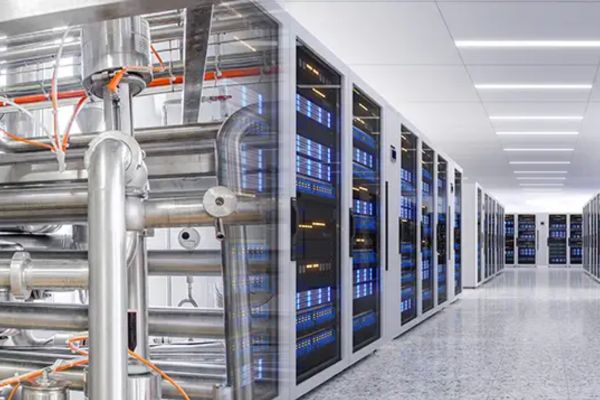
The data center valves market is emerging as a critical backbone of modern digital infrastructure, driven by the explosive growth of hyperscale data centers, artificial intelligence (AI), and high-performance computing (HPC). As global data consumption accelerates, efficient thermal management has become essential, placing advanced valve systems at the center of next-generation cooling technologies.

According to industry estimates, the global data center valves market is projected to grow from around USD 1.10 billion in 2025 to approximately USD 4.04 billion by 2035, expanding at a strong CAGR of about 13.90% during 2026–2035.
Market Overview: Enabling Precision Cooling in the AI Era
Data center valves are specialized flow-control components used in cooling infrastructure to regulate the movement of liquids such as chilled water, coolant fluids, and dielectric liquids. These systems are essential for maintaining optimal operating temperatures in high-density server environments.
With the rise of AI workloads and GPU-intensive computing, traditional air-cooling systems are being rapidly replaced by liquid cooling technologies, significantly increasing demand for precision-engineered valve solutions. Smart and automated valves are now being integrated with digital monitoring systems to ensure real-time thermal regulation and energy efficiency.
Key Growth Drivers
1. Rapid Expansion of Hyperscale Data Centers
Hyperscale facilities are expanding globally to support cloud computing, AI model training, and big data analytics. These environments generate extremely high heat loads, requiring advanced liquid cooling systems supported by high-performance valves.
2. Rising Adoption of Liquid Cooling Systems
The shift from air-based cooling to liquid and immersion cooling is one of the strongest growth catalysts. This transition demands highly reliable valves capable of controlling coolant flow with precision and minimal leakage risk.
3. Surge in AI and HPC Workloads
AI model training and inference workloads are increasing rack power densities significantly, sometimes exceeding 100kW per rack. This creates critical demand for advanced thermal management systems and automated valve control.
4. Increasing Focus on Energy Efficiency
Data center operators are under pressure to reduce Power Usage Effectiveness (PUE). Smart valves integrated with IoT and automation systems help optimize cooling efficiency and reduce energy consumption.
Market Segmentation Insights
By Valve Type
- Ball valves remain widely used due to reliability and leak-proof performance
- Butterfly valves are gaining traction for cost efficiency and compact design
- Control valves are the fastest-growing segment due to smart cooling requirements
By Function
- Flow control dominates the market as it ensures stable thermal regulation
- Pressure regulation is growing rapidly with dynamic AI workloads
- Isolation and backflow prevention are critical for system safety
By Actuation Type
- Manual valves currently hold a large share due to simplicity and cost benefits
- Electric actuated valves are expanding rapidly with automation trends
- Pneumatic systems are used for high-speed cooling response applications
By Application
- Cooling water distribution systems lead the market
- Chilled water systems remain widely deployed
- Liquid cooling loop systems are the fastest-growing segment
By End Use
- Hyperscale data centers dominate demand
- Colocation centers follow closely due to multi-tenant infrastructure
- Edge data centers are emerging rapidly with 5G and IoT expansion
Regional Outlook
North America
North America leads the global market, supported by large-scale data center investments, strong cloud infrastructure, and early adoption of advanced cooling technologies.
Asia-Pacific
Asia-Pacific is the fastest-growing region, driven by rapid digitalization, hyperscale expansion, and strong government investment in AI infrastructure.
Europe
Europe maintains steady growth with a strong focus on energy efficiency regulations and sustainable data center operations.
Emerging Trends
- Shift toward smart, IoT-enabled valve systems
- Rapid adoption of liquid and immersion cooling technologies
- Increasing use of AI-driven predictive maintenance in cooling systems
- Development of high-efficiency, low-leakage valve materials
- Integration of automation and digital twin technologies
Industry Challenges
Despite strong growth, the market faces several challenges:
- High installation and maintenance costs of advanced valve systems
- Lack of standardization across cooling infrastructures
- Risk of leakage in high-density liquid cooling environments
- Requirement for skilled technical workforce for system integration
Future Outlook
The data center valves market is expected to experience sustained growth as digital infrastructure continues to expand globally. The convergence of AI computing, cloud services, and edge data centers will further intensify cooling demands, making advanced valve technologies indispensable.
Over the next decade, smart valve systems integrated with AI and real-time analytics are expected to become standard in modern data center design, enabling higher efficiency, lower downtime, and improved sustainability.