

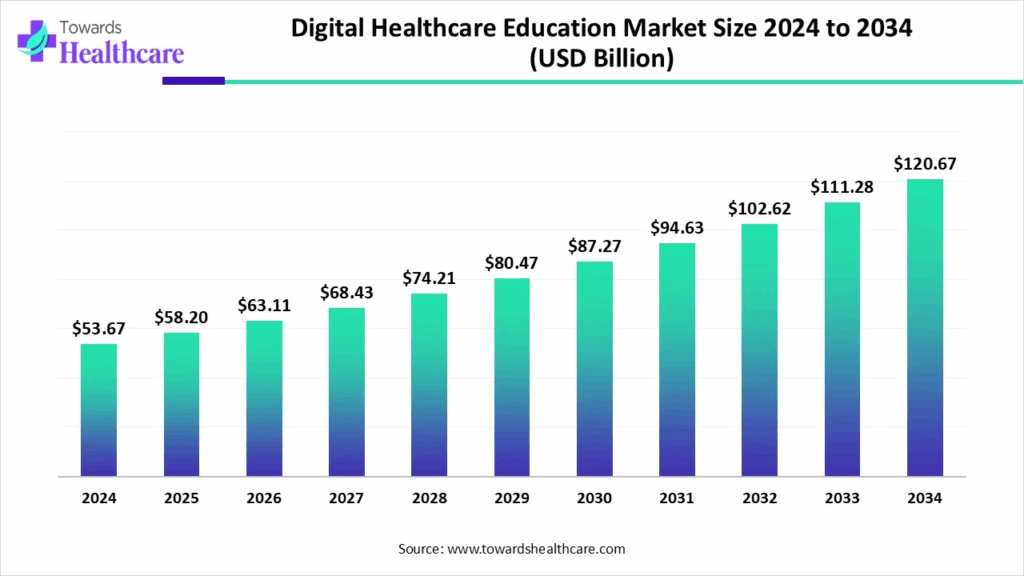
In 2024, the global digital healthcare education market is estimated to be worth a staggering USD 53.67 billion. By 2025, it is projected to reach USD 58.2 billion, and within the next decade, the market is expected to more than double, reaching approximately USD 120.67 billion by 2034. This remarkable growth, at a CAGR of 8.44%, underscores a fundamental shift in how medical knowledge is delivered and consumed worldwide.
The driving force behind this surge is not just technology it is necessity. The pandemic reshaped education in ways no one could have anticipated. Social distancing measures compelled institutions to rethink traditional teaching methods, pushing medical students and healthcare professionals toward digital learning platforms. digital healthcare education is no longer a supplement it is a lifeline, providing tools and resources that save lives.
The Power of Technology in Learning
At the heart of this transformation are digital tools such as Learning Management Systems (LMS), virtual reality (VR), augmented reality (AR), and AI-driven platforms. LMS platforms dominate the market helping healthcare professionals and students stay up-to-date with the latest medical practices, compliance standards, and technological advances. Yet, the real excitement lies in immersive technologies. VR and AR are revolutionizing medical training, enabling learners to perform simulated surgeries, explore human anatomy in three dimensions, and experience patient care scenarios long before they encounter them in real life.
Artificial intelligence, paired with machine learning and natural language processing, is redefining personalized education. AI algorithms analyze learners’ progress, adapt content to their skill level, and identify knowledge gaps, while chatbots powered by NLP answer common questions in real-time. This ensures that every learner, from medical students to practicing physicians, receives a tailored educational experience, optimizing both knowledge retention and practical application.
Collaboration Across Borders
Digital healthcare education does more than teach it connects. Physicians in North America can collaborate with experts in Asia-Pacific, while medical students in Europe can access lectures from top universities in the U.S. This global connectivity is fostering unprecedented collaboration in healthcare. Shared knowledge accelerates problem-solving and enables professionals to tackle complex cases collectively, strengthening the entire healthcare ecosystem.
North America currently holds the largest market share, fueled by advanced technological infrastructure, top-tier academic institutions, and strong government support. The U.S. boasts over 215 active academic medical centers, and more than 5.7 million students were enrolled in online programs in 2024 alone. Meanwhile, Asia-Pacific is emerging as the fastest-growing region, supported by government initiatives, affordable digital tools, and the rapidly expanding healthcare sector. Countries like China and India are making significant investments in digital learning infrastructure, ensuring even rural students have access to high-quality education.
The Learner at the Center
Self-paced learning remains the preferred format globally, allowing learners to study on their own schedule and absorb information at a comfortable pace. However, instructor-led training is quickly gaining traction, offering real-time feedback, collaborative problem-solving, and personalized guidance an approach that fosters deeper understanding and practical skills. Similarly, cloud-based solutions have revolutionized access, providing learners with instant availability of resources anytime, anywhere, without the limitations of physical infrastructure.
The primary users of digital healthcare education are physicians and medical students. Physicians dominate the market due to their constant need to stay updated on emerging treatments and technologies, while medical students represent the fastest-growing segment, driven by increasing enrollments and the demand for personalized, high-quality education. Academic institutions lead in adoption, using digital tools to attract students and improve training outcomes, while hospitals and clinics are expanding their use to train staff and enhance patient care.
A Promising Future
The road ahead is filled with opportunities. The integration of VR and AR into medical curricula is creating immersive learning experiences that were once the realm of science fiction. Students can practice complex surgical procedures without risk, and healthcare professionals can continually update their skills with realistic simulations. Government initiatives and private partnerships are providing funding, resources, and policy support to make digital learning more accessible, even in developing regions.
Recent examples illustrate this momentum. In March 2025, the Australian Digital Health Agency collaborated with universities to embed digital health education into degree programs, preparing the workforce for future challenges. Similarly, RIT Croatia launched the DigHealth project to revolutionize healthcare education in Ethiopia and Somalia, demonstrating the global reach and impact of digital learning initiatives.
Major industry players such as Adobe, Oracle, Wolters Kluwer, AVIA Health, and MedLe are at the forefront of this revolution, continuously innovating and partnering with institutions to deliver cutting-edge solutions. Initiatives like SUSA in Europe highlight the transformative potential of collaboration, technology, and education to drive meaningful change in healthcare systems.
Digital healthcare education is no longer an emerging concept it is a movement reshaping the way knowledge is shared, absorbed, and applied across the globe. From AI-driven learning analytics to immersive AR simulations, technology is enabling a new generation of healthcare professionals to train faster, learn smarter, and collaborate more effectively. As the market continues its rapid growth, the future of medical education promises not only more informed healthcare professionals but better patient outcomes worldwide.
In the words of Minna Isomursu, Project Leader at the University of Oulu, “Through collaboration and innovation in education, we can transform healthcare systems and create meaningful change for patients everywhere.”