
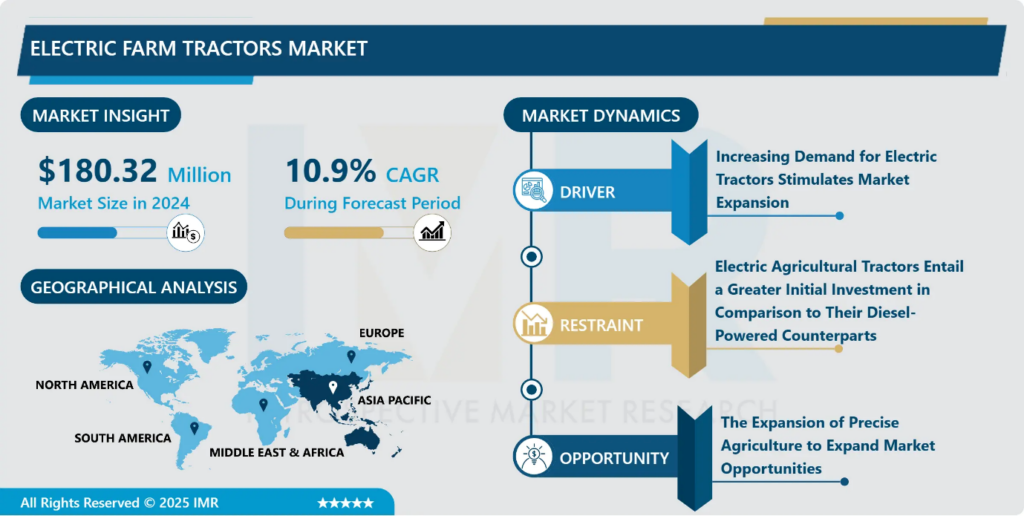
The global Electric Farm Tractors Market is entering a high-growth phase, projected to expand from approximately USD 180.32 million in 2024 to USD 412.6 million by 2032, registering a strong CAGR of 10.9% during the forecast period. The surge is primarily driven by rising fuel costs, increasing adoption of sustainable farming practices, and advancements in battery and smart farming technologies.
Electric farm tractors powered by battery-electric or hybrid systems are redefining agricultural operations by reducing emissions, lowering operating costs, and enabling precision farming. As the global agricultural sector shifts toward sustainability and digitalization, electric tractors are emerging as a critical enabler of next-generation farming ecosystems.
Quick Insights
- Market Size (2024): USD 180.32 Million
- Forecast Size (2033): USD 412.6 Million
- CAGR (2025–2032): 10.9%
- Dominant Segment: Battery Electric Tractors (over 60% share)
- Leading Region: Asia-Pacific
- Fastest Growth Segment: Hybrid Electric Tractors
- Key Players: Deere & Company, AGCO Corporation, CNH Industrial, Monarch Tractor, Mahindra & Mahindra
- Core Driver: Rising fuel costs and sustainability initiatives
- Key Opportunity: Integration with renewable energy and smart farming systems
- Primary Challenge: Battery limitations and high upfront costs
Revenue Breakdown & Market Segmentation
| Segment Category | Key Insights |
|---|---|
| Base Year | 2024 – USD 180.32 Million |
| Forecast Year | 2032 – USD 412.6 Million |
| CAGR | 10.9% |
| By Type | Battery Electric, Hybrid Electric |
| By Power Output | Below 30 HP, 31–70 HP, Above 70 HP |
| By Battery Type | Lithium-ion, Lead-acid |
| By Application | Tillage, Harvesting, Seeding, Spraying |
| By Drive Type | 2WD, 4WD |
| By Region | North America, Europe, Asia-Pacific, MEA, South America |
The battery electric segment dominates due to its zero-emission capability and compatibility with renewable energy-powered farming systems.
What’s Driving Growth? What Trends Are Reshaping the Market?
Why is the electric farm tractor market accelerating so rapidly?
- Sustainable agriculture push: Governments and farmers are prioritizing low-emission farming equipment.
- Rising fuel costs: Electric tractors offer lower operating and maintenance expenses compared to diesel counterparts.
- Precision farming adoption: Integration of IoT, GPS, and AI enhances productivity and efficiency.
- Renewable energy integration: Solar-powered farms are enabling cost-effective tractor charging.
- Mechanization in emerging markets: Increasing demand for agricultural equipment in Asia and Africa is boosting adoption.
Regional & Segment Analysis
- Asia-Pacific leads the market due to rapid agricultural mechanization and growing adoption of renewable energy in rural areas.
- Europe is expected to witness the fastest growth, driven by stringent emission regulations and sustainability initiatives.
- North America is experiencing steady growth supported by technological advancements and large-scale farming operations.
Segment Insights:
- Below 30 HP tractors dominate due to their suitability for small and medium farms.
- High-power (>70 HP) tractors are the fastest-growing segment, driven by large-scale commercial farming needs.
- 2WD systems lead currently, while 4WD systems are gaining traction for heavy-duty applications.
Latest Industry Developments
- Monarch Tractor raised significant funding to expand autonomous electric tractor production and global distribution.
- Leading manufacturers such as Deere & Company and Mahindra & Mahindra are investing in electric and hybrid tractor platforms.
- Companies are integrating AI-driven analytics, telematics, and autonomous capabilities into electric tractors.
- Development of swappable batteries and fast-charging systems is addressing operational challenges in large farms.
Challenges & Cost Pressures
- High upfront costs: Electric tractors remain more expensive than diesel models.
- Battery limitations: Range and charging time constraints impact large-scale farming operations.
- Infrastructure gaps: Limited charging infrastructure in rural areas slows adoption.
- Performance concerns: Heavy-duty applications still require higher power density solutions.
Case Study: Solar-Powered Electric Farming in India
A mid-sized farm in India integrated solar panels with electric tractors for daily operations. This shift enabled significant fuel cost savings and near-zero emissions, while improving operational efficiency. The model demonstrates how renewable energy and electric machinery can create a self-sustaining agricultural ecosystem, especially in regions with high solar potential.