
Global manufacturing has run on fossil-fuel-based plastics for decades, producing waste that neither soil nor water breaks down in any useful timescale. In India, a separate problem runs in parallel. Each harvest season, farmers across northern states burn millions of tonnes of crop residue to clear fields for the next planting cycle, sending toxic particulate matter across some of the country’s most densely populated regions. At UKHI, we recognised early that both problems share a solution.
We have developed a proprietary bio-refinery process that converts agricultural waste into high-value feedstock, producing carbon-negative, industrial-grade biodegradable polymers in place of conventional plastics. This article walks through the science and engineering behind our flagship material, EcoGran, and how we are turning what Indian agriculture discards into what Indian manufacturing needs.

The Feedstock Revolution: Beyond Food-Grade Sources
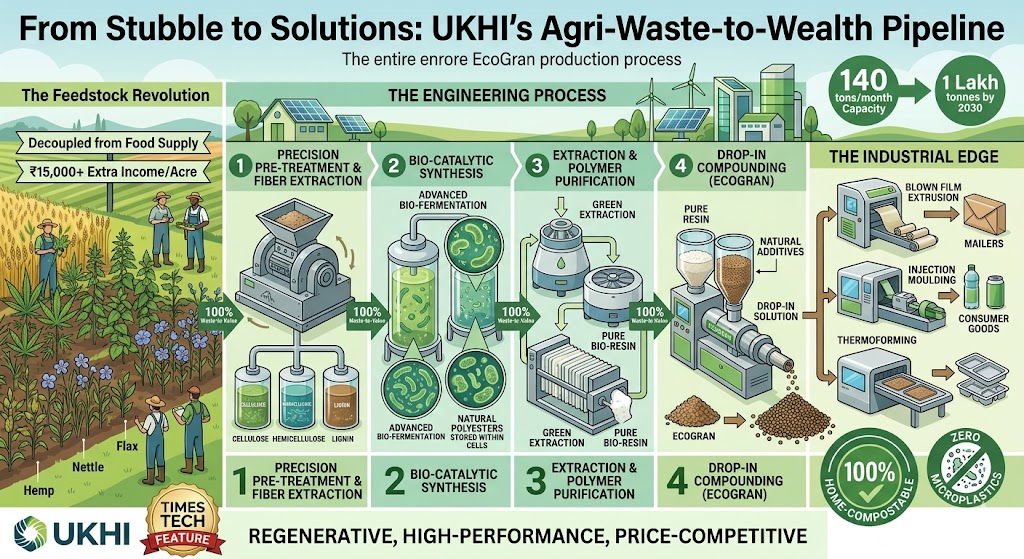
Most conventional bioplastics rely on “first-generation” feedstocks like corn starch or sugarcane. These crops compete directly with food production and demand significant arable land and water. We source non-food agricultural residues instead, specifically lignocellulosic biomass from hemp, nettle, and flax, fibre crops whose structural residues and waste extracts feed our bio-refinery process.
None of these crops needs pesticides. All sequester carbon through the cultivation cycle and place far less pressure on water resources than conventional feedstocks. Sourcing from their structural waste keeps our production entirely outside the food supply chain, and farmers who supply this material earn an additional income of over ₹15,000 per acre for what would otherwise go unused.
The Engineering Process: From Biomass to Bio-Polymer
Raw biomass becomes an industrial-grade granule through a multi-stage refinement process. While the specific biological catalysts remain proprietary, the process runs through four stages:
1. Precision Pre-treatment and Fibre Extraction
Agricultural waste is inherently variable, and the pre-treatment stage exists to manage that. We apply a specialised mechanical and chemical pre-treatment to break down the complex lignocellulosic structure of the biomass, separating cellulose, hemicellulose, and lignin into a consistent, high-purity feedstock that meets the requirements of industrial polymer synthesis.
2. Bio-Catalytic Synthesis
At this stage, instead of chemical polymerisation, we employ advanced bio-fermentation. Specialised microbes are introduced to the refined biomass extracts and, in a controlled environment, consume the carbon-rich material to produce polyhydroxyalkanoates (PHAs) within their cell walls. It works much the way the human body stores fat; these organisms accumulate energy-dense polymers within their cells, which are then extracted and refined into the polymer that underpins EcoGran.
3. Extraction and Polymer Purification
Once the microbes have produced the maximum yield of bio-polyester, we use a green extraction process to rupture the cell walls and harvest the polymer. This material is purified to remove residual biomass and microbial matter. We are left with a high-molecular-weight bio-resin that is naturally biodegradable and biocompatible.
4. Drop-in Compounding (EcoGran)
The purified bio-resin is compounded with natural additives to create EcoGran. This granule is designed to behave like conventional plastics, matching the melt flow index and tensile strength of LDPE, PP, and HDPE so that manufacturers can run it through existing equipment without modification.
The Industrial Edge: Matching Performance with Sustainability
The standard critique of biodegradable materials is that they sacrifice durability. Material testing conducted with IIT Mandi Catalyst and ICAR-Pusa, covering mechanical stress, thermal tolerance, and processing behaviour, has put EcoGran at par with conventional plastics across real manufacturing conditions.
EcoGran is currently running across multiple sectors:
• Blown Film Extrusion: For compostable packaging and e-commerce mailers.
• Injection Moulding: For consumer goods and automotive components.
• Thermoforming: For food-safe trays and medical disposables.
EcoGran is 100% home-compostable. Many biodegradable plastics on the market need industrial composting facilities to break down; ours degrades in ordinary home conditions and leaves no microplastics in the soil.
Scaling the Circular Economy in India
UKHI has established a production capacity of 140 tonnes per month, with a roadmap to reach 1 Lakh tonnes by 2030. We are getting there through a decentralised bio-refinery model tied to India’s agricultural supply chain.
Most sustainable materials struggle on at least one of three counts. Ours holds on to all of them:
• High Performance: Meeting the mechanical requirements of modern manufacturing.
• Price Competitive: Our proprietary process allows us to price EcoGran at 20–30% below imported biodegradable resins.
• Environmentally Regenerative: Every kilogram of EcoGran produced prevents emissions from stubble burning and sequesters carbon within the material itself.
Conclusion
Industry needs better materials, priced so that switching is economically straightforward. Indian agriculture already holds the raw inputs for that shift; that has been our starting point from day one. As we scale, the number that counts is not how much EcoGran we produce. It is how much of the manufacturing sector no longer needs to reach for conventional plastic to get the job done.