
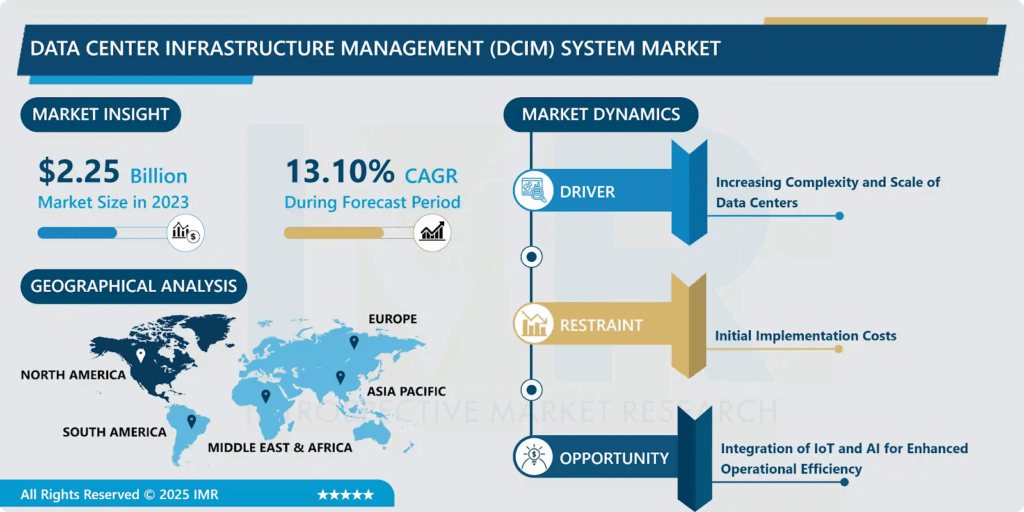
Introspective Market Research (IMR) published a comprehensive report on the Data Center Infrastructure Management System Market (DCIM). forecasting a robust growth trajectory over the next decade. According to IMR’s analysis, the global DCIM market, valued at USD 2.25 billion in 2023, is projected to reach approximately USD 6.03 billion by 2032, reflecting a compound annual growth rate (CAGR) of about 13.10% between 2024–2032. Key growth drivers include the rapid expansion of hyperscale and edge data centers, rising demand for energy-efficient operations, increasing adoption of cloud and hybrid infrastructure, and growing regulatory and ESG pressure to optimize power, cooling and asset utilization.
Quick Insights

- 2023 market valuation: USD 2.25 billion
- Projected market size (2032): ~ USD 6.03 billion
- Estimated CAGR (2024–2032): ~13.10%
- Leading region (2024): North America, due to mature data center infrastructure and early adoption of DCIM tools
- Fastest-growing region: Asia Pacific, driven by surging data-center investments, cloud migration and new facilities in India, China, Southeast Asia
- Top segment by component: DCIM solutions (software + dashboard tools) commanding the majority share, with services (managed DCIM/outsourced operations) rising fast
- Primary end-users: Hyperscale cloud providers, colocation operators, large enterprises, and edge computing infrastructure owners
What’s Accelerating the Rise of DCIM?
Why is DCIM becoming indispensable for modern data center operations?
- Explosion of data and workloads: Cloud migration, AI/ML compute workloads, IoT, 5G and edge computing are driving rapid expansion of data centers increasing complexity of power, cooling, space, and asset management.
- Hyperscale & colocation growth: Large-scale and multi-site facilities require centralized visibility and control to optimize uptime, energy costs, cooling, and capacity utilization.
- Energy efficiency and sustainability pressure: As data centers consume rising amounts of power, operators are turning to DCIM to monitor energy usage, reduce waste, and comply with ESG or regulatory mandates.
- Cloud and edge proliferation: Smaller, distributed edge facilities with limited staffing rely on DCIM-as-a-Service and remote monitoring to manage operations efficiently.
- Real-time analytics & predictive maintenance: Modern DCIM solutions embed AI/ ML-driven analytics to anticipate failures, optimize resource utilization, and minimize downtime a big draw for enterprise and hyperscale operators.
“As data centers evolve from isolated silos into distributed, hyperconnected infrastructures, DCIM is evolving from a nice-to-have tool to the core nervous system of digital infrastructure enabling visibility, efficiency and scale,” says Dr Sneha Malik, Principal Consultant, Introspective Market Research.
Regional Dynamics & Market Trends
- North America continues to lead thanks to early adoption, regulatory maturity, extensive colocation infrastructure and large-scale cloud/hyperscale campuses.
- Asia Pacific is emerging as the fastest-growing region led by expanding hyperscale data center footprints in India, China and Southeast Asia, alongside growing demand for edge compute to support IoT, 5G and enterprise digitalization.
- Europe and Middle East / Africa show steady growth, driven by data sovereignty policies, rising demand for cloud and colocation services, and increased focus on energy efficiency.
- Segment-wise trends: The shift toward remote/cloud-based DCIM solutions is accelerating; services are growing faster than traditional on-premises deployments. Modular DCIM suites and lightweight cloud-native platforms are gaining favor for edge and SME data centers.
Recent Breakthroughs & Strategic Moves
- Leading DCIM vendors are rolling out AI-driven predictive maintenance and thermal-optimization modules, helping optimize cooling and power dynamically, reducing energy costs while boosting uptime.
- Emergence of cloud-native DCIM-as-a-Service platforms allowing data center operators to subscribe to monitoring, analytics, and remote management, avoiding heavy upfront CAPEX.
- Growing integration of DCIM with IoT sensors, smart PDUs, environmental monitoring, and BMS systems, enabling real-time telemetry across power, cooling, space and airflow an increasingly critical need for hyperscale and edge campuses.
- Some major colocation providers and cloud operators are deploying digital twin-based DCIM frameworks, offering virtual replicas of data center infrastructure for planning, predictive load balancing and capacity expansion.
Challenges & Cost Pressures
- High initial CAPEX for comprehensive DCIM systems, particularly for full-featured solutions with predictive analytics, IoT integration, and real-time dashboards a barrier for smaller operators.
- Supply-chain constraints and parts shortage, especially for IoT sensors, smart PDUs, environmental monitors and power/cooling hardware.
- Skilled personnel shortage many data center operators lack trained staff to manage and interpret DCIM analytics; lack of trained staff may hinder adoption despite clear ROI.
- Integration and interoperability issues legacy infrastructure, heterogeneous hardware, and multiple vendors complicate unified DCIM deployment.
- Regulatory and compliance complexity, especially around data privacy, energy reporting, and environmental standards across regions raising cost of compliance and infrastructure upgrades.
Case Study: Hyperscale Campus Optimizes Energy & Uptime Through DCIM Deployment
A leading hyperscale cloud provider recently retrofitted its 150 MW data center campus across multiple halls with a unified DCIM platform integrating power metering, environmental sensors, cooling controls, and asset tracking. Over 12 months:
- Energy usage per rack dropped by ~18%
- Cooling-related downtime reduced by 42%
- Utilization of floor space improved by 22% (via smarter capacity planning)
- Payback period for DCIM investment achieved in under 14 months
This real-world example underscores how DCIM deployments deliver tangible operational efficiencies, cost savings, and sustainability gains validating the market’s strong growth outlook.