Hydrogen Aircraft Market Outlook: Transforming Aviation Through Clean Hydrogen Propulsion
The global aviation industry is entering a transformative era as governments, aerospace manufacturers, airlines, and technology providers intensify efforts to decarbonize air transportation. Among the most promising innovations shaping the future of aviation is hydrogen-powered flight. Hydrogen aircraft are increasingly being recognized as a viable pathway toward achieving net-zero emissions while addressing the environmental challenges associated with conventional jet fuel.
“The Global Hydrogen Aircraft Market was valued at USD 715 million in 2025and is projected to reach approximately USD 8,072 million by 2035, expanding at a robust CAGR of 27.4% between 2026 and 2035” – Acumen Research And Consulting
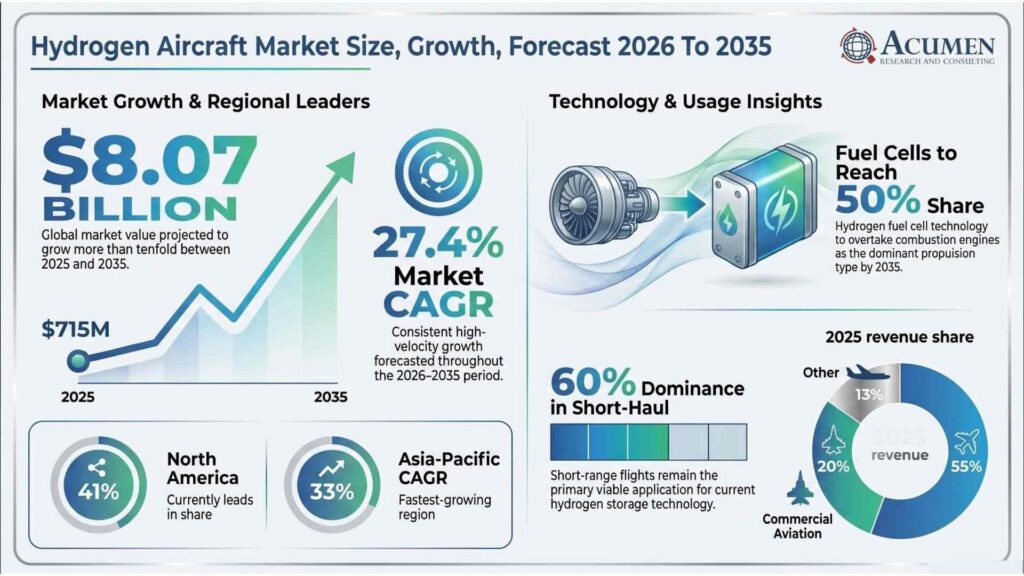
Growing investments in hydrogen infrastructure, advancements in fuel cell technologies, increasing regulatory pressure to reduce aviation emissions, and rising demand for sustainable air travel are driving market expansion worldwide.
What is the Hydrogen Aircraft Market?
The Hydrogen Aircraft Market encompasses aircraft that utilize hydrogen as a primary energy source through either hydrogen combustion engines or hydrogen fuel cell systems.
Unlike traditional aircraft powered by fossil-based aviation fuels, hydrogen aircraft offer significantly lower carbon emissions and have the potential to achieve near-zero-emission flight operations.
Hydrogen aviation technologies are currently being developed for:
- Commercial passenger aircraft
- Regional aviation
- Cargo aircraft
- Military aircraft
- Urban air mobility platforms
- Unmanned aerial vehicles (UAVs)
As sustainability becomes a strategic priority for the aviation sector, hydrogen-powered aircraft are expected to become a critical component of future air transportation systems.
Hydrogen Aircraft Market Key Statistics
The Hydrogen Aircraft Market is experiencing rapid development and investment activity.
- Hydrogen Aircraft Market size reached USD 715 million in 2025
- Hydrogen Aircraft Market Forecast to reach USD 8,072 million by 2035
- Hydrogen Aircraft Market CAGR projected at 27.4% from 2026 to 2035
- North America held 41% market share in 2025
- Asia-Pacific expected to grow at 33.0% CAGR
- Hydrogen combustion engines accounted for 45% market share
- Hydrogen fuel cell technology represented 35% market share
- Short-haul aircraft captured 60% market share
- Commercial aviation dominated with 55% market share
- Defense aviation accounted for 20% market share
These figures highlight the increasing role hydrogen technologies are expected to play in the aviation industry’s long-term sustainability strategy.
Key Growth Drivers of the Hydrogen Aircraft Market
Aviation Industry’s Net-Zero Emissions Commitments
Airlines worldwide are facing mounting pressure to reduce carbon emissions and meet ambitious sustainability targets.
Many carriers have committed to achieving net-zero emissions by 2050, driving investment in alternative propulsion technologies, including hydrogen-powered aircraft.
Hydrogen aviation offers one of the most promising long-term solutions for eliminating emissions from air travel.
Government Support for Green Aviation
Governments across North America, Europe, and Asia-Pacific are introducing incentives, funding programs, and research initiatives to accelerate hydrogen aviation development.
Public-private partnerships are helping support:
- Hydrogen production facilities
- Airport refueling infrastructure
- Aerospace R&D programs
- Fuel cell innovation
- Aircraft certification efforts
These initiatives are reducing commercialization barriers and supporting industry growth.
Advances in Hydrogen Storage Technology
One of the biggest challenges facing hydrogen-powered aviation has been onboard storage.
Recent developments in:
- Cryogenic storage systems
- Liquid hydrogen technologies
- Lightweight composite tanks
- Thermal insulation systems
are making hydrogen aircraft increasingly viable for commercial operations.
Growing Demand for Sustainable Aviation Solutions
Passengers, regulators, and investors are increasingly demanding cleaner transportation alternatives.
As environmental awareness grows, airlines are investing in next-generation aircraft capable of significantly reducing carbon footprints while maintaining operational efficiency.
Hydrogen Aircraft Market Segmentation Analysis
By Propulsion Technology
Hydrogen Combustion Engines Lead the Market
Hydrogen combustion engines accounted for the largest market share of 45% in 2025.
The segment benefits from:
- Compatibility with existing aircraft engine designs
- Easier integration into current aviation infrastructure
- Lower transition costs
- Faster commercialization potential
Aircraft manufacturers continue exploring modified turbine engines capable of operating on hydrogen fuel.
Hydrogen Fuel Cell Technology Gains Momentum
Hydrogen fuel cells are expected to emerge as the dominant long-term technology.
The segment’s market share is projected to increase from 35% in 2025 to 50% by 2035.
Key growth drivers include:
- Higher energy efficiency
- Zero direct carbon emissions
- Reduced noise levels
- Improved sustainability performance
Fuel cell systems are particularly attractive for regional and short-haul aircraft applications.
By Range
Short-Haul Aircraft Dominate Current Deployments
Short-haul hydrogen aircraft captured 60% market share in 2025 and are projected to reach USD 3,632.51 million by 2035.
Growth is driven by:
- Lower energy requirements
- Existing hydrogen technology readiness
- Regional aviation demand
- Easier infrastructure deployment
Many early hydrogen aviation projects are focused on regional and short-distance routes.
Long-Haul Aircraft Expected to Witness Fastest Growth
The long-haul segment is expected to register the highest CAGR of 33.2% during the forecast period.
Market value is anticipated to increase from USD 91.58 million in 2026 to USD 1,210.84 million by 2035.
Growth is supported by:
- Advances in liquid hydrogen storage
- Aircraft design innovations
- Lightweight materials development
- Improved propulsion efficiency
Long-haul hydrogen aviation remains a significant long-term opportunity for the aerospace industry.
By End Use
Commercial Aviation Leads Market Demand
Commercial aviation accounted for 55% market share in 2025, making it the largest end-use segment.
Factors driving growth include:
- Airline decarbonization initiatives
- Rising sustainability commitments
- Regulatory pressure
- Growing passenger demand for eco-friendly travel
Major airlines are actively participating in hydrogen aviation pilot programs and technology partnerships.
Defense Sector Represents Significant Opportunity
The defense segment captured 20% market share in 2025.
Military organizations are increasingly investing in hydrogen-powered aviation technologies due to:
- Reduced logistical dependence on fossil fuels
- Enhanced operational efficiency
- Lower emissions
- Strategic energy security objectives
Hydrogen-powered drones and tactical aircraft are emerging as key areas of development.
Hydrogen Aircraft Market Regional Analysis
North America Dominates the Global Hydrogen Aircraft Market
North America held the largest market share of 41% in 2025.
The regional market is projected to reach USD 2,744.56 million by 2035, growing at a CAGR of 24.7%.
Major growth drivers include:
- Strong aerospace manufacturing ecosystem
- Early investments in hydrogen aviation
- Advanced research capabilities
- Government-backed clean aviation programs
- Presence of leading aerospace companies
The United States continues to lead global hydrogen aircraft innovation through significant public and private sector investments.
Asia-Pacific Emerges as the Fastest-Growing Hydrogen Aircraft Market
Asia-Pacific is expected to achieve the highest CAGR of 33.0% from 2026 to 2035.
The region’s market share is projected to rise from 20.0% in 2025 to 29.5% by 2035.
Growth is fueled by:
- Expanding air passenger traffic
- Government support for hydrogen initiatives
- Growing aerospace investments
- Rapid economic development
- Increasing focus on sustainable transportation
Countries such as China, Japan, South Korea, Singapore, and India are actively investing in hydrogen aviation infrastructure and research programs.
Hydrogen Aircraft Market Competitive Landscape
The Hydrogen Aircraft Market remains highly competitive, with aerospace manufacturers, hydrogen technology developers, and aviation startups accelerating innovation.
Key companies operating in the Hydrogen Aircraft Market include:
- Airbus
- Boeing
- ZeroAvia
- Universal Hydrogen
- H2FLY
- GKN Aerospace
- Rolls-Royce
- Safran
- Honeywell Aerospace
These organizations are investing heavily in hydrogen propulsion systems, fuel cells, aircraft integration technologies, and hydrogen storage innovations.
Recent Developments and Investments in Hydrogen Aviation
Major Aerospace Companies Increase Hydrogen Investments
Leading aerospace manufacturers continue to expand hydrogen-focused research and development programs aimed at commercializing zero-emission aircraft.
Airport Hydrogen Infrastructure Projects Accelerate
Several international airports are investing in hydrogen production, storage, and refueling facilities to prepare for future hydrogen-powered aircraft operations.
Growth of Public-Private Partnerships
Governments and aerospace companies are collaborating on demonstration projects, certification programs, and hydrogen aviation ecosystem development.
Hydrogen Fuel Cell Advancements
Recent improvements in fuel cell efficiency, durability, and power density are accelerating adoption across regional and commercial aviation segments.
Emerging Opportunities in the Hydrogen Aircraft Market
Several factors are expected to create substantial long-term opportunities:
Regional Air Mobility
Hydrogen-powered regional aircraft could revolutionize short-distance air travel by offering sustainable and cost-effective transportation.
Green Airport Infrastructure
Airports investing in hydrogen production and storage facilities are expected to become critical enablers of hydrogen aviation.
Military Aviation Applications
Defense organizations are exploring hydrogen propulsion for unmanned systems, reconnaissance aircraft, and future tactical aviation platforms.
Sustainable Aviation Ecosystems
Integration of renewable hydrogen production, hydrogen logistics, and aircraft technologies will create new value chains across the aviation industry.
Frequently Asked Questions (FAQs)
What is the current size of the Hydrogen Aircraft Market?
The global Hydrogen Aircraft Market was valued at USD 715 million in 2025 and is projected to reach USD 8,072 million by 2035.
What is the CAGR of the Hydrogen Aircraft Market?
The market is expected to grow at a CAGR of 27.4% from 2026 to 2035.
Which region dominates the Hydrogen Aircraft Market?
North America held the largest market share of 41% in 2025 due to strong aerospace manufacturing capabilities and early hydrogen aviation investments.
Which region is expected to grow the fastest?
Asia-Pacific is projected to register the highest CAGR of 33.0% during the forecast period.
Which propulsion technology holds the largest market share?
Hydrogen combustion engines dominated the market with 45% share in 2025.
Why are hydrogen fuel cells gaining popularity?
Hydrogen fuel cells offer higher efficiency, lower noise, and zero direct carbon emissions, making them attractive for sustainable aviation.
Which aircraft category dominates the market?
Short-haul aircraft accounted for 60% market share in 2025 due to the current technological viability of hydrogen propulsion for regional operations.
What is driving demand for hydrogen aircraft?
Key growth drivers include net-zero emission goals, government support, advancements in hydrogen storage technologies, and growing demand for sustainable aviation solutions.
Access Full Market Report
For comprehensive forecasts, company profiles, investment analysis, and competitive intelligence, visit:
The global Hydrogen Aircraft Market is poised for substantial growth as the aviation industry accelerates its transition toward sustainable flight technologies. With the market expected to expand from USD 715 million in 2025 to more than USD 8.07 billion by 2035, hydrogen-powered aircraft are emerging as a cornerstone of future zero-emission aviation.
Advancements in hydrogen fuel cells, liquid hydrogen storage systems, and aircraft design innovations will continue driving commercialization efforts. As governments, airlines, aerospace manufacturers, and investors intensify their commitment to sustainable aviation, hydrogen aircraft are expected to play a transformative role in reshaping the future of global air transportation.