
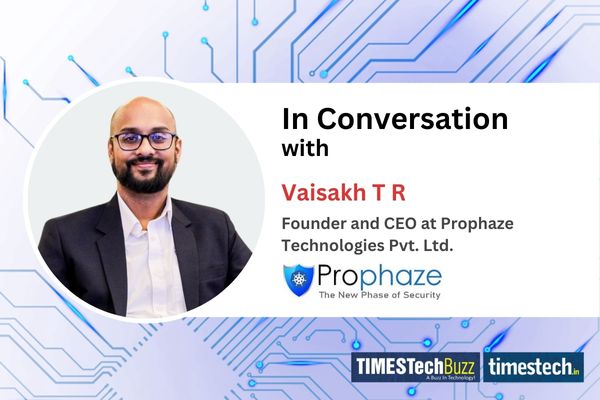
In an interview, Vaisakh T R, Founder and CEO of Prophaze Technologies Pvt. Ltd., spoke with TimesTech on how cybersecurity has become the digital equivalent of defence insurance. He highlighted the growing need for AI-driven, indigenous solutions to safeguard India’s critical infrastructure. Emphasizing resilience, sovereignty, and national security, Vaisakh explained why integrating cyber defence with traditional strategies is no longer optional but central to India’s security doctrine.
Read the full interview here:
TimesTech: General Naravane compared defence spending to insurance. In the digital era, how do you see cybersecurity investments serving as insurance against modern warfare for both government and critical industries?
Vaisakh: We see cybersecurity as the digital equivalent of defence insurance. Just as missiles and tanks protect against physical invasions, AI-driven platforms like Prophaze’s WAAP safeguard command-and-control systems, SCADA networks, airports, and financial infrastructure. Twice recognized by Gartner and KuppingerCole, Prophaze represents India’s sovereign capability in advanced threat defence, ensuring continuity, operational resilience, and national security.
TimesTech: India faces threats on both physical borders and in cyberspace. How do you see the integration of cyber defence with traditional defence strategies evolving in India’s security doctrine?
Vaisakh: Modern warfare is no longer limited to physical borders. Cyber attacks can disrupt civilian services, defence operations, and national infrastructure simultaneously. We believe that integrating AI-driven cyber defence with traditional military strategies is not optional — it’s essential. Real-time monitoring, predictive threat intelligence, and resilient infrastructure must go hand-in-hand with troop deployments and border security to ensure comprehensive protection.
TimesTech: Prophaze is tackling cloud and application security threats, including DDoS strikes on critical infrastructure. How serious is the challenge for India, and what innovations are being deployed to counter them?
Vaisakh: The challenge is growing. Critical infrastructure — from airports to banks and healthcare systems — is being probed and targeted daily. At Prophaze, we have built AI-powered solutions that automatically detect and mitigate attacks, whether they involve bot-driven threats, API exploitation, or zero-day vulnerabilities. This demonstrates India’s ability to defend itself digitally, in real time, using homegrown technology.
TimesTech: Prophaze emphasizes AI/ML in its defence-tech offerings. How is AI changing the game for real-time threat detection and mitigation, and why is building indigenous AI solutions critical for India?
Vaisakh: AI is a game-changer because it allows threats to be identified and neutralized faster than any human team could manage. But beyond speed, building indigenous AI is about sovereignty. We cannot depend on foreign black-box tools when critical national infrastructure is at stake. Developing AI in India ensures that we control both the defence systems and the sensitive data they protect.
TimesTech: Prophaze has countered major DDoS strikes on airports and financial institutions. How have India’s threat perceptions shifted from 2008 to the present, and what lessons can we draw?
Vaisakh: Cyber threats in 2008 were largely seen as IT risks. Today, they are recognized as strategic national security challenges. Attacks on airports and banks have taught us that proactive threat intelligence, AI-driven monitoring, and indigenous security platforms are essential. The key lesson: cybersecurity must be treated as a core component of national defence, not just a support function.
TimesTech: With homegrown companies now creating Kubernetes-native WAFs and advanced cybersecurity solutions, do you see India becoming a global exporter of sovereign defence-tech, much like it aspires to be in traditional defence manufacturing?
Vaisakh: Absolutely, India has immense potential. Homegrown, AI-powered WAAP platforms and advanced bot mitigation solutions are proof that we can secure our own critical infrastructure and offer solutions globally. Sovereign defence-tech is not just about pride — it’s about trust. With continued innovation, India can become a respected exporter of truly indigenous cyber defence solutions.