


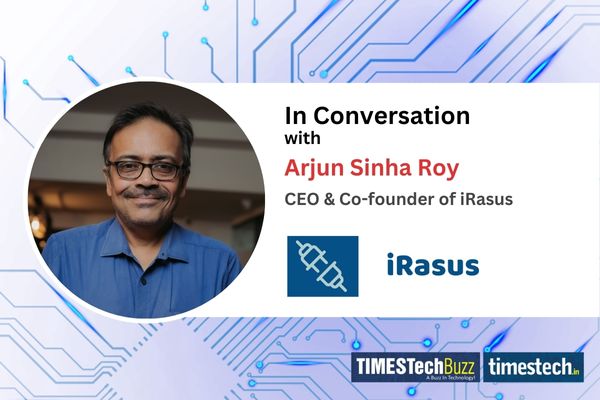
In an interview with TimesTech, Arjun Sinha Roy, CEO & Co-founder of iRasus, shares how their Preksha Platform is redefining EV battery safety through AI-driven real-time analytics and predictive intelligence. By detecting anomalies before they escalate, iRasus is enabling OEMs and fleet operators to prevent failures, extend battery life, and position India as a global leader in battery intelligence and software-led energy innovation.
Read the full interview here:
TimesTech: Battery safety has become a growing concern, especially with increasing EV adoption. How does iRasus’ Preksha Platform contribute to reducing fire risks and enhancing safety in EV batteries through real-time analytics and predictive intelligence?
Arjun: One of the main issues facing the EV ecosystem today is battery safety. Preksha, our platform, is made to take a proactive stance in order to deal with this directly. Preksha uses AI models to continually ingest real-time data from the Battery Management System (BMS) in order to identify temperature anomalies, abrupt voltage drops and aberrant cell activity before they become safety risks.
For instance, we monitor over 50+ parameters in real-time—ranging from temperature gradients to charge/discharge cycles—and assign a risk index to every battery pack. By acting on early warning signs such as possible thermal runaway indicators this predictive safety layer helps OEMs and fleet operators prevent fire-related incidents. Thousands of battery packs running in hot and load-stressed conditions have already benefited from our platform’s assistance in reducing risk.
TimesTech: You’ve mentioned that the true innovation lies not just in cell manufacturing but in AI-layered BMS. Could you elaborate on how software is becoming the new differentiator in the battery ecosystem, and what this means for India’s positioning in the global EV market?
Arjun: The future of EV battery performance, endurance and safety is being rewritten by software even though hardware innovation is still crucial. Reactive management is replaced by predictive and prescriptive capabilities in an AI-layered BMS. It adjusts to use-cases, learns from millions of data points and continuously improves discharge profiles, thermal control and charging behavior.
This software-first strategy is revolutionary for India, where usage habits, charging infrastructure, and ambient temps vary greatly. By increasing the effectiveness and dependability of current chemistries, it lessens reliance on imported cells. Additionally, it positions India as a battery intelligence hub in addition to being an EV assembler, selling SaaS-led solutions to developing markets in Africa, LATAM and Southeast Asia.
TimesTech: With over one crore kilometers of on-road EV battery data, what key insights has iRasus uncovered, and how have these insights improved your battery intelligence models?
Arjun: Three main conclusions have been drawn from the analysis of more than one crore kilometers of on-road battery data:
- The most significant predictor of early degradation, particularly in tropical regions, is temperature stress.
- In commercial fleets aggressive driving habits and deep discharges reduce battery life by 20–25%.
- Cell chemistry is greatly impacted by charging behavior especially repeated fast-charging without cooldown intervals.
Our machine learning models have been directly influenced by these insights, which have improved our estimates of the State of Health (SoH) and Remaining Useful Life (RUL). As a result Preksha’s diagnosis accuracy has improved by over 35% during the past 12 months.
TimesTech: Can you walk us through a real-world case study where your platform successfully prevented battery failure or a thermal event in a commercial EV fleet? What were the early warning signs, and how did your system intervene?
Arjun: In early 2025, two battery packs in one of our fleet clients’ intercity electric trucks in Rajasthan started to show strange temperature spikes even though the weather was regular. Preksha’s analytics showed that one module was heating up more than the others during normal charge-discharge cycles, which is a clear symptom of a thermal mismatch.
It was discovered that the cooling system wasn’t working well. This problem was fixed right away, and after that, the strange heating disappeared completely. By finding the problem early, we not only stopped a possible thermal runaway, but we also saved batteries worth more than ₹10 lakhs from being lost.
TimesTech: What is the concept of a ‘Battery Cloud,’ and how does iRasus envision building India’s first interoperable battery intelligence database? What role do you see it playing in shaping the country’s energy and EV infrastructure?
Arjun: The Battery Cloud is our vision of a shared, AI-native database that brings together battery health, usage, lifecycle, and recycling-readiness data across brands and chemistries. Much like a credit score for batteries, it assigns a real-time “Battery Intelligence Score” (BIS) to every asset.
We’re working with OEMs, fleet operators, and component manufacturers to create India’s first interoperable battery intelligence layer—one that can plug into vehicle telematics, charging stations, and energy grids. This will drive smarter financing, safer second-life deployment, and data-driven policy interventions. The expansion of energy storage and battery second-life makes this infrastructure essential to a sustainable and circular EV economy.
TimesTech: Looking ahead, what are the biggest technological or regulatory challenges to scaling battery intelligence in India, and how is iRasus working to address them?
Arjun: The two most significant obstacles are:
- Standardization of data between OEMs and BMS platforms Scalability is challenging in the absence of a standard telemetry and diagnostics format.
- Regulatory lag: Long-term deployments are uncertain due to the ongoing evolution of battery safety, second-life usage, and recycling standards.
At iRasus, we are actively involved in industry consortia’s standardization efforts and are developing BMS-agnostic APIs. Additionally, we’re working with government agencies and think tanks to provide real-world battery intelligence data to emerging policy frameworks. Our objective is to make sure that India not only embraces EVs but also sets the standard for utilizing battery data for innovation, efficiency and safety.