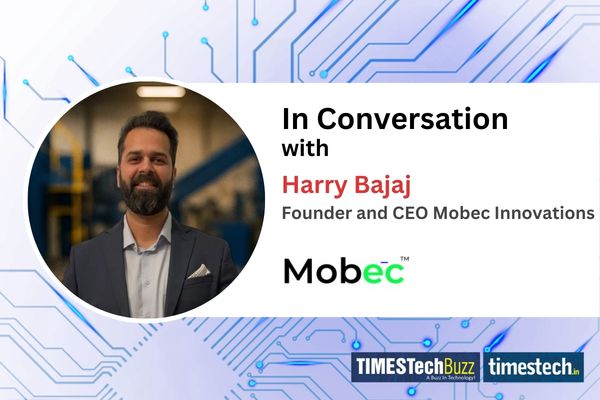
In an interview, Harry Bajaj, Founder and CEO Mobec Innovations speaks with TimesTech on why India’s EV growth demands more than fixed charging stations. He outlines Mobec Innovation’s mobile-first strategy, integrated battery lifecycle approach, and focus on recycling, refurbishment, and energy storage as alternatives to diesel backup. Bajaj explains how asset-light deployment, circular economy practices, and policy support can make EV infrastructure scalable, resilient, and less dependent on imported critical minerals.
Read the full interview here:
TimesTech: Mobec is positioned as India’s first full-range provider of mobile EV charging and battery lifecycle solutions. What key infrastructure gaps did you identify in India’s EV ecosystem that led to this integrated, mobile-first approach?
Harry: EV adoption in India is growing much faster than public charging infrastructure, with nearly 7.67 million EVs and only about 30,000 public chargers, a gap that’s even wider beyond metro cities. Fixed charging stations require high capex of ₹25–40 lakh per site, long deployment timelines, and are often constrained by grid limitations and unreliable power supply. For fleets, this results in range anxiety and operational downtime due to the lack of on-demand charging.
We also saw that thebattery lifecycle is largely ignored, even though batteries account for 40–50% of an EV’s cost, along with India’s heavy dependence on imported critical minerals like lithium and cobalt. Although new policies under PM E-DRIVE and updated Ministry of Power guidelines have boosted charging infra, the rapid surge in EV adoption demands more than just fixed chargers; it needs intelligent grid integration and widespread battery swapping.
That’s why a mobile and integrated model made sense. Charging needs to go to the vehicle, not the other way around. Mobile charging enables faster, asset-light deployment without land or heavy infrastructure, complements fixed charging especially for fleets and remote areas and integrating battery refurbishment and recycling ensures long-term sustainability and cost efficiency.
TimesTech: Mobile EV charging challenges the traditional static charging model. How do Mobec’s mobile and decentralized energy solutions change the economics, accessibility, and scalability of EV charging in India?
Harry: Mobile charging changes the EV charging equation in India in a very practical way. Traditional DC fast-charging stations need a heavy upfront investment running into several tens of lakhs, along with land, civil work, and power upgrades. A mobile, service-based model brings those costs down, avoids heavy infrastructure, and improves efficiency for operators. For fleets, even losing an hour per vehicle every day can hurt business, so better uptime makes a real economic difference. Mobile energy solutions also work as a clean alternative to diesel generators for backup and emergency needs.
From an access point of view, mobile charging brings power to the vehicle instead of tying charging to fixed locations. This makes EV charging possible in Tier 2 and Tier 3 cities, on highways, at depots, and in remote areas. It supports fleets, logistics, real estate, and service-on-wheels models, and on-demand charging helps ease range anxiety across different vehicle categories.
What really helps with scale is speed and flexibility. Mobile chargers can be deployed much faster than static stations, moved as demand shifts, and scaled gradually without locking in large infrastructure costs. They are designed to work alongside fixed charging networks, not replace them. When combined with energy storage, battery refurbishment, and recycling, this model also supports long-term sustainability and flexible growth across fleets, highways, and emerging EV markets.
TimesTech: Battery recycling and second-life applications are central to Mobec’s circular economy vision. How critical will battery refurbishment and material recovery be in reducing India’s dependence on imported raw materials?
Harry: Battery recycling and second-life applications are not optional for India- they are essential. Today, we are heavily dependent on imports for critical rare earth minerals, like lithium, cobalt, and nickel, which creates long-term supply and cost risks for the EV ecosystem.
Through recycling, we can recover these materials domestically, reduce import exposure, and build resilience against global price volatility and geopolitical uncertainty. Refurbishment and second-life applications extend battery life, reduce fresh raw material extraction, and significantly improve resource efficiency by maximising value from existing batteries.
This approach keeps materials within the domestic ecosystem, supports a true circular economy, and lowers the environmental impact associated with mining and long-distance imports. Over time, it also enables greater cost stability for battery and EV manufacturers. Most importantly, it aligns closely with India’s Atmanirbhar Bharat goals and the country’s net-zero commitments.
TimesTech: With products like MOBEC EV11 and NewGen 10, Mobec is expanding beyond charging into energy resilience. How do you see energy storage systems evolving as a cleaner alternative to diesel generators across urban and off-grid use cases?
Harry: Energy storage systems are increasingly emerging as a clean, silent alternative to diesel generators in India, especially in a backup power market valued at around estimated USD 2.0 billion, which is expected to grow steadily over the next few years. Unlike diesel gensets, ESS eliminate fuel dependency, emissions, and high maintenance costs, making them far more suitable for modern urban and off-grid needs.
Portable systems like NewGen 10 make reliable backup power possible across both cities and remote locations. They are well-suited for homes, offices, events, construction sites, and emergency use, and their plug-and-play, quick-deployment design makes them significantly easier to deploy than conventional diesel generators. When paired with charging solutions such as MOBEC EV11, these systems strengthen overall energy resilience by ensuring power availability even in constrained environments.
Looking ahead, energy storage will play a critical role in reducing diesel usage and supporting India’s net-zero goals. With enabling government measures like transmission charge waivers, viability gap funding, and the ongoing expansion of urban electrification, solutions like NewGen 10 are well-positioned to gain traction as a cleaner, scalable alternative to diesel generators.
TimesTech: Mobec recently received the ‘Excellence in Battery Manufacturing and Recycling’ award. What technological or process innovations set Mobec apart in battery recycling and black mass extraction?
Harry: What sets Mobec apart is our complete battery lifecycle approach. Every battery that comes to us is first evaluated for reuse, and only those that can no longer be used are moved into recycling. This ensures that we extract maximum value before breaking a battery down.
We follow safe and controlled dismantling processes, after which advanced black mass extraction methods are used to recover critical materials that would otherwise go to waste. These include lithium, cobalt, nickel, copper, aluminium, and graphite. The recovered materials are then further processed into usable minerals for new battery manufacturing.
Batteries that are still viable are refurbished and reused for home, commercial, and energy storage applications. This integrated approach helps reduce waste, lowers dependence on imported raw materials, and supports overall sustainability. Continuous research and process improvement allow us to steadily improve recovery rates and operational efficiency over time.
TimesTech: Having built businesses across EV infrastructure, marketing, and CSR initiatives, what is your long-term vision for sustainable mobility in India, and what policy or ecosystem support is most critical to accelerate this transition?
Harry: My long-term vision for sustainable mobility in India goes beyond just increasing EV adoption. It’s about building an integrated mobility ecosystem where charging, energy storage, and the battery lifecycle work together in a circular model. Clean mobility must be accessible, reliable, and affordable, not just in metro cities but across the country. As early EVs begin to retire, responsible battery end-of-life management becomes critical, and all of this needs to align with India’s net-zero and decarbonisation goals. Technology alone won’t drive this shift; it requires awareness and responsible participation across the industry.
To accelerate this transition, policy and ecosystem support are crucial. We need forward-looking incentives for battery recycling, refurbishment, and material recovery, along with extending production-linked incentives to critical minerals such as lithium, cobalt, nickel, and rare earths. There must also be clear policy recognition for battery energy storage systems, and mobile, flexible charging solutions should be encouraged as a core part of EV infrastructure. Finally, stronger circular economy frameworks and effective EPR implementation will be key to building a sustainable and resilient mobility ecosystem in India.