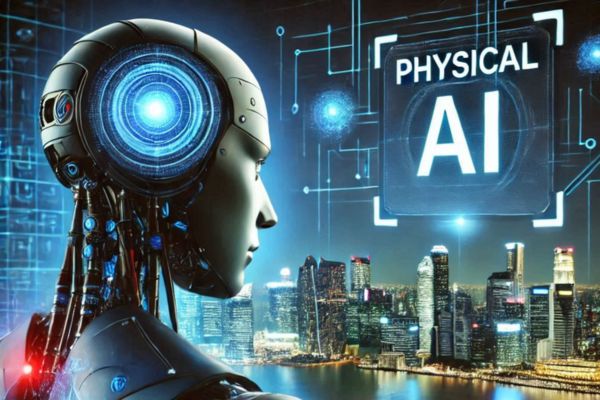
The Physical AI Market is emerging as one of the most transformative segments within the broader artificial intelligence ecosystem. Physical AI represents the convergence of robotics, machine learning, computer vision, and sensor technologies that enable machines to perceive, understand, and interact with the physical world.
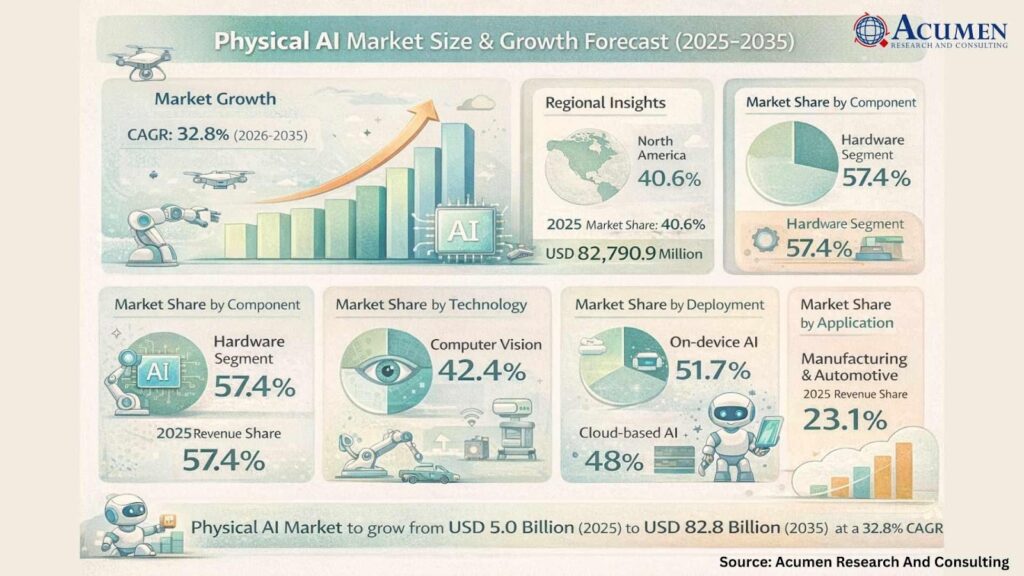
According to recent market analysis, the Global Physical AI Marketsize accounted for USD 5,021.2 million in 2025 and is projected to reach USD 82,790.9 million by 2035, expanding at a compound annual growth rate (CAGR) of 32.8% from 2026 to 2035.
The remarkable expansion of the Physical AI Market highlights the growing importance of intelligent machines capable of interacting with real-world environments and supporting next-generation automation across industries.
As industries increasingly integrate intelligent machines into real-world operations, the demand for advanced AI-driven robotics and automation solutions is growing rapidly. From manufacturing and logistics to healthcare and autonomous systems, physical AI technologies are enabling machines to perform complex tasks with greater precision, adaptability, and autonomy.
Physical AI and Its Growing Importance
Physical AI refers to artificial intelligence systems embedded within machines that operate in the physical world. Unlike traditional software-based AI systems that primarily process digital information, physical AI combines computational intelligence with hardware systems such as sensors, robotics, and actuators.
These systems enable machines to:
- Perceive real-world environments
- Process sensory data in real time
- Make intelligent decisions
- Perform physical tasks autonomously
As industries seek greater efficiency, safety, and operational productivity, the integration of physical AI technologies is becoming increasingly essential.
The rise of advanced robotics, intelligent manufacturing systems, and autonomous vehicles is further accelerating Physical AI Market Growth.
Key Physical AI Market Statistics
The latest Physical AI Market Report highlights several important indicators demonstrating the strong expansion of this emerging technology sector.
- Global Market Size (2025): USD 5,021.2 Million
- Projected Market Size (2035): USD 82,790.9 Million
- Forecast CAGR (2026–2035): 32.8%
These figures underscore the extraordinary growth potential of the Physical AI Market, driven by technological innovation and expanding industrial applications.
North America Leads the Global Physical AI Market
Regionally, North America accounted for approximately 40.6% of the global Physical AI Market share in 2025, making it the largest regional market.
The region’s leadership is supported by several key factors, including strong investments in artificial intelligence research, advanced robotics development, and widespread adoption of automation technologies.
Major technology companies, robotics developers, and AI startups across the United States and Canada are actively developing intelligent machines capable of performing complex tasks in real-world environments.
Additionally, North America benefits from strong collaboration between technology companies, research institutions, and government agencies working to accelerate innovation in robotics and artificial intelligence.
These factors are expected to sustain North America’s dominance in the Physical AI Market Share during the forecast period.
Asia-Pacific Emerging as the Fastest-Growing Regional Market
While North America currently leads the market, the Asia-Pacific region is rapidly emerging as a major growth hub for physical AI technologies.
In 2025, Asia-Pacific accounted for approximately 30.6% of the global market share and is projected to expand at a CAGR of 34.6% from 2026 to 2035.
The region’s rapid growth is driven by increasing adoption of industrial automation, robotics manufacturing, and artificial intelligence technologies across countries such as China, Japan, South Korea, and India.
Asia-Pacific also hosts several major robotics manufacturers and technology innovators, which are investing heavily in AI-powered automation solutions.
Government initiatives promoting smart manufacturing, Industry 4.0 technologies, and robotics innovation are further strengthening the region’s position in the Physical AI Market Analysis.
Hardware Segment Dominates the Physical AI Market
By component, the hardware segment accounted for approximately 57.4% of the total Physical AI Market share in 2025, making it the dominant segment.
Hardware components play a critical role in enabling physical AI systems to interact with the real world. These components include:
- Sensors and cameras
- Robotic arms and actuators
- AI processors and edge computing devices
- Mechatronic systems
These technologies allow machines to perceive environmental data, process information, and perform precise physical actions.
The continued development of advanced sensor technologies and AI chips is expected to further accelerate Physical AI Market Growth in the coming years.
On-Device AI Deployment Leads the Market
Deployment models play a crucial role in determining how physical AI systems process data and execute decisions.
According to the report, on-device AI accounted for approximately 51.7% of the total market share, while cloud-based AI accounted for around 48%.
On-device AI processing offers several advantages, including:
- Low latency response times
- Real-time decision making
- Improved operational reliability
- Enhanced data privacy and security
These capabilities are particularly important for applications such as robotics, autonomous vehicles, and industrial automation systems where immediate responses are critical.
Computer Vision Dominates the Technology Segment
Technology-wise, computer vision held the largest share of the Physical AI Market, accounting for approximately 42.4% of the market.
Computer vision enables machines to analyze visual information captured through cameras and sensors. This technology allows robots and intelligent systems to identify objects, detect patterns, and navigate complex environments.
Applications of computer vision in physical AI include:
- Autonomous robot navigation
- Quality inspection in manufacturing
- Medical imaging and diagnostics
- Surveillance and security systems
The reinforcement learning and control systems segment accounted for approximately 15.3% of the market, supporting machines in learning optimal actions through interaction with their environment.
Together, these technologies are enabling machines to develop adaptive intelligence and perform increasingly complex tasks.
Industrial Robots Lead the Robot Type Segment
When analyzed by robot type, industrial robots generated the largest revenue share of approximately 38.6% in 2025.
Industrial robots are widely used in automated manufacturing environments to perform tasks such as assembly, welding, packaging, and material handling.
These robots offer several advantages:
- High precision and repeatability
- Improved production efficiency
- Reduced operational costs
- Enhanced workplace safety
As global manufacturing industries continue to adopt automation technologies, the demand for industrial robots integrated with AI capabilities is expected to grow significantly.
This trend will continue to strengthen the Physical AI Market Size in the years ahead.
Manufacturing and Automotive Sector Leads Market Applications
Based on application, the manufacturing and automotive segment accounted for approximately 23.1% of the total Physical AI Market revenue in 2025.
These industries are rapidly adopting AI-powered robotics to improve productivity, reduce operational costs, and enhance manufacturing precision.
Physical AI technologies are enabling automated production systems capable of performing tasks such as:
- Intelligent assembly operations
- Real-time quality inspection
- Predictive maintenance
- Autonomous logistics and material handling
As Industry 4.0 initiatives expand globally, the integration of AI-driven robotics within manufacturing environments is expected to increase significantly.
Key Drivers Accelerating Physical AI Market Growth
Several major factors are contributing to the rapid expansion of the Physical AI Market.
Rapid Adoption of Industrial Automation
Manufacturing industries worldwide are increasingly deploying robotics and AI-powered systems to improve efficiency and productivity.
Physical AI technologies enable machines to perform complex operations with minimal human intervention, significantly reducing operational costs.
Advancements in Robotics and Sensor Technologies
The development of advanced sensors, AI chips, and robotics platforms is enabling machines to interact more effectively with their surroundings.
These technological advancements are improving machine perception, navigation, and decision-making capabilities.
Rising Demand for Intelligent Machines
Organizations across industries are adopting intelligent machines capable of operating autonomously in dynamic environments.
From autonomous warehouse robots to AI-powered surgical systems, physical AI is expanding into numerous real-world applications.
Emerging Trends in the Physical AI Market
Several emerging trends are shaping the future of the Physical AI Market.
Integration of AI with Robotics
Robotics systems are increasingly integrating artificial intelligence algorithms to enable adaptive learning and intelligent decision-making.
This integration is transforming traditional automation systems into highly autonomous intelligent machines.
Development of Collaborative Robots
Collaborative robots, or cobots, are designed to work alongside human workers in industrial environments.
These robots enhance productivity while maintaining safe interactions between humans and machines.
Expansion of Autonomous Systems
Autonomous vehicles, drones, and mobile robots are becoming increasingly sophisticated as AI technologies advance.
Physical AI is playing a critical role in enabling these systems to operate safely in complex environments.
Future Outlook of the Physical AI Market
The future of the Physical AI Market appears extremely promising as industries continue to adopt intelligent automation technologies.
The projected expansion from USD 5.0 billion in 2025 to more than USD 82.7 billion by 2035 highlights the enormous potential of physical AI systems.
Advancements in robotics, computer vision, reinforcement learning, and sensor technologies will continue to expand the capabilities of intelligent machines.
As industries increasingly integrate AI-powered robotics into real-world operations, the Physical AI Market Growth is expected to accelerate significantly over the next decade.
The Physical AI Market is rapidly transforming the global technology landscape by enabling machines to interact intelligently with the physical world.
With strong growth across robotics, manufacturing, healthcare, and automation industries, physical AI technologies are becoming a critical component of next-generation intelligent systems.
Supported by continuous technological innovation and rising adoption of automation solutions, the Physical AI Market Size is expected to expand dramatically over the coming years.
As organizations continue to invest in advanced robotics and AI-powered systems, physical AI will play a central role in shaping the future of intelligent automation worldwide.