

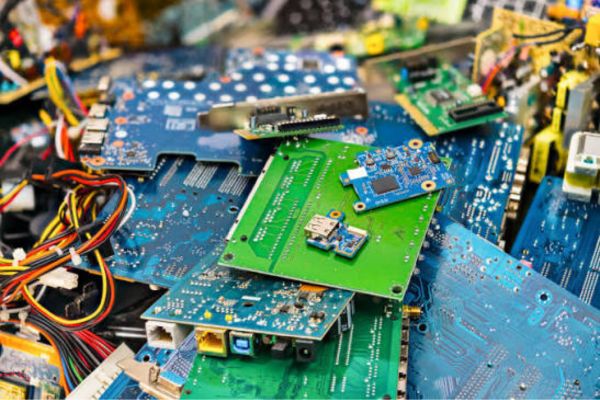
The global Printed Circuit Board (PCB) market is entering a new phase of growth as electronics become increasingly sophisticated across consumer devices, automobiles, telecommunications, industrial systems, aerospace, defense, artificial intelligence (AI), and data centers. PCBs serve as the fundamental interconnection platform for electronic components, making them indispensable to virtually every modern electronic system.
According to Cervicorn Consulting, the global printed circuit board market was valued at USD 94.21 billion in 2025 and is projected to reach approximately USD 154.89 billion by 2035, expanding at a CAGR of 5.1% from 2026 to 2035.
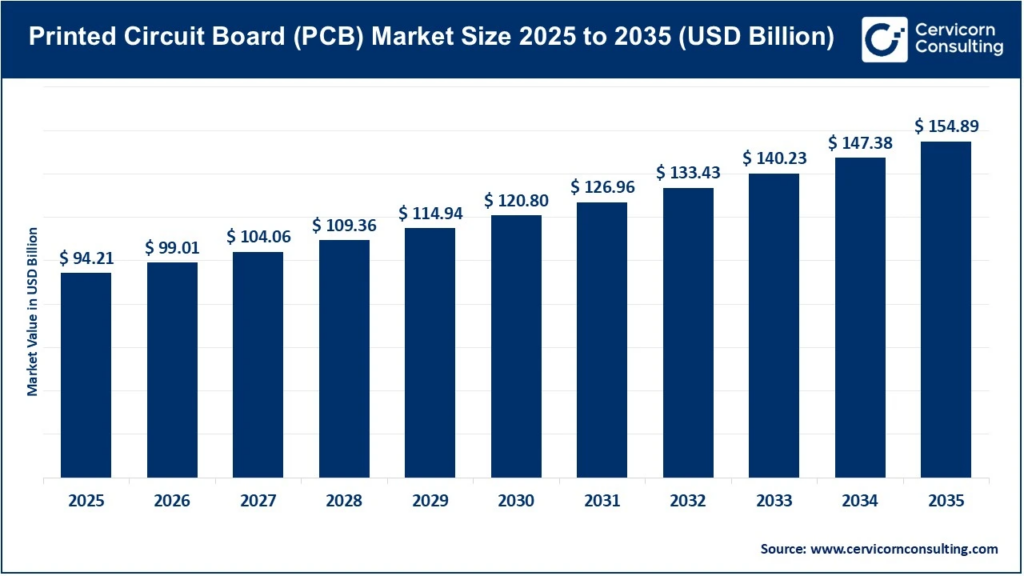
The market is being supported by rising electronics production, increasing semiconductor integration, rapid deployment of 5G infrastructure, growing electric vehicle adoption, and the expansion of AI servers and high-performance computing (HPC). These trends are simultaneously increasing PCB volumes and creating demand for technologically advanced products such as high-density interconnect (HDI), flexible, rigid-flex, multilayer PCBs, and advanced IC substrates.
Key Market Highlights
- Market Size, 2025: USD 94.21 billion
- Projected Market Size, 2035: USD 154.89 billion
- CAGR, 2026–2035: 5.1%
- Largest Region: Asia-Pacific
- Leading Product: Rigid PCB
- Leading Laminate Material: FR-4
- Leading Application: Consumer Electronics
- Forecast Period: 2026–2035
- Base Year: 2025
Asia-Pacific accounted for 81.2% of the global PCB market in 2025, reflecting its dominant position in electronics manufacturing, PCB fabrication, semiconductor production, and electronic component supply chains. Rigid PCBs represented 52.4% of the market, while FR-4 held a 64.5% share among laminate materials. Consumer electronics represented the largest application segment with a 36.7% share.
AI, Data Centers and HPC Reshape PCB Demand
One of the most important growth opportunities for the PCB industry is the rapid expansion of artificial intelligence infrastructure and high-performance computing.
AI servers require significantly greater computing capacity and more sophisticated electronic architectures than conventional servers. As a result, they require higher-layer-count PCBs, advanced HDI structures, high-speed interconnects, and sophisticated substrates capable of supporting GPUs, AI accelerators, memory, networking components, and high-speed data transmission.
Modern AI server motherboards can incorporate 20–40 or more PCB layers, compared with approximately 8–16 layers commonly found in standard server configurations. This increases both material consumption and manufacturing complexity while creating opportunities for higher-value PCB products.
The continued expansion of hyperscale data centers, AI computing infrastructure, cloud services, and advanced semiconductor packaging is therefore expected to shift PCB demand toward more technically sophisticated and higher-value solutions.
Electronics Miniaturization Accelerates HDI and Flexible PCB Adoption
The ongoing miniaturization of electronic devices is another major market driver.
Smartphones, wearables, laptops, connected devices, automotive electronics, and medical equipment increasingly require smaller components with greater functionality. This is encouraging manufacturers to adopt HDI, flexible, and rigid-flex PCBs, which provide higher wiring density while reducing space and weight.
Flexible PCBs are particularly important in applications where compact form factors, bending capability, lightweight construction, and reliability are essential. Growing adoption of wearables, EV electronics, advanced automotive systems, and portable electronic devices is expected to support demand for flexible PCB technologies.
Automotive Electronics Create a New Growth Engine
Automotive electronics are rapidly becoming one of the most important growth opportunities for PCB manufacturers.
The transition toward electric vehicles (EVs), autonomous driving, connected vehicles, advanced driver-assistance systems (ADAS), battery management systems, digital cockpits, and vehicle infotainment is increasing the amount of electronic content installed in vehicles.
These systems require high-reliability PCBs capable of operating under demanding temperature, vibration, electromagnetic, and environmental conditions.
As vehicles become increasingly software-defined and electronically controlled, PCB manufacturers are expected to benefit from rising demand for multilayer, HDI, rigid-flex, and high-reliability boards.
Asia-Pacific Maintains Global PCB Leadership
- Asia-Pacific remains the dominant region in the global PCB industry, supported by its extensive electronics manufacturing ecosystem and integrated supply chains.
- The Asia-Pacific PCB market was valued at approximately USD 76.50 billion in 2025 and is projected to exceed USD 125.77 billion by 2035. The region benefits from strong manufacturing capabilities across China, Japan, South Korea, Taiwan, India, and Vietnam.
- The region accounts for approximately 81.2% of global PCB market revenue, supported by large-scale electronics production, semiconductor manufacturing, consumer electronics, telecommunications, automotive electronics, and data center infrastructure.
China: The Global Manufacturing Powerhouse
China remains the world’s largest PCB manufacturing hub, contributing more than half of global PCB production according to the Cervicorn Consulting analysis.
Its competitive advantages include:
- Large-scale manufacturing capacity
- Mature electronics supply chains
- Strong domestic electronics demand
- Extensive semiconductor and component ecosystems
- High PCB export capabilities
- Growing demand from smartphones, EVs, telecom equipment, and computing
China’s continued investment in semiconductor and electronics self-sufficiency is also encouraging technological advancement in advanced PCB and substrate manufacturing.
India: An Emerging PCB Manufacturing Hub
- India is increasingly positioning itself as an alternative and complementary electronics manufacturing destination.
- Government initiatives, electronics manufacturing investments, smartphone production, automotive electrification, and increasing demand for domestic electronics components are supporting the expansion of India’s PCB ecosystem.
- The country’s increasing investment in multilayer, HDI, and advanced PCB manufacturing could gradually reduce import dependence while strengthening India’s role in global electronics supply chains.
North America Focuses on High-Value PCB Applications
- The North American PCB market is characterized by strong demand for advanced and high-reliability products used in aerospace, defense, AI data centers, medical electronics, telecommunications, and advanced computing.
- The market was valued at approximately USD 5.84 billion in 2025 and is projected to reach around USD 9.60 billion by 2035.
- Growing concerns surrounding supply-chain resilience and geopolitical risks are encouraging greater emphasis on domestic and regional manufacturing capabilities.
- The expansion of AI data centers and cloud computing is also creating demand for high-layer-count, high-speed, RF, and advanced multilayer PCBs.
Europe Emphasizes High-Reliability and Specialized PCBs
- Europe’s PCB industry is strongly connected to automotive, aerospace, industrial automation, energy, and advanced engineering applications.
- The European PCB market was valued at approximately USD 8.01 billion in 2025 and is expected to reach around USD 13.17 billion by 2035.
- The region is increasingly focused on high-performance and specialized PCB technologies, including rigid-flex, multilayer, high-reliability, and advanced automotive PCBs.
- Germany remains a key market because of its strong automotive and industrial manufacturing base, while the UK has notable demand from aerospace, defense, telecommunications, and high-frequency applications.
PCB Market by Product
Rigid PCBs continue to represent the largest product segment, accounting for 52.4% of the market in 2025.
Their widespread use across consumer electronics, computing, telecommunications, industrial equipment, and automotive systems supports their market leadership.
At the same time, HDI, flexible, rigid-flex, and IC substrate technologies are gaining importance as electronics manufacturers pursue higher component density, smaller form factors, faster signal transmission, and improved performance.
PCB Market Share by Product, 2025
| Product | Revenue Share |
| Rigid PCB | 52.4% |
| Flexible PCB | 16.3% |
| HDI PCB | 14.8% |
| IC Substrate | 8.7% |
| Rigid-flex PCB | 6.1% |
PCB Market by Laminate Material
FR-4 remains the dominant laminate material, accounting for 64.5% of market revenue in 2025. Its combination of cost efficiency, mechanical strength, thermal performance, and broad applicability makes it the standard choice for a wide range of PCB applications.
Meanwhile, polyimide (PI) is emerging as an important high-growth material because of its flexibility, thermal resistance, and suitability for miniaturized electronic systems.
PCB Market Share by Laminate Material, 2025
| Laminate Material | Revenue Share |
| FR-4 | 64.5% |
| High-performance FR-4 | 12.6% |
| Polyimide (PI) | 10.2% |
| PET | 5.4% |
| Paper-based Laminates | 3.8% |
| Composites/Specialty Materials | 3.5% |
PCB Market by Application
Consumer electronics represented the largest application segment in 2025, accounting for approximately 36.7% of global PCB market revenue.
Smartphones, laptops, tablets, smart home devices, gaming systems, wearables, and other connected products require large volumes of PCBs, particularly rigid, multilayer, HDI, and flexible products.
The automotive segment is emerging as one of the fastest-growing areas due to the increasing electronic content of EVs, connected vehicles, ADAS platforms, infotainment systems, and autonomous driving technologies.
Other important applications include:
- Telecommunications
- Industrial automation
- Data centers
- Aerospace and defense
- Medical electronics
- Energy systems
- Consumer appliances
Supply Chain Localization Creates New Opportunities
The PCB industry is undergoing a structural shift as manufacturers and governments seek to reduce dependence on concentrated supply chains.
Geopolitical tensions, raw-material availability, logistics disruptions, and rising demand for advanced electronics are encouraging manufacturers to diversify production across multiple geographic regions.
This trend is creating opportunities for emerging manufacturing hubs, particularly in India, Vietnam, Southeast Asia, Europe, and North America.
At the same time, PCB manufacturers are investing in automation, advanced materials, higher-layer-count production, HDI capabilities, and substrate technologies to improve competitiveness.
Major Industry Developments
Several recent developments are influencing the direction of the PCB market.
- Expansion of PCB manufacturing in India: Kaynes Circuits has announced a major investment of approximately INR 4,995 crore for an advanced PCB and electronic components facility in Tamil Nadu, with capabilities targeting high-end PCBs, including 74-layer boards, HDI, and flexible PCBs.
- Government-supported localization: India’s PLI and Make in India initiatives are encouraging domestic electronics and component manufacturing, supporting the development of local PCB capacity and supply chains.
- Growth of advanced PCB technologies: Rising AI, HPC, EV, 5G, and semiconductor demand is pushing manufacturers toward higher-layer-count PCBs, advanced substrates, high-frequency materials, and HDI technologies.
- Supply-chain diversification: Material shortages and geopolitical disruptions are encouraging PCB manufacturers to develop alternative sourcing strategies and regional production networks.
Competitive Landscape
The global PCB market is highly competitive, with leading manufacturers investing in capacity expansion, advanced materials, high-density technologies, and semiconductor-related substrates.
Major companies include:
- Zhen Ding Technology Holding Limited
- Unimicron Technology Corporation
- Nippon Mektron Ltd.
- TTM Technologies Inc.
- AT&S Austria Technologie & Systemtechnik AG
- Ibiden Co. Ltd.
- Shennan Circuits Co. Ltd.
- Compeq Manufacturing Co. Ltd.
- Samsung Electro-Mechanics
- Tripod Technology Corporation
- Young Poong Electronics Co. Ltd.
- Daeduck Electronics Co. Ltd.
Future Outlook
The outlook for the global PCB market remains positive as electronic content continues to expand across industries.
The next phase of growth will be influenced not only by increasing PCB volumes but also by a transition toward higher-performance and higher-value PCB technologies.
AI servers, data centers, EVs, 5G networks, semiconductor packaging, industrial automation, and connected devices are expected to create sustained demand for advanced boards capable of supporting high-speed signals, greater component density, thermal management, and increasingly complex electronic architectures.
As a result, PCB manufacturers that can combine advanced manufacturing capabilities, supply-chain resilience, material innovation, automation, and high-reliability production are likely to be well positioned to capture emerging opportunities through 2035.