
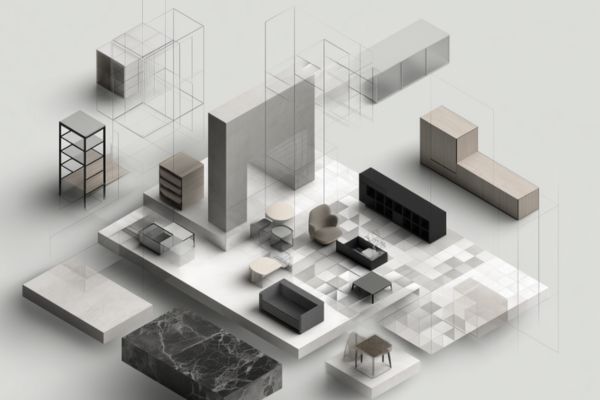
Commercial interior design has always been a discipline of trade-offs. Every project balances aesthetics against budget, timelines against compliance, and client vision against structural reality. For decades, these trade-offs were resolved slowly, through rounds of manual drafting, back-and-forth approvals, and on-site corrections. That is changing. A new category of artificial intelligence, often described as “agentic AI,” is beginning to reshape how commercial spaces are conceived, planned, and built.
Unlike earlier generations of design software that simply assisted a human operator, agentic AI systems can take a goal, break it into steps, and act on those steps with a degree of independence. In interior design terms, this means an AI system can move beyond suggesting a colour palette or generating a 3D render. It can actually manage parts of a workflow: analysing a floor plan, checking it against building codes, coordinating material orders, and flagging conflicts between design intent and engineering constraints, often before a human ever notices the problem.
From Concept to Layout: Faster, Smarter Planning
The earliest and most visible impact of agentic AI has been in the planning phase. Traditionally, translating a client’s brief into a workable floor plan required multiple iterations between designers, architects, and space planners. Agentic systems can now ingest a brief, along with data on square footage, occupancy requirements, and functional zones, and generate multiple layout options that account for traffic flow, natural light, acoustics, and accessibility standards simultaneously.
What makes this “agentic” rather than merely automated is the ability of these systems to evaluate their own output against constraints and revise it without explicit human instruction at every step. If a proposed layout violates fire egress norms or clashes with HVAC placement, the system can identify the conflict and propose alternatives on its own, presenting designers with pre-vetted options rather than raw possibilities that still need manual checking.
Bridging Design Intent and Technical Reality
One of the most persistent challenges in commercial interiors has been the gap between creative vision and technical feasibility. A striking design concept can look compelling on a mood board, yet fall apart when tested against load-bearing walls, electrical capacity, or plumbing routes. Agentic AI is increasingly being used to close this gap early by cross-referencing design proposals with structural and MEP (mechanical, electrical, plumbing) data in real-time.
This shifts a significant portion of technical validation from the construction phase back into the design phase. Instead of discovering a conflict on-site, where it is costly and time-consuming to fix, teams can identify and resolve it digitally, before materials are ordered or contractors are mobilised. For an industry where rework has historically eaten into both margins and schedules, this earlier detection is one of the more consequential shifts underway.
Coordinating the Execution Phase
Design and planning are only part of the equation. Execution, procurement, vendor coordination, scheduling, and quality checks have traditionally required significant manual project management. Agentic AI is beginning to take on coordination tasks here as well. Systems can track material availability, flag delays before they cascade into the broader schedule, and adjust sequencing recommendations when a dependency shifts, such as a delayed shipment or a change in site conditions.
This does not eliminate the need for experienced project managers and site supervisors. Rather, it changes what they spend their time on. Instead of manually cross-checking spreadsheets and following up on every vendor, professionals can focus on judgement calls, client relationships, and the nuanced decisions that still require human experience and accountability.
A More Iterative, Data-Informed Design Process
Perhaps the most important shift is philosophical rather than technical. Commercial interior design has traditionally been a linear process: brief, concept, design development, documentation, construction. Agentic AI encourages a more iterative model, where design decisions are continuously tested against real constraints, and revisions happen in hours rather than weeks. This does not replace creative judgement, but it does mean creative judgement is exercised with far better information, much earlier in the process.
What This Means Going Forward
None of this suggests that human designers, architects, or project managers are becoming less important. If anything, the value of experienced professionals is increasing, because they are now positioned to focus on the decisions that genuinely require expertise, taste, and accountability, while routine analysis, coordination, and validation are handled by systems built for exactly that kind of work.
The commercial interior design industry has long operated under pressure to deliver faster, at lower cost, without compromising quality or safety. Agentic AI does not resolve every tension inherent in that mandate, but it is beginning to change where time and attention are spent across a project’s lifecycle. As these systems mature, the projects that benefit most will likely be those where design teams treat agentic AI not as a replacement for expertise, but as a rigorous, tireless partner in getting the details right, from the first sketch to the final walkthrough.

By – Sanjeev Bhandari, Founder & CEO of AirBrick