
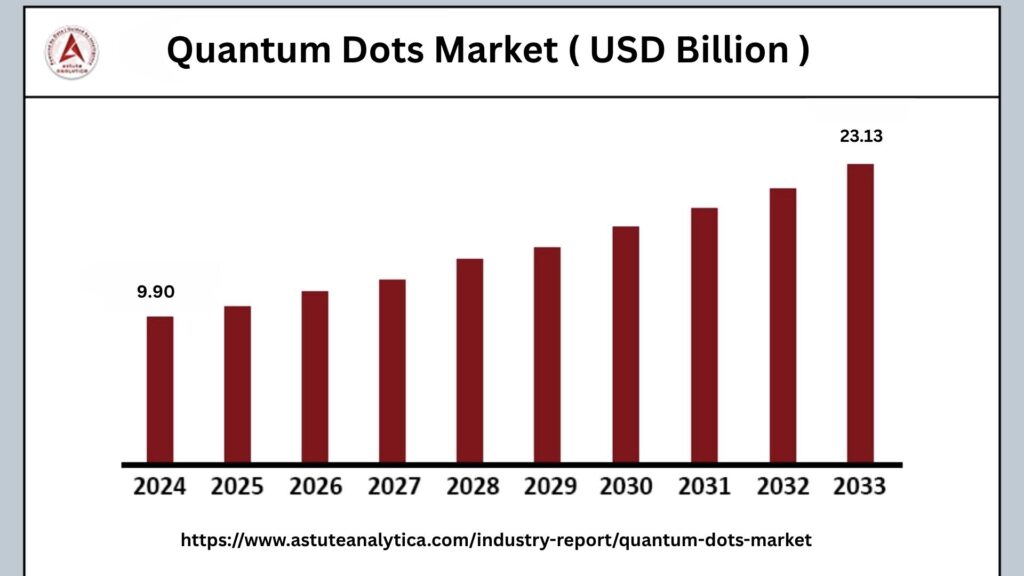
The global quantum dots market was valued at US$ 9.90 billion in 2024 and is projected to reach US$ 23.13 billion by 2033, reflecting a Compound Annual Growth Rate (CAGR) of 9.92% during the forecast period from 2025 to 2033.
Quantum dots (QDs) are semiconductor nanoparticles that typically range in size from 2 to 10 nanometers. Their ultra-small dimensions give rise to unique optical and electronic properties that are governed by quantum mechanical effects. These distinctive characteristics allow quantum dots to absorb and emit light with exceptional precision and tunability, making them highly valuable for a wide array of advanced technological applications.
The quantum dots market is currently experiencing robust growth fueled by strong demand across several key sectors, including automotive displays, industrial sensing, and smart-building photonics. Automotive displays utilize quantum dots to provide enhanced color accuracy and brightness, improving the overall user experience in vehicle infotainment systems.
Quantum Dots Market Key Takeaways
- By material, the quantum dots market is experiencing a rapid shift toward cadmium-free quantum dots (CFQDs), which currently command a significant 57.12% share of the revenue.
- In terms of production techniques, colloidal synthesis leads the market, accounting for 35.67% of the total market share.
- When looking at products, quantum optics has emerged as one of the most dominant applications within the quantum dots market, capturing 27.29% of the revenue share.
- By industry, consumer electronics stands out as the largest end-use sector for quantum dots, generating more than 31.26% of the market share.
Regional Analysis
Asia Pacific: The Undisputed Powerhouse in Quantum Dots Market
Asia Pacific has emerged as the dominant force in the global quantum dots market, commanding more than 42.15% of the total market share. This impressive dominance is largely fueled by the region’s advanced manufacturing infrastructure and relentless focus on innovation.
- Technological Edge in Product Quality and Innovation: The technological superiority of Asia Pacific in the quantum dots market is clearly reflected in the quality and innovation of its products. Companies in the region invest heavily in research and development to enhance the optical performance, stability, and eco-friendliness of quantum dots. These innovations include improvements in synthesis techniques and new material compositions that increase efficiency and reduce environmental impact.
- Strong Presence of Leading Electronics Manufacturers: The presence of globally renowned electronics manufacturers in Asia Pacific plays a pivotal role in sustaining the region’s market leadership. Companies based in countries such as South Korea, China, and Japan are major players in the production and integration of quantum dot technologies. These manufacturers drive innovation and contribute to large-scale adoption by embedding quantum dots into a wide range of electronic products.
- Government Initiatives Promoting Solar Energy: Asia Pacific’s quantum dots market benefits significantly from proactive government initiatives aimed at promoting renewable energy, particularly solar power. Many countries in the region have implemented policies and incentives to accelerate solar energy adoption as part of their sustainability agendas. Quantum dots enhance solar cell efficiency by improving light absorption and energy conversion rates, making them critical to next-generation photovoltaic technologies.
North America as a Global Innovation Hub in Quantum Dots
North America has firmly established itself as a global innovation powerhouse within the quantum dots market, driven by a strong emphasis on cutting-edge research, strategic collaboration, and the development of advanced applications.
- Focus on Quality and Efficiency in Production and Research: The North American quantum dots market is distinguished by its commitment to quality and efficiency, reflected in both production methods and research outputs. Manufacturers prioritize precision and scalability to meet the stringent demands of various industries, including consumer electronics, healthcare, and renewable energy.
- The U.S. as the Market Leader in North America: The United States holds a stronghold over the North American quantum dots market, thanks to its robust semiconductor industry and technological infrastructure. Home to industry giants such as Intel and NVIDIA, the U.S. benefits from significant investments in research and development, enabling the rapid advancement and deployment of quantum dot technologies.
- Demand for High-End Consumer Electronics:: A key factor underpinning market expansion in North America is the high demand for premium consumer electronics equipped with advanced display technologies. Quantum dots are integral to delivering enhanced color accuracy, brightness, and energy efficiency in devices such as smartphones, televisions, monitors, and virtual reality headsets.
Europe Leading the Quantum Dots Market
Europe’s prominence in the quantum dots market is largely driven by its strong commitment to sustainability, environmental compliance, and eco-friendly production practices. European countries have implemented rigorous environmental regulations that promote the development and use of non-toxic, sustainable materials in manufacturing processes.
- Research and Supply Chain Advancements: Europe’s dedication to sustainability is reflected in its significant achievements in research and supply chain development within the quantum dots market. The region boasts a robust network of research institutions and technology companies focused on advancing quantum dot materials and applications. Collaborative efforts between academia and industry have accelerated breakthroughs in eco-friendly quantum dot synthesis and scalable production methods.
- Rising Adoption of Solar Energy and Demand for HD Displays: The increasing adoption of solar energy across Europe is expected to be a key driver of growth in the quantum dots market. Quantum dots are instrumental in enhancing the efficiency of next-generation solar cells, making them highly relevant to Europe’s renewable energy initiatives. As countries intensify their investments in clean energy solutions, the integration of quantum dot technologies into solar panels becomes more widespread, fueling market expansion.
- Established Automotive Industry: Europe’s established automotive manufacturing industry plays a crucial role in supporting the growth of the quantum dots market. Countries such as Germany, France, and the UK are home to some of the world’s leading automotive companies, which are increasingly incorporating quantum dot-enabled LED products into vehicle displays, lighting, and infotainment systems.
Top Trends Escalating the Quantum Dots Market
Shift Toward Heavy-Metal-Free Chemistries: The quantum dots market is witnessing a significant transition toward heavy-metal-free chemistries, primarily prompted by increasingly stringent environmental regulations worldwide. Regulatory bodies are tightening restrictions on the use of toxic heavy metals such as cadmium, lead, and mercury due to their detrimental impact on human health and ecosystems. This shift compels manufacturers to develop safer, environmentally friendly quantum dot materials that meet performance standards without compromising sustainability.
Inkjet Printing Techniques Enable Patterning Quantum Dots: Innovations in manufacturing processes have introduced inkjet printing as a highly effective technique for patterning quantum dots, especially in the production of cutting-edge micro-LED displays. Inkjet printing allows for precise and controlled deposition of quantum dots onto display substrates, facilitating the creation of high-resolution, energy-efficient micro-LED panels.
Colloidal Synthesis Dominates Production: Colloidal synthesis remains the dominant production method for quantum dots, thanks to its ability to deliver precise control over particle size and composition while supporting large-scale, cost-efficient manufacturing. This wet-chemical process enables the production of quantum dots with consistent optical properties, essential for high-quality applications across various industries.
Rising Demand for Cadmium-Free Displays: The consumer electronics sector is a major driver of the shift toward cadmium-free quantum dots, fueled by increasing consumer awareness and regulatory pressures. Cadmium-free displays are favored for their reduced environmental impact and compliance with global safety standards, making them attractive to manufacturers and consumers alike.
Expanding Healthcare Bioimaging Applications: Quantum dots are making significant inroads into healthcare, particularly in bioimaging applications, where their unique fluorescence properties enable highly precise diagnostics. The ability of quantum dots to emit bright, stable, and tunable light makes them ideal for labeling biological tissues and cells, allowing for enhanced imaging resolution and sensitivity. This facilitates early disease detection, improved monitoring of treatment progress, and more accurate medical research.
Efficiency Gains in Next-Generation Solar Cells: The pursuit of higher efficiency in next-generation solar cells is driving increased investment in quantum dot technologies. Quantum dots offer unique advantages in photovoltaic applications, such as size-tunable band gaps and multiple exciton generation, which can significantly boost solar cell performance beyond the limits of conventional materials. Their integration into solar panels can lead to improved light absorption, energy conversion efficiency, and device stability.
Quantum Dots Market Segmentation
By Material
The quantum dots market is experiencing a significant transition toward cadmium-free quantum dots (CFQDs), fueled by a combination of regulatory mandates, technological progress, and an increasing preference for sustainable and environmentally responsible solutions. Governments and regulatory bodies worldwide have imposed strict limitations on the use of cadmium due to its toxicity and environmental hazards.
The adoption of cadmium-free quantum dots extends well beyond the conventional display industry and is gaining momentum in diverse sectors such as automotive, renewable energy, and healthcare. In automotive applications, CFQDs are being integrated into next-generation lighting and display systems that demand high performance alongside environmental safety.
By Production Technique
Colloidal synthesis has become the foremost production technique in the quantum dots market, renowned for its exceptional precision, scalability, and adaptability. This method enables manufacturers to produce quantum dots with highly controlled sizes and compositions, which directly influence their optical and electronic properties. The ability to tailor quantum dots at such a fine level is essential for meeting the specific performance requirements of various applications, ranging from consumer electronics to advanced medical devices.
Beyond its precision, the versatility of colloidal synthesis is a key factor driving its dominance in the quantum dots market. This technique facilitates the creation of quantum dots with narrow emission spectra, meaning they can emit very pure, specific colors, which enhances color accuracy and vibrancy in displays. At the same time, these quantum dots possess broad excitation profiles, allowing them to be efficiently excited by a wide range of light wavelengths.
By Product
Quantum optics has become one of the most influential and rapidly growing applications within the quantum dots market, harnessing the exceptional properties of quantum dots to transform a range of high-tech industries such as communication, computing, and medical imaging. The unique ability of quantum dots to manipulate light at the nanoscale has enabled breakthroughs that were previously unattainable with conventional optical materials.
The prominence of quantum optics in the quantum dots market is underscored by its integral role in developing cutting-edge technologies that push the boundaries of performance and efficiency. A prime example of this is the utilization of quantum dot lasers, which exhibit significantly improved characteristics when compared to traditional lasers. These lasers benefit from reduced threshold currents, meaning they require less energy to initiate lasing, and they also offer around 30% greater temperature stability.
By Industry
Consumer electronics has firmly established itself as the largest end-use sector within the quantum dots market, largely due to the widespread integration of quantum dot technology into various display systems, lighting solutions, and advanced electronic devices. This dominance is not accidental but the result of continuous innovation and the increasing consumer demand for high-performance, visually superior, and energy-efficient products.
The leadership of consumer electronics in the quantum dots arena is further reinforced by notable advancements in manufacturing processes and improvements in energy efficiency. These developments have made quantum dot components more reliable, cost-effective, and scalable, allowing manufacturers to incorporate them into a broad range of products without compromising affordability. One of the key advantages of quantum dot displays is their ability to reduce power consumption by approximately 40% compared to conventional LCD panels.
Recent Developments in the Quantum Dots Market
- Samsung Launches AI-Powered QLED and Crystal Clear 4K UHD TVs in India: In May 2025, Samsung, India’s largest consumer electronics brand, announced the launch of its latest range of AI-powered QLED TVs alongside Crystal Clear 4K UHD TVs. Available from May 1, 2025, through popular online platforms like Amazon, Flipkart, and Samsung’s official website, this new lineup aims to elevate the home entertainment experience. The QLED series, branded as QEF1, incorporates cutting-edge AI technology designed to optimize picture quality and user interaction.
- Hisense Introduces Advanced QLED Technology in South Africa: In April 2025, Hisense’s South African division unveiled its most advanced television technology to date, marking a significant shift in the home entertainment landscape. Their new QLED range surpasses traditional UHD standards by offering superior picture quality and enhanced color performance. This launch follows a strategic move towards price standardization, making cutting-edge QLED technology more accessible to a broader consumer base in the region.
- Koorui Debuts World’s First 750Hz Quantum Dot Monitor: In January 2025, emerging brand Koorui made waves by launching the world’s first consumer-grade monitor with an ultra-high 750Hz refresh rate, utilizing quantum dot technology. The 24.5-inch G7 monitor addresses the common color accuracy limitations of twisted nematic (TN) panels by integrating a quantum dot film, which expands the color gamut to cover up to 95% of the DCI-P3 spectrum.
Top Companies in the Quantum Dots Market
- Agilent Technologies, Inc.
- TCL Group
- Luminus, Inc.
- Samsung Electronics Co., Ltd
- Nanoco Group plc
- LG Electronics
- Quantum Materials Corporation
- Sony Group Corporation
- VueReal
- Shoei Chemical, Inc.
- Other Prominent Players
Market Segmentation Overview
By Material
- Cadmium-Based
- Cadmium-Free
- Indium Arsenide
- Silicon
- Graphene
- Perovskite
- Lead Sulfide
- Lead Selenide
- Others
By Production Technique
- Colloidal Synthesis
- Bulk Manufacturing
- Plasma Synthesis
- Fabrication
- Bio-Molecular Self-Assembly
By Product
- Quantum Optics
- Quantum Dot Laser
- Quantum Dot Photodetectors/Sensors
- Biological Imaging
- Quantum Dot Medical Devices
- QR-Based Security and Surveillance
- Quantum Dot Ink
- Quantum Dot Photodetectors/Sensors
- Optoelectronics
- Quantum Dot Display
- Quantum Dot Photodetectors/Sensors
- Quantum Dot LED Products
- Quantum Dot Laser
- Renewable Energy
- Quantum Dot Solar Cells /Modules
- Photovoltaics
- Others
By Industry
- Consumer Electronics
- Healthcare & Medical Devices
- Defense & Security
- Telecommunications
- Energy (Solar & PV)
- Others
By Geography
- North America
- Europe
- Asia-Pacific
- Latin America
- Middle East and Africa