


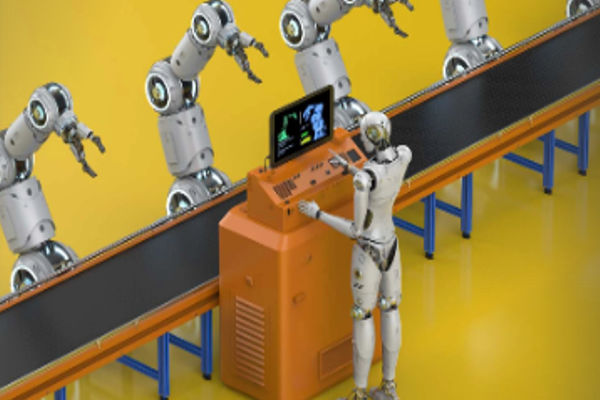
Robots have long been a fixture of manufacturing. What began in the 1950s as machines programmed for repetitive, high-risk tasks has evolved into an ecosystem of intelligent systems that can see, sense, and decide. Early industrial robots were limited in their flexibility and application. Today, robotics in manufacturing is no longer about replacing manual labor; it’s about rethinking how work gets done.
This change is being driven by automation. Once limited to assembly lines, robotics is now used throughout the factory floor and is driven by data and software. In addition to physical handling, robotic process automation (RPA) is essential for workflow integration, idle time reduction, and machine action on real-time data. Manufacturers are using RPA to make operations more resilient, scalable, and adaptive, in addition to increasing speed.

Emerging Tech Meets Real-Time Agility
Emerging technologies are accelerating this transformation significantly. With their power to make immediate decisions, autonomous artificial intelligence agents are assisting in the optimization of production flows, the efficient reassignment of tasks, and even the cessation of operations upon the discovery of anomalies. This level of sensitivity guarantees more control over complicated production systems and lowers downtime. Going further, Multi-Agent Systems (MAS) allow robot networks to coordinate and interact without human interference. Depending on varying circumstances, be it supply levels, equipment performance, or order priorities, these systems can adjust dynamically.
Concurrent with this, gesture-based controls are becoming more important on the factory floor. Gesture technology provides user friendly methods for using machines in settings when hygiene is paramount or conventional interfaces may be limited. It enhances both safety and user experience especially in precision-driven companies.
The manufacturing industry has been transformed by the growth of artificial intelligence (AI) and automation. One of the most significant changes in recent years has been the concept of dark facilities, entirely automated plants wherein robots, artificial intelligence-driven systems, and IoT (Internet of Things) devices encompass all manufacturing processes. These facilities are meant to run without human involvement, therefore making conventional labor-intensive methods obsolete. Combining robots, artificial intelligence, and IoT guarantees quality and consistency. Swarm robotics is another breakthrough, where dozens, even hundreds, of simple robots work in harmony. Unlike traditional automation, these swarms can flex and respond to complexity, mimicking the decentralized coordination found in nature.
Collaboration, Not Replacement
Human-robot collaboration (HRC) marks a major step forward in the fields of artificial intelligence and robotics as cobots, or collaborative robots and humans, work together, hence combining the cognitive abilities of humans with the accuracy, efficiency, and endurance of robots. This synergy highlights the future of collaboration.
This growth is fueled by advancements in robotics, artificial intelligence, and machine learning, enabling robots to collaborate with humans in more sophisticated and versatile ways. Robotics will be critical in helping Indian producers aim for scale, quality, and sustainability. The demand for high-mix, low-volume manufacture; the requirement for steady output; and the worldwide push toward ESG-aligned businesses are driving adoption.
Robotics and automation today extend far beyond technological progress. They represent a shift toward greater operational clarity, enhanced workforce safety, and long-term business resilience. In a manufacturing landscape often marked by uncertainty, these technologies bring much-needed consistency. They provide effectiveness in a world driven by sustainability. The future of manufacturing will belong to those who can embed intelligence into every layer of production and robotics will be a strategic foundation for growth.