

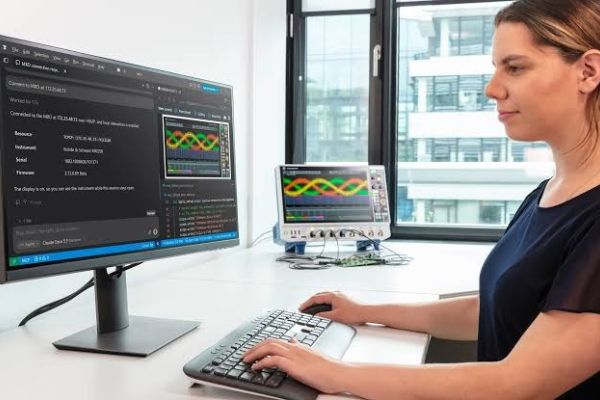
With the new MXO AI Connect, Rohde & Schwarz brings AI-assisted instrument intelligence to its MXO oscilloscopes. Engineers can use natural language to describe a task, while the connected AI assistant draws on instrument-specific knowledge to map that request to oscilloscope functions and actions.
Modern test environments combine complex measurements, broad instrument functionality and growing automation requirements. MXO AI Connect links the reasoning capabilities of the user’s chosen AI model with trusted, instrument-specific knowledge from Rohde & Schwarz. This helps the assistant understand the user’s intent, determine how a requested task can be carried out on the oscilloscope and interact with the connected instrument. In this way, the software extends the instrument workflow beyond remote control by combining natural language interaction, technical knowledge and execution.
MXO AI Connect supports all models of the MXO 3, MXO 4, MXO 5 and MXO 5C oscilloscope series, as well as R&S ScopeStudio. It is a locally installed Model Context Protocol (MCP) server that runs on a user’s PC or on a shared lab host. No additional software is required on the instrument. Engineers can choose their preferred AI client such as Cursor, Claude Desktop, Claude Code and GitHub Copilot, along with their preferred large language model and data handling policy. The server provides access to model-specific MXO help content and communicates with the instrument through standard VISA connections such as HiSLIP, VXI-11 or TCP/IP, keeping instrument communication within the local environment. Front-panel operation remains available while the AI assistant is connected.
Typical AI-assisted workflows with MXO AI Connect include:
- Understanding: Engineers can bring instrument-specific knowledge, documentation and application guidance directly into their workflow to support learning and day-to-day work with the oscilloscope.
- Configuration: Natural language requests can be translated into the appropriate instrument functions, settings and automation approaches, which can reduce setup and implementation effort and limit the need to search through documentation or coding examples manually.
- Analysis: The reasoning and data processing capabilities of modern AI models can support the review of measurement results, the identification of waveform characteristics and the assessment of relationships or behavior in the data.
- Automation: For more complex tasks, AI agents can coordinate instrument control, analysis methods and software automation across broader test workflows, with repeated adjustments to setups and code until the intended measurement objective is reached.
Philip Diegmann, Vice President Digital & Power Test Solutions at Rohde & Schwarz, says “AI offers engineers a new way to work with increasingly capable test instruments. With MXO AI Connect, they can move more quickly from a measurement task to the right instrument setup and from there to analysis and automation. This makes it easier to work with complex instrument functions and integrate them into broader test workflows.”