
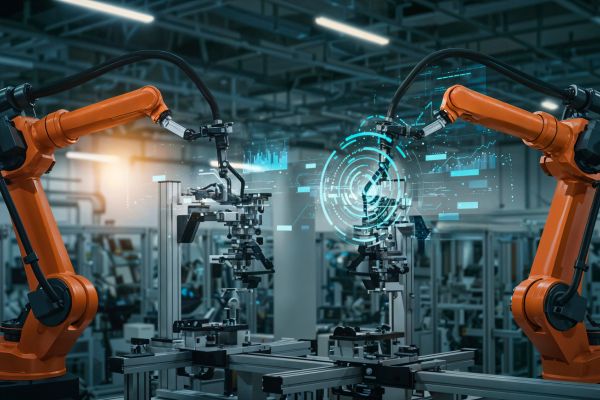
Digital Twins Are Moving From Individual Machines to Entire Factories
Manufacturing digital twins are undergoing an important transition.
The first generation of industrial digital twins often focused on a specific asset: a motor, machine, robot, production cell or other physical component represented digitally and connected to operating data.

The emerging generation is considerably more ambitious.
Manufacturers are increasingly connecting equipment models, production processes, material flows, robotics, energy systems and operational data to create virtual representations of complete production environments.
Artificial intelligence is adding another layer.
Instead of merely showing what is happening inside a factory, advanced digital twins can increasingly help manufacturers analyze why it is happening, what is likely to happen next and how alternative operating decisions could affect production.
This transition is helping turn digital twins from engineering visualization tools into operational decision environments.
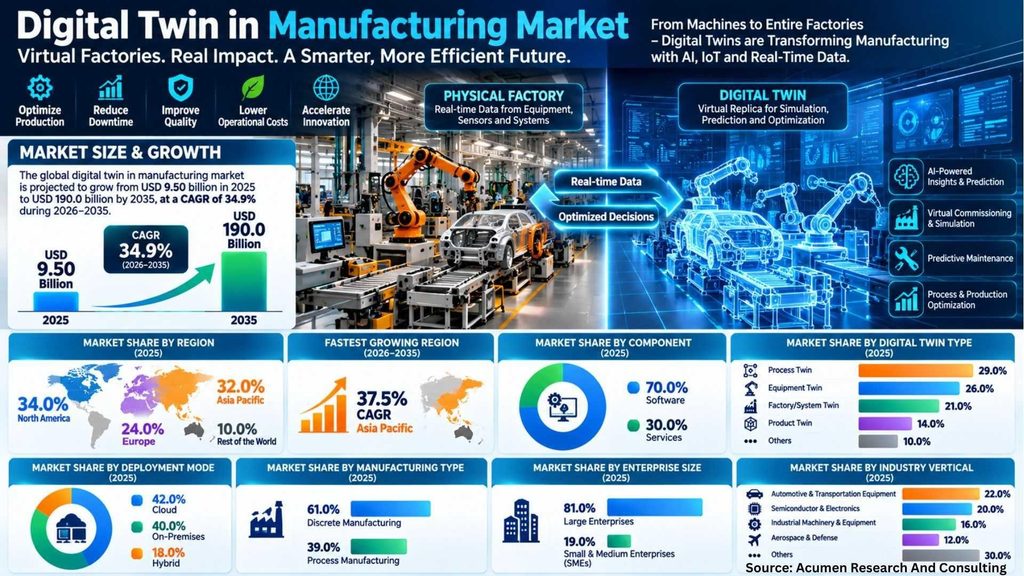
The global digital twin in manufacturing market was valued at USD 9.50 billion in 2025 and is projected to reach USD 190.0 billion by 2035, representing a 34.9% CAGR from 2026 to 2035, according to Acumen Research and Consulting.
The projected twentyfold expansion reflects more than growing adoption of 3D factory models.
It represents a convergence of industrial IoT, simulation, AI, machine learning, cloud computing, edge infrastructure, robotics and manufacturing data.
And that convergence is gradually changing what a digital twin can do.
What Is a Digital Twin in Manufacturing?
A manufacturing digital twin is a synchronized virtual representation of a physical manufacturing asset, process, production system or factory that uses data from the physical environment to support monitoring, simulation, prediction and optimization.
The critical distinction is the connection between the virtual and physical environments.
A static 3D CAD model may accurately represent a machine geometrically, but that alone does not make it an operational digital twin.
A manufacturing digital twin can incorporate data from sensors, industrial control systems, manufacturing execution systems, enterprise systems, engineering models and other sources to keep its virtual representation aligned with the physical system.
NIST describes manufacturing digital twins as synchronized virtual models capable of helping manufacturers represent, diagnose, predict and optimize operations. Their applications include machine-health analysis, production planning, maintenance and virtual commissioning.
This creates a progression in capability:
Physical asset → connected data → virtual representation → simulation → prediction → optimization → operational feedback
AI is increasingly strengthening the later stages of that chain.
Digital Twin in Manufacturing Market Could Reach $190 Billion by 2035
The Digital Twin in Manufacturing market is projected to expand from USD 9.50 billion in 2025 to USD 190.0 billion by 2035.
At a 34.9% CAGR during 2026–2035, digital twins represent one of the faster-growing layers of the broader smart-manufacturing technology stack.
Several structural trends are converging.
Factories are generating substantially more data as sensors, robotics, machine vision, connected equipment and industrial IoT infrastructure expand.
Manufacturing processes are also becoming more complex.
Automotive factories increasingly integrate advanced robotics and electrified vehicle production. Semiconductor fabs operate tightly controlled equipment networks with enormous capital costs. Aerospace manufacturers must coordinate complex products and production processes. Pharmaceutical and chemical facilities depend on continuous monitoring of critical operating parameters.
Traditional trial-and-error optimization becomes increasingly expensive in these environments.
Digital twins offer an alternative: test more changes virtually before making them physically.
That capability becomes particularly valuable when shutting down or modifying the real production system is expensive, disruptive or risky.
AI Is Turning Digital Twins From Descriptive Models Into Predictive Systems
The integration of artificial intelligence represents one of the biggest changes occurring in the digital twin in manufacturing market.
Traditional digital twins can show the current state of equipment or simulate predefined scenarios.
AI can expand that capability by analyzing patterns across historical and real-time data.
Machine-learning models can help detect anomalies, estimate remaining useful equipment life, predict process deviations and identify relationships that may not be obvious from conventional monitoring.
Physics-informed AI introduces another possibility: combining physical models with machine learning rather than relying exclusively on either approach.
NIST’s 2026 roadmap for AI and machine learning in smart manufacturing identifies advanced digital twins, physics-informed AI, generative AI, autonomous systems and foundation models among important emerging directions for increasingly connected manufacturing systems.
The distinction matters.
A digital twin that simply reports machine temperature is useful.
A digital twin that understands operating history, compares current behavior with expected physical behavior and estimates whether the equipment is moving toward failure can potentially provide substantially greater operational value.
The long-term direction therefore moves through three levels:
Descriptive: What is happening?
Predictive: What is likely to happen?
Prescriptive: What should we change?
That progression could ultimately make digital twins an important foundation for increasingly adaptive factories.
Software Commands 70% of the Digital Twin in Manufacturing Market
Software represented 70% of the digital twin in manufacturing market in 2025, compared with 30% for services.
This reflects the central role digital twin platforms play in connecting engineering models, factory data, sensors, production systems, analytics and visualization environments.
But services could become increasingly important as deployments expand.
The services segment is projected to grow at a 36.7% CAGR from 2026 to 2035, faster than software.
The reason is practical.
Creating an enterprise-scale manufacturing twin is rarely a plug-and-play software exercise.
Factories frequently contain machines installed over several decades. Equipment may come from different vendors and use different communication protocols, data structures and automation systems.
Digital twin deployments therefore require consulting, integration, implementation, data engineering, cybersecurity, system configuration, training and ongoing maintenance.
As companies move from isolated pilots toward factory-level deployments, integration complexity can increase substantially.
That helps explain why services may outpace the already rapidly growing software segment.
Process Twins Lead Today, but Factory Twins Are Growing Fastest
Process twins represented 29% of the market in 2025, making them the largest digital twin type.
Equipment and asset twins followed at 26%.
Factory/system digital twins represented 21%, but this category is projected to record the fastest growth at a 36.9% CAGR between 2026 and 2035.
This creates one of the clearest signals about where the market is heading.
Digital twin adoption is expanding from:
Product Twin → Asset Twin → Process Twin → Production-Line Twin → Factory/System Twin
A process twin can model interconnected production variables and help manufacturers evaluate how adjustments affect throughput, quality, equipment utilization or resource consumption.
A factory twin extends the concept further.
It can potentially combine machines, production lines, robotics, material movement, facility layouts, energy consumption and operating conditions into a coordinated virtual environment.
That creates opportunities for optimization that cannot easily be identified when each asset is analyzed independently.
Siemens and NVIDIA Are Pushing Digital Twins Toward Adaptive Manufacturing
One of the clearest examples of this transition came in January 2026 when Siemens and NVIDIA expanded their strategic partnership around what they describe as an Industrial AI Operating System.
The collaboration spans AI-native design, simulation, adaptive manufacturing, AI factories and supply chains.
Siemens also introduced Digital Twin Composer, designed to connect 3D representations of products, plants or processes with real-world operational data.
The direction is strategically important.
Digital twins have traditionally helped engineers test changes before implementing them physically.
AI creates the possibility of a more continuous cycle:
Factory data → digital twin → AI analysis → virtual simulation → validated improvement → physical implementation → new factory data
Instead of being used only during factory planning, the twin can potentially remain connected throughout operations.
That moves the technology closer to a continuously updated manufacturing intelligence layer.
Virtual Commissioning Can Reduce the Cost of Physical Trial and Error
One of the most commercially valuable digital twin applications is virtual commissioning.
Commissioning a new production line traditionally requires engineers to install equipment, configure control systems, test operations and identify problems in the physical environment.
Errors discovered late can be expensive.
A digital twin allows engineers to test parts of the production system virtually before the physical line is fully operational.
Robot movements can be simulated.
Control logic can be tested.
Production sequences can be evaluated.
Potential collisions or bottlenecks can be identified.
Factory layouts can be modified before equipment is permanently installed.
The underlying economic logic is straightforward:
Finding a problem in simulation is generally preferable to discovering it after physical production has been disrupted.
This is one reason digital twins are becoming increasingly important as manufacturing systems incorporate larger numbers of robots and automated processes.
NVIDIA Omniverse Is Connecting Digital Twins With Physical AI
The intersection between digital twins and robotics is particularly important.
Autonomous machines need environments in which they can be developed, trained and tested without relying exclusively on physical experimentation.
NVIDIA Omniverse provides simulation technologies that companies can use to develop physically based virtual environments.
Manufacturers including Foxconn, TSMC, Wistron, Toyota, Caterpillar and Lucid Motors have been developing factory digital twins using NVIDIA’s Omniverse technologies, while robotics companies are using simulation environments to develop and validate autonomous systems.
This creates an important connection between the digital twin market and physical AI.
A factory twin can model the environment.
A robot twin can model the machine.
Physics simulation can model interactions.
AI can learn or evaluate behavior.
The physical factory can then execute the validated process.
As robotics becomes more autonomous, digital twins may therefore become an increasingly important development and testing environment for physical AI.
Dassault Systèmes and NVIDIA Are Connecting Virtual Twins With Industrial AI
A second major development came in February 2026 when Dassault Systèmes and NVIDIA announced a long-term partnership combining Dassault Systèmes’ Virtual Twin technologies with NVIDIA AI infrastructure, accelerated software and models.
The companies describe the collaboration as a shared industrial AI architecture spanning engineering and manufacturing and incorporating science-validated industry world models.
The development illustrates a broader shift in the competitive landscape.
Digital twins are no longer evolving independently from AI infrastructure.
Simulation software companies, industrial automation providers, cloud platforms and accelerated-computing companies are increasingly converging around the same industrial workflows.
The result could be a new software stack in which engineering models, operational data, physics simulation and AI increasingly operate together.
Cloud Leads With 42%, but On-Premises Remains Close Behind
Cloud deployment represented 42% of the digital twin in manufacturing market in 2025, narrowly ahead of on-premises deployment at 40%. Hybrid environments accounted for the remaining 18%.
The relatively narrow difference is significant.
Cloud infrastructure is attractive because large simulations, AI models and analytics workloads can require substantial computing resources.
Cloud environments also make it easier for engineering teams across different facilities and geographies to access shared digital models.
But manufacturing presents requirements that prevent a simple cloud-only transition.
Production data can be commercially sensitive.
Some factories require extremely low latency.
Operational systems may need to remain available even when external connectivity is interrupted.
Manufacturers may also have strict cybersecurity requirements around production recipes, equipment data or intellectual property.
Consequently, the future manufacturing digital twin architecture is likely to remain distributed.
Some computation can occur in the cloud.
Some can remain on-premises.
Some time-sensitive analytics can run at the industrial edge.
The most important question may therefore become less “cloud or on-premises?” and more “which digital-twin workload belongs where?”
Discrete Manufacturing Holds 61% of the Market
Discrete manufacturing represented 61% of digital twin in manufacturing revenue in 2025, compared with 39% for process manufacturing.
The dominance of discrete manufacturing reflects the technology’s suitability for products assembled from identifiable components.
Automobiles, aircraft, electronics and industrial machinery contain numerous components moving through complex production sequences.
Manufacturers can create digital representations of products, machines, assembly lines and factories and use those models to evaluate production changes.
But process manufacturing represents a substantial opportunity as well.
Chemical, pharmaceutical, food and materials manufacturers operate around variables such as temperature, pressure, flow, composition and energy consumption.
Digital twins can help simulate how these variables interact.
NIST research published in 2026, for example, examined how digital-twin architectures and interoperable process analytical technologies can support model-based predictive control in biomanufacturing.
That illustrates why digital twins can expand beyond conventional machine-oriented manufacturing into highly controlled continuous and batch processes.
Automotive Leads, but Semiconductor Manufacturing Is Close Behind
Automotive and transportation equipment accounted for 22% of the digital twin in manufacturing market in 2025, making it the largest manufacturing-industry segment.
Semiconductor and electronics manufacturing followed closely at 20%.
Automotive factories are particularly suitable for digital twins because they combine complex assembly operations, industrial robots, conveyors, machine vision, quality inspection and large equipment networks.
Manufacturers can simulate line configurations before physical changes are made and model how robots, workers, machines and material flows interact.
Semiconductor manufacturing presents a different but equally compelling use case.
A semiconductor fab contains extraordinarily expensive equipment operating across highly controlled processes.
Virtual experimentation can help manufacturers examine process conditions, equipment utilization, production scheduling and facility operations without relying entirely on physical wafer experimentation.
This is why semiconductor manufacturing could become one of the most sophisticated environments for industrial digital twins.
North America Leads With 34% Market Share
North America accounted for 34% of the global digital twin in manufacturing market in 2025, making it the largest regional market.
The region benefits from a substantial base of aerospace, automotive, semiconductor, industrial equipment and advanced manufacturing activity.
It also contains a strong industrial-software, cloud-computing and AI ecosystem.
Digital twins increasingly connect these technology layers.
A manufacturer may combine factory automation with industrial IoT, cloud infrastructure, engineering simulation, AI analytics and enterprise software rather than purchasing a standalone “digital twin” product.
This is one reason the market is evolving toward broader platforms and ecosystems.
North America is projected to grow at a 32.5% CAGR between 2026 and 2035, maintaining substantial demand even as Asia-Pacific expands more rapidly.
Asia-Pacific Could Become the Most Important Growth Engine
Asia-Pacific represented 32% of the global digital twin in manufacturing market in 2025, only two percentage points behind North America.
More importantly, the region is projected to grow at a 37.5% CAGR from 2026 to 2035, making it the fastest-growing regional market.
The reason is manufacturing scale.
China, Japan, South Korea, India and Taiwan collectively represent enormous automotive, electronics, semiconductor, machinery and industrial production ecosystems.
As these factories deploy more automation, robotics, industrial IoT and AI, the amount of operational data available for digital twin systems increases.
Asia-Pacific also demonstrates how digital twins can intersect with robotics and physical AI.
NVIDIA has highlighted manufacturers including Foxconn, TSMC and Wistron using physically based digital twins for factory planning and the development, testing and validation of autonomous robots and robotic fleets.
The region therefore has the potential to become not only a large consumer of digital twin software but one of the principal environments in which factory-scale twins are operationalized.
Large Enterprises Hold 81%—but Cloud Platforms Could Open the SME Market
Large enterprises accounted for 81% of the digital twin in manufacturing market in 2025.
SMEs represented the remaining 19%.
The imbalance reflects implementation economics.
Large manufacturers have more equipment, more factories, larger engineering teams and greater volumes of operational data.
They also have greater capacity to fund integration projects.
But the SME opportunity could expand as digital twin technology becomes more modular.
Cloud infrastructure can reduce the need for large upfront computing investments.
Manufacturers can also begin with one machine or process rather than attempting to model an entire factory.
That creates a potential adoption pathway:
Single asset → production cell → process → production line → factory
This incremental approach could become particularly important for smaller manufacturers that cannot justify large-scale digital transformation programs from the outset.
Interoperability Could Become the Market’s Biggest Scaling Challenge
Building an impressive digital representation is only part of the challenge.
The harder problem is connecting it reliably to the physical manufacturing environment.
Factories contain equipment from multiple vendors.
Machines can operate using different protocols.
Legacy systems may have limited connectivity.
Operational data may use inconsistent formats.
Engineering models may exist in separate software environments.
As digital twins expand from individual assets to entire factories, these integration challenges multiply.
NIST’s July 2026 workshop report identified interoperability, verification and validation, uncertainty quantification, cybersecurity and workforce readiness among continuing challenges for trustworthy and scalable manufacturing digital twins.
NIST research published in August 2026 also argues that building a new monolithic twin for every factory is impractical and examines composition of reusable component twins as an alternative approach.
That could become strategically important.
Instead of constructing one enormous digital model from scratch, manufacturers could increasingly assemble interoperable twins of machines, robots and processes into larger system-level twins.
Standards Will Matter as Digital Twins Scale
Interoperability is also why standards matter.
ISO 23247 provides a digital twin framework specifically for manufacturing, while NIST continues to work on implementation guidance, interoperability, verification and validation.
NIST notes that the lack of common approaches around terminology, design, interoperability and trustworthiness remains a significant implementation barrier.
Standards become more important as digital twins cross organizational boundaries.
A factory twin may eventually need information from equipment suppliers, automation vendors, engineering software, logistics providers and other external systems.
Without common frameworks, manufacturers risk creating another generation of digital silos.
The long-term value of digital twins may therefore depend as much on interoperability and data architecture as on visualization quality.
Digital Twins Could Become the Simulation Layer for Autonomous Manufacturing
The most important long-term opportunity may emerge when digital twins, AI and robotics converge.
Imagine a manufacturing system detecting a potential bottleneck.
Instead of immediately changing the physical production line, an AI system could test alternative configurations inside the digital twin.
Production schedules could be changed virtually.
Robot paths could be recalculated.
Material flows could be simulated.
Energy consumption could be compared.
Quality impacts could be estimated.
Only after the system identifies an acceptable configuration would the change move toward the physical environment—with appropriate human oversight and operational safeguards.
That represents a fundamentally different role for digital twins.
The twin becomes not merely a representation of the factory but a simulation and decision layer between AI and the physical production system.
The expanded Siemens–NVIDIA partnership provides a glimpse of this direction, with the companies explicitly targeting AI-driven adaptive manufacturing and the continuous use of digital twins to evaluate improvements before implementation.
What Could Slow Digital Twin Adoption?
The projected growth does not mean deployment is easy.
The first challenge is data quality.
A digital twin can only be as useful as the information connecting it to the physical system.
Missing sensor data, inconsistent timestamps, inaccurate measurements or outdated engineering models can undermine the reliability of the twin.
Cybersecurity is another concern.
Connecting production equipment, operational systems and cloud infrastructure expands the digital attack surface manufacturers must protect.
Model credibility matters as well.
A visually impressive simulation is not necessarily an accurate representation of physical behavior.
Manufacturers need methods to verify and validate models and understand uncertainty before relying on their outputs for important operational decisions.
NIST’s current work reflects these concerns, emphasizing validation, quantified uncertainty, interoperability and trustworthy digital twin implementation.
The final challenge is organizational.
Digital twins span engineering, IT, operational technology, data science and manufacturing operations.
Successful implementation therefore requires more than software—it requires coordination across traditionally separate teams.
What Comes Next for the Digital Twin in Manufacturing Market?
The next phase of the market will likely be defined by scale, intelligence and integration.
Digital twins will expand from machines toward production lines and entire factories.
AI will increasingly move them from monitoring toward prediction and optimization.
Physics-based simulation will combine with machine learning.
Robotics and physical AI will use virtual factories for training, testing and validation.
Cloud, edge and on-premises infrastructure will operate together.
And manufacturers will demand greater interoperability among digital models rather than accepting isolated twins that cannot communicate.
The digital twin in manufacturing market‘s projected expansion from USD 9.50 billion in 2025 to USD 190.0 billion by 2035 reflects this much broader transformation.
The real opportunity is not simply creating a digital copy of a factory.
It is creating a continuously connected virtual environment where manufacturers can observe the physical world, understand it, simulate alternatives and make better decisions before changing production.
That is why the next generation of digital twins could become one of the foundational technologies of AI-driven manufacturing.
Key Takeaways
- The global digital twin in manufacturing market is projected to expand from USD 9.50 billion in 2025 to USD 190.0 billion by 2035, representing a 34.9% CAGR during 2026–2035.
- North America led with 34% market share in 2025, while Asia-Pacific represented 32% and is projected to record the fastest regional CAGR at 37.5%.
- Software accounted for 70% of 2025 revenue, but services are projected to grow faster at a 36.7% CAGR as implementation and integration requirements increase.
- Process twins led with 29% market share, while factory/system digital twins are projected to grow fastest at 36.9% CAGR.
- Cloud deployment accounted for 42%, narrowly ahead of on-premises deployment at 40%, indicating that manufacturing digital twins will likely remain distributed across cloud, plant and edge infrastructure.
- Discrete manufacturing represented 61% of the market, while automotive & transportation equipment led industry adoption at 22%.
- Large enterprises accounted for 81% of 2025 revenue, although modular cloud deployments could gradually lower barriers for SMEs.
- AI, physics-based simulation, industrial IoT and robotics are moving digital twins beyond visualization toward predictive and increasingly adaptive manufacturing.
Frequently Asked Questions
What is a digital twin in manufacturing?
A manufacturing digital twin is a synchronized virtual representation of a product, machine, process, production system or factory that connects models with data from the corresponding physical environment. Manufacturers use digital twins for monitoring, simulation, predictive maintenance, process optimization, virtual commissioning and production planning.
How big is the digital twin in manufacturing market?
The global digital twin in manufacturing market was valued at USD 9.50 billion in 2025 and is projected to reach USD 190.0 billion by 2035, growing at a 34.9% CAGR from 2026 to 2035.
Which region leads the digital twin in manufacturing market?
North America held the largest share at approximately 34% in 2025. Asia-Pacific represented approximately 32% and is projected to be the fastest-growing region at a 37.5% CAGR through 2035.
How is AI changing manufacturing digital twins?
AI enables digital twins to move beyond monitoring and predefined simulation toward anomaly detection, predictive maintenance, process prediction and optimization. Physics-informed AI and advanced industrial AI could further connect virtual simulations with increasingly adaptive manufacturing systems.
What is a factory digital twin?
A factory digital twin is a virtual representation that integrates multiple parts of a manufacturing facility—including equipment, production lines, material flows, robotics, facility conditions and potentially energy systems—rather than representing only one asset.
What is the difference between a digital twin and a simulation?
A simulation typically models how a system may behave under defined conditions. A digital twin adds an ongoing relationship with the corresponding physical system and its data. Simulation can therefore be one of the capabilities used within a digital twin.
What are the biggest barriers to manufacturing digital twin adoption?
Major barriers include interoperability between equipment and software, legacy-system integration, data quality, cybersecurity, model verification and validation, uncertainty management, implementation cost and workforce capabilities.