

EV Battery Swapping Market Accelerates as Electric Mobility Adoption and Battery-as-a-Service Models Expand
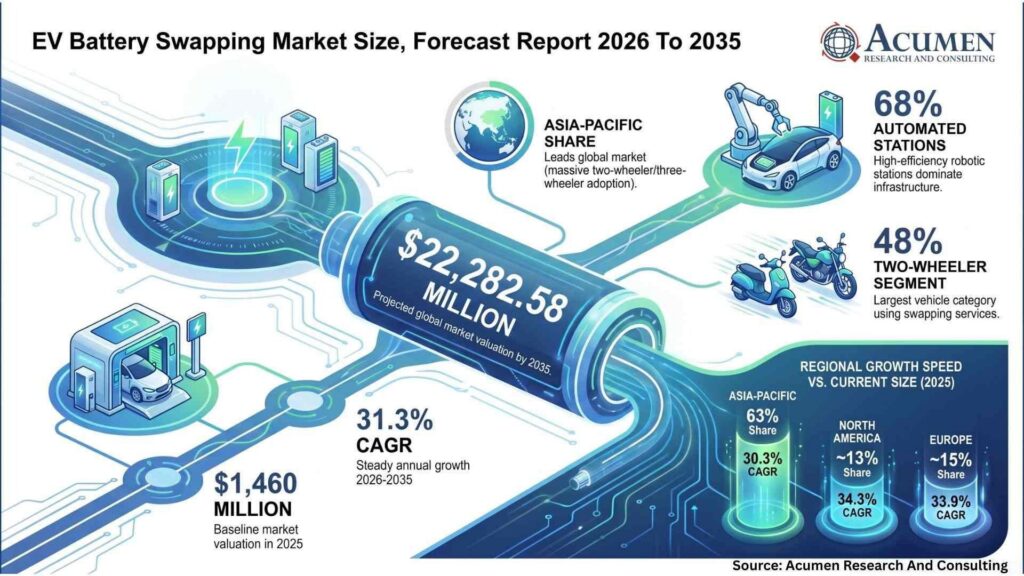
The global EV Battery Swapping Market is witnessing rapid growth as electric vehicle adoption increases worldwide and businesses seek faster, more efficient alternatives to conventional charging infrastructure. According to the latest market analysis by Acumen Research And Consulting, the EV Battery Swapping Marketsize reached USD 1,460 million in 2025 and is projected to surpass USD 22,282.58 million by 2035, expanding at a remarkable CAGR of 31.3% from 2026 to 2035.
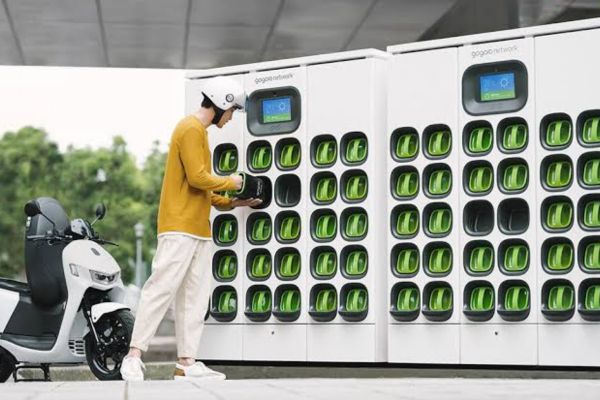
The rising demand for reduced vehicle downtime, improved battery utilization, and scalable electric mobility solutions is accelerating the adoption of battery swapping technologies. Battery swapping enables electric vehicle users to replace depleted batteries with fully charged units within minutes, providing a practical solution for commercial fleets, two-wheelers, and urban transportation networks.
Increasing investments in electric mobility infrastructure, growing interest in battery-as-a-service models, and advancements in automated swapping stations are expected to create significant opportunities for market participants during the forecast period.
EV Battery Swapping Market Statistics at a Glance
- EV Battery Swapping Market Size (2025): USD 1,460 million
- Projected Market Size (2035): USD 22,282.58 million
- Forecast CAGR (2026–2035): 31.3%
- Asia-Pacific Market Share (2025): 63%
- Subscription Model Share (2025): 62%
- Pay-per-use Model Share (2025): 38%
- Two-Wheeler Segment Share (2025): 48%
- Automated Station Share (2025): 68%
Growing Electric Vehicle Adoption Drives EV Battery Swapping Market Growth
The expansion of the EV Battery Swapping Market Growth is closely linked with the increasing adoption of electric vehicles and the need for convenient charging alternatives. While traditional charging infrastructure requires longer charging periods, battery swapping provides a faster approach that allows drivers to exchange batteries and continue operations with minimal interruption.
Battery swapping solutions are gaining traction among commercial operators, fleet owners, and urban mobility providers because they help improve vehicle availability and operational efficiency. The technology is particularly valuable for high-utilization applications where reducing charging downtime is essential.
The growing transition toward sustainable transportation, combined with rising investments in electric mobility ecosystems, is supporting increased deployment of battery swapping networks across multiple regions.
Asia-Pacific Leads EV Battery Swapping Market Share
Regionally, Asia-Pacific dominated the EV Battery Swapping Market Share in 2025, accounting for 63% of the global market. The region’s leadership is supported by strong electric vehicle adoption, expanding urban transportation networks, and increasing investments in battery swapping infrastructure.
Countries across Asia-Pacific are witnessing growing demand for electric two-wheelers, commercial vehicles, and fleet-based transportation solutions. The high adoption of electric mobility solutions and the development of battery exchange networks are contributing significantly to regional market growth.
Meanwhile, North America is expected to experience strong expansion during the forecast period, registering the fastest growth rate with a CAGR of 34.3%. Increasing investments in electric vehicle infrastructure and growing interest in alternative charging technologies are supporting regional opportunities.
Subscription-Based Battery Swapping Models Gain Market Momentum
Based on business model, the subscription segment accounted for 62% of the EV Battery Swapping Market in 2025, making it the leading model. Subscription-based battery swapping allows users to access battery services through flexible plans while reducing upfront battery ownership costs.
The model is gaining popularity among commercial fleets and electric mobility operators because it enables predictable operational expenses and simplifies battery management.
The pay-per-use segment accounted for 38% market share in 2025, offering users greater flexibility by allowing battery swapping services without long-term commitments. This model is particularly suitable for occasional users and emerging electric mobility markets.
Two-Wheelers Dominate EV Battery Swapping Applications
By vehicle type, the two-wheeler segment led the EV Battery Swapping Market in 2025 with a 48% market share. The segment growth is supported by increasing adoption of electric scooters and motorcycles, particularly in densely populated urban areas.
Two-wheelers are among the most suitable applications for battery swapping due to their compact battery designs, high daily usage, and demand for quick energy replenishment. Battery swapping infrastructure helps improve convenience for delivery services, commuters, and shared mobility operators.
The commercial vehicle segment is also expected to witness strong expansion, registering a CAGR of 36.3% during the forecast period. Growing electrification of delivery fleets, logistics vehicles, and commercial transportation systems is creating additional demand for battery swapping solutions.
Automated Battery Swapping Stations Transform Market Development
By station type, automated stations accounted for the largest share of the EV Battery Swapping Market Analysis in 2025, representing 68% of the market. Automated swapping stations improve efficiency by enabling faster battery replacement, reducing manual intervention, and supporting large-scale deployment.
The increasing adoption of automation technologies is helping operators enhance service reliability and improve customer experience. Automated stations are becoming an important component of future electric mobility infrastructure.
Manual stations accounted for 32% market share in 2025 and continue to serve applications where flexible operations and lower infrastructure complexity are preferred.
EV Battery Swapping Market Trends Supporting Future Expansion
The latest EV Battery Swapping Market Trends indicate increasing demand for efficient energy solutions that support the rapid growth of electric transportation. Key trends shaping the industry include:
- Expansion of battery-as-a-service business models.
- Increasing deployment of automated swapping stations.
- Growing adoption among electric two-wheelers and commercial fleets.
- Rising investments in electric mobility infrastructure.
- Development of scalable battery exchange networks.
As electric vehicles become more integrated into transportation systems, battery swapping is emerging as an important solution for improving charging convenience and reducing vehicle downtime.
Future Outlook of EV Battery Swapping Market
The EV Battery Swapping Market Report highlights significant growth opportunities driven by accelerating electric vehicle adoption, infrastructure expansion, and increasing demand for flexible energy solutions.
With the market expected to grow from USD 1,460 million in 2025 to USD 22,282.58 million by 2035, battery swapping technology is positioned to play an important role in the evolution of electric mobility.
The combination of faster energy replenishment, reduced charging dependency, and growing adoption of battery service models is expected to support continued market expansion. Industry participants focusing on automated infrastructure, fleet solutions, and scalable battery exchange networks are likely to benefit from emerging opportunities in this rapidly developing market.
Frequently Asked Questions (FAQs) – EV Battery Swapping Market
1. What is the EV battery swapping market and how does it work?
The EV Battery Swapping Market refers to the industry focused on technologies and services that allow electric vehicle users to replace depleted batteries with fully charged batteries at dedicated swapping stations. Instead of waiting for conventional charging, users can exchange batteries within a short time, improving vehicle availability and reducing operational downtime.
2. What is the current size of the EV Battery Swapping Market?
The global EV Battery Swapping Market Size reached USD 1,460 million in 2025 and is projected to surpass USD 22,282.58 million by 2035, expanding at a CAGR of 31.3% from 2026 to 2035. Growing electric vehicle adoption, battery-as-a-service models, and investments in swapping infrastructure are key factors supporting market expansion.
3. What are the major factors driving EV battery swapping market growth?
The primary factors driving EV Battery Swapping Market Growth include increasing electric vehicle adoption, the need for faster energy replenishment solutions, growing demand from commercial fleets, expansion of battery-as-a-service models, and rising investments in automated battery swapping infrastructure.
4. Which segment dominates the EV Battery Swapping Market?
The hardware and infrastructure ecosystem plays a significant role in the EV Battery Swapping Market. By business model, the subscription segment dominated with a 62% market share in 2025. By vehicle type, two-wheelers led the market with a 48% share in 2025, supported by rising adoption of electric scooters and motorcycles.
5. Why are electric two-wheelers adopting battery swapping faster than other EV segments?
Electric two-wheelers are adopting battery swapping solutions rapidly because they require smaller battery packs, have frequent daily usage patterns, and benefit from reduced charging downtime. Battery swapping provides greater convenience for commuters, delivery operators, and shared mobility services.
6. What are the advantages of EV battery swapping technology?
EV battery swapping offers several advantages, including faster energy replenishment compared with traditional charging, improved vehicle utilization, reduced charging downtime, and flexible battery ownership models. It is especially beneficial for commercial vehicles and fleet operators that require continuous vehicle operation.
7. Which region leads the EV Battery Swapping Market?
Asia-Pacific dominated the EV Battery Swapping Market Share in 2025, accounting for 63% of the global market. The region’s leadership is supported by increasing electric vehicle adoption, expanding urban mobility solutions, and investments in battery swapping infrastructure.
8. What are the key trends shaping the EV Battery Swapping Market?
Major EV Battery Swapping Market Trends include the expansion of battery-as-a-service models, increasing adoption of automated swapping stations, growing demand from electric fleet operators, and the development of scalable infrastructure networks for electric mobility.
9. Are automated battery swapping stations becoming more popular?
Yes. Automated battery swapping stations are gaining importance due to their ability to improve operational efficiency, reduce manual intervention, and provide faster battery exchange services. Automated stations accounted for 68% of the EV Battery Swapping Market in 2025.
10. What is the future outlook for the EV Battery Swapping Market?
The future outlook for the EV Battery Swapping Market remains highly positive as electric mobility adoption accelerates globally. Increasing investments in battery infrastructure, commercial EV fleets, and energy service models are expected to create significant opportunities through 2035.