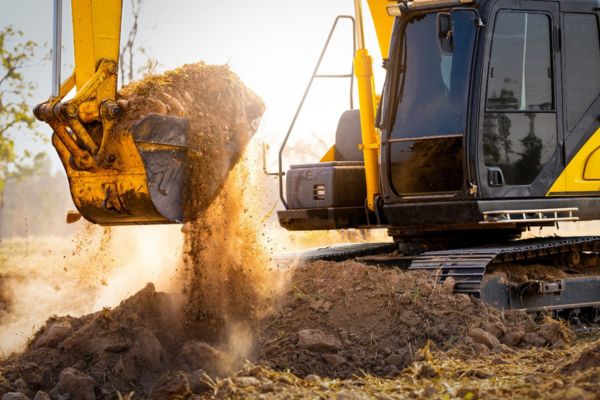
The global Industrial Vehicles Market is witnessing remarkable growth driven by rapid warehouse automation, rising e-commerce demand, industrial digitalization, and increasing investments in smart logistics infrastructure. Industrial vehicles have become essential across manufacturing plants, warehouses, ports, mining sites, and logistics centers to improve operational efficiency, productivity, and material handling capabilities.
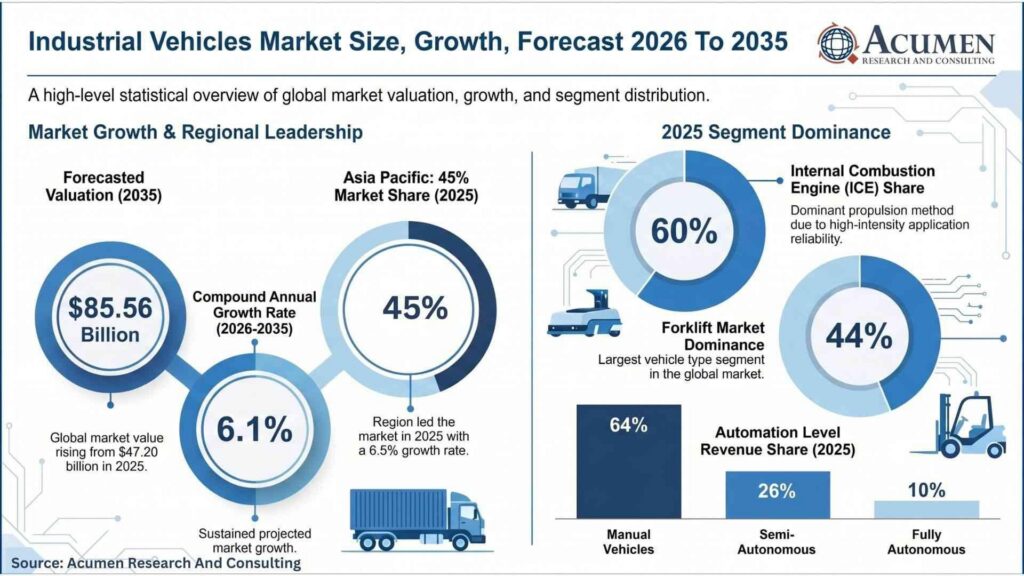
According to Acumen Research And Consulting analysis, the Global Industrial Vehicles Market size was valued at USD 47.20 billion in 2025 and is projected to surpass USD 85.56 billion by 2035, growing at a CAGR of 6.1% from 2026 to 2035.
Why the Industrial Vehicles Market is Growing Rapidly
The Industrial Vehicles Market is expanding significantly due to increasing automation in warehousing, logistics, and manufacturing sectors worldwide.
Industries are rapidly adopting industrial vehicles to streamline:
- Material transportation
- Inventory movement
- Warehouse automation
- Freight handling
- Pallet movement
- Supply chain operations
The rise of e-commerce and quick-commerce delivery models has dramatically increased demand for efficient warehouse and logistics solutions. Industrial vehicles help businesses improve operational efficiency, reduce downtime, minimize labor dependency, and optimize workflow management.
In addition, rapid industrialization across emerging economies and increasing smart factory adoption are further accelerating market demand.
Industrial Vehicles Market Size & Forecast
The future outlook for the industrial vehicles market remains highly optimistic as industries continue investing in intelligent mobility and warehouse automation technologies.
Industrial Vehicles Market Statistics
- Industrial Vehicles Market Size in 2025: USD 47.20 Billion
- Industrial Vehicles Market Forecast by 2035: USD 85.56 Billion
- Industrial Vehicles Market CAGR (2026–2035): 6.1%
- Asia-Pacific Market Share (2025): 45%
- Asia-Pacific Forecast CAGR: 6.5%
- Latin America Forecast CAGR: 6.3%
- Forklifts Segment Share (2025): 44%
- AGVs Segment Share (2025): 16%
- ICE Propulsion Market Share (2025): 60%
- Electric Vehicle Share (2025): 34%
- Electric Vehicle CAGR: 10.2%
- Manual Vehicles Share (2025): 64%
- Semi-Autonomous Vehicles Share (2025): 26%
- Material Handling Application Share (2025): 24%
- Warehousing & Logistics Application Share (2025): 20%
- Logistics & Warehousing End-Use Share (2025): 24%
- Manufacturing Industry Share (2025): 19%
The growing focus on automation, operational efficiency, and smart logistics systems is expected to continue driving long-term market growth.
Asia-Pacific Dominates the Global Industrial Vehicles Market
Asia-Pacific led the industrial vehicles market in 2025 with 45% market share and is expected to grow at the fastest CAGR of 6.5% during the forecast period.
Several factors are fueling regional growth:
- Rapid industrialization
- Expansion of e-commerce
- Growing warehouse infrastructure
- Increasing manufacturing investments
- Smart factory adoption
- Rising logistics automation
China remains a global manufacturing and warehouse automation hub, while India, Japan, and South Korea are investing heavily in intelligent logistics and industrial mobility solutions.
India’s booming e-commerce ecosystem and government-backed industrial initiatives are significantly increasing demand for forklifts, AGVs, and electric industrial vehicles.
Latin America Emerging as a High-Growth Region
Latin America is projected to expand at a significant CAGR of 6.3% during the forecast period.
The region is witnessing strong growth due to:
- Expansion of massive logistics networks
- Rising industrial automation
- E-commerce growth
- Increasing infrastructure development
- Growing warehouse modernization
Countries such as Brazil and Mexico are rapidly investing in supply chain optimization and warehouse automation technologies to improve logistics efficiency and meet rising consumer demand.
Forklifts Continue Dominating the Market
By vehicle type, the forklifts segment dominated the market in 2025 with 44% share.
Forklifts remain essential across industries due to:
- Heavy-load lifting capabilities
- Warehouse material handling
- Manufacturing operations
- Construction site logistics
- Cost-effective transportation
Continuous advancements in forklift manufacturing technologies by major industry players are further improving operational efficiency, safety, and energy performance.
Smart forklifts equipped with IoT sensors, AI-powered fleet management systems, and autonomous navigation capabilities are becoming increasingly popular in modern industrial environments.
Automated Guided Vehicles (AGVs) Witnessing Fastest Growth
The automated guided vehicles (AGVs) segment accounted for 16% market share in 2025 and is expected to grow at the fastest pace during the forecast period.
The rapid growth of AGVs is primarily driven by increasing warehouse automation, particularly in:
- E-commerce
- Retail
- Logistics
- Manufacturing
- Distribution centers
AGVs offer several advantages including:
- Reduced labor dependency
- Improved operational precision
- Enhanced workplace safety
- 24/7 operational capability
- Faster inventory movement
As companies increasingly pursue autonomous warehouse operations, AGV adoption is expected to accelerate significantly over the next decade.
ICE Vehicles Continue Leading but EVs Growing Rapidly
By propulsion type, internal combustion engine (ICE) vehicles dominated the market with 60% share in 2025.
Diesel-powered industrial vehicles remain widely used due to:
- High reliability
- Heavy-duty performance
- Longer operating hours
- Established infrastructure
- Strong payload capabilities
However, electric industrial vehicles are rapidly gaining momentum.
The electric vehicles segment held 34% share in 2025 and is projected to grow at the fastest CAGR of 10.2%.
This growth is supported by:
- Government EV initiatives
- Sustainability regulations
- Lower operating costs
- Reduced emissions
- Improved battery technologies
Companies worldwide are investing heavily in electric forklifts, electric AGVs, and battery-powered industrial fleets to achieve carbon reduction targets and improve energy efficiency.
Manual Vehicles Still Dominate Industrial Operations
By automation level, manual vehicles accounted for 64% market share in 2025.
Manual industrial vehicles continue dominating due to:
- Lower acquisition costs
- Operational simplicity
- Easier maintenance
- Widespread availability
- Flexibility in smaller operations
These vehicles remain highly preferred across manufacturing facilities, warehouses, and construction industries where fully automated systems may not yet be economically viable.
Semi-Autonomous Vehicles Gaining Strong Adoption
As per Acumen Research insights, semi-autonomous industrial vehicles accounted for 26% market share in 2025.
Industries are increasingly adopting semi-autonomous technologies to improve:
- Workplace safety
- Productivity
- Fleet optimization
- Material handling accuracy
- Operational efficiency
Semi-autonomous systems combine human oversight with automation technologies such as:
- Smart navigation
- Collision avoidance
- Automated lifting
- Fleet monitoring
The rising labor shortage in logistics and warehousing sectors is expected to further boost demand for semi-autonomous industrial vehicles.
Material Handling Dominates Application Segment
By application, material handling dominated the market with 24% market share in 2025.
Industrial vehicles play a critical role in efficient transportation and movement of goods across:
- Warehouses
- Distribution centers
- Factories
- Shipping yards
- Manufacturing facilities
The increasing complexity of modern supply chains is significantly boosting demand for intelligent material handling solutions.
Warehousing & Logistics Sector Driving Massive Demand
The warehousing & logistics application segment accounted for 20% market share in 2025.
This growth is primarily fueled by:
- E-commerce expansion
- Omnichannel retailing
- Faster delivery expectations
- Supply chain modernization
- Smart warehouse development
Warehouse operators are heavily investing in industrial vehicles to improve operational speed, inventory accuracy, and fulfillment efficiency.
Logistics & Warehousing Industry Leads End-Use Segment
By end-use industry, the logistics and warehousing segment dominated the market with 24% share in 2025.
The rapid rise of online shopping and quick-delivery business models is dramatically increasing the need for advanced industrial mobility systems.
Companies are increasingly deploying:
- Forklifts
- AGVs
- Tow tractors
- Automated pallet movers
- Smart warehouse fleets
to optimize warehouse operations and logistics workflows.
Manufacturing Sector Emerging as a Strong Growth Industry
The manufacturing segment accounted for 19% market share and is expected to witness significant growth.
Manufacturers across the Middle East & Africa (MEA) and Asian countries are rapidly investing in automated industrial solutions to improve:
- Production efficiency
- Material handling
- Inventory movement
- Factory automation
Industry 4.0 initiatives and smart factory deployments are expected to continue supporting demand for advanced industrial vehicles globally.
Technological Advancements Reshaping the Industrial Vehicles Market
The Industrial Vehicles Market is evolving rapidly through AI, robotics, and IoT integration.
Modern industrial vehicles now feature:
- Real-time fleet tracking
- AI-powered route optimization
- Predictive maintenance
- Autonomous navigation
- Smart safety systems
- IoT-enabled monitoring
These technologies improve operational efficiency while reducing downtime and maintenance costs.
The integration of AI-driven analytics is helping companies optimize fleet performance and warehouse productivity more effectively than ever before.
Key Companies Operating in the Industrial Vehicles Market
Several global manufacturers are actively competing through innovation, automation technologies, and electric mobility solutions.
Major market players include:
- Toyota Industries Corporation
- KION Group AG
- Jungheinrich AG
- Crown Equipment Corporation
- Mitsubishi Logisnext Co. Ltd.
- Hyster-Yale Materials Handling Inc.
- Hyundai Construction Equipment
- Doosan Industrial Vehicle
- Cargotec Corporation
- Daifuku Co. Ltd.
These companies are heavily investing in:
- Electric industrial vehicles
- AI-powered fleet management
- Autonomous vehicle systems
- Smart warehouse technologies
- Sustainable logistics solutions
Future Trends Shaping the Industrial Vehicles Market
Several transformative trends are expected to reshape the industry over the next decade.
Autonomous Warehouse Operations
Fully automated warehouses utilizing AGVs and autonomous forklifts are expected to become increasingly common.
AI-Driven Fleet Optimization
Artificial intelligence will improve route planning, maintenance scheduling, and energy management.
Expansion of Electric Mobility
Battery-powered industrial vehicles will continue gaining popularity due to sustainability initiatives and lower operational costs.
Hydrogen-Powered Industrial Vehicles
Hydrogen fuel cell-powered vehicles are emerging as sustainable alternatives for heavy-duty industrial operations.
Smart Logistics Ecosystems
Connected industrial fleets integrated with IoT and cloud platforms will improve supply chain visibility and operational efficiency.
Challenges Impacting Market Growth
Despite strong growth prospects, the market faces several challenges:
- High automation investment costs
- Charging infrastructure limitations
- Integration complexities
- Cybersecurity risks
- Skilled workforce shortages
- Supply chain disruptions
However, declining automation costs and continuous technological innovation are expected to offset these challenges over time.
Why Businesses Are Investing in the Industrial Vehicles Market
The Industrial Vehicles Market presents significant long-term opportunities due to:
- Rising warehouse automation
- Expansion of global logistics networks
- E-commerce growth
- Smart manufacturing adoption
- AI-powered industrial mobility
- Sustainability-focused industrial operations
As supply chains become increasingly digitized and automated, demand for intelligent industrial vehicles is expected to grow substantially worldwide.
Businesses seeking detailed market forecasts and strategic insights can ask for sample pages of full report here.
Frequently Asked Questions About the Industrial Vehicles Market
What is the size of the Industrial Vehicles Market?
The global industrial vehicles market was valued at USD 47.20 billion in 2025 and is projected to surpass USD 85.56 billion by 2035, growing at a CAGR of 6.1% from 2026 to 2035.
Which region dominates the Industrial Vehicles Market?
Asia-Pacific dominated the market in 2025 with 45% share and is expected to grow at the fastest CAGR of 6.5% due to rapid industrialization and e-commerce expansion.
Which industrial vehicle type holds the largest market share?
Forklifts dominated the market with 44% share in 2025 due to widespread use in material handling and warehouse operations.
Why are AGVs growing rapidly?
Automated Guided Vehicles (AGVs) are growing rapidly because of increasing warehouse automation and rising demand from e-commerce and retail industries.
Which propulsion type dominates the market?
Internal combustion engine (ICE) vehicles dominated the market with 60% share in 2025 due to their reliability and heavy-duty operational capabilities.
What is driving electric industrial vehicle growth?
Electric industrial vehicles are growing rapidly due to government EV initiatives, sustainability regulations, lower operating costs, and advancements in battery technologies.
Which end-use industry leads the market?
The logistics and warehousing sector dominated the market with 24% share in 2025 driven by e-commerce growth and increasing warehouse automation.