

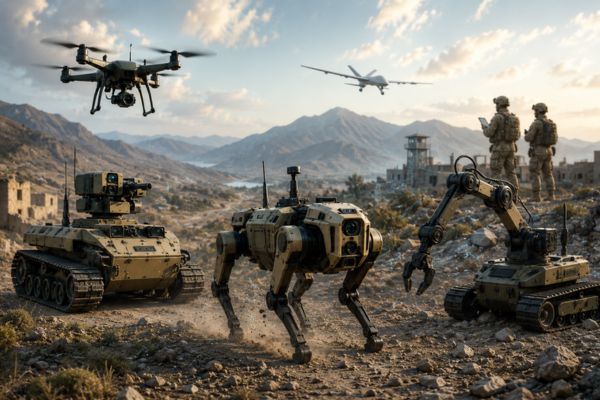
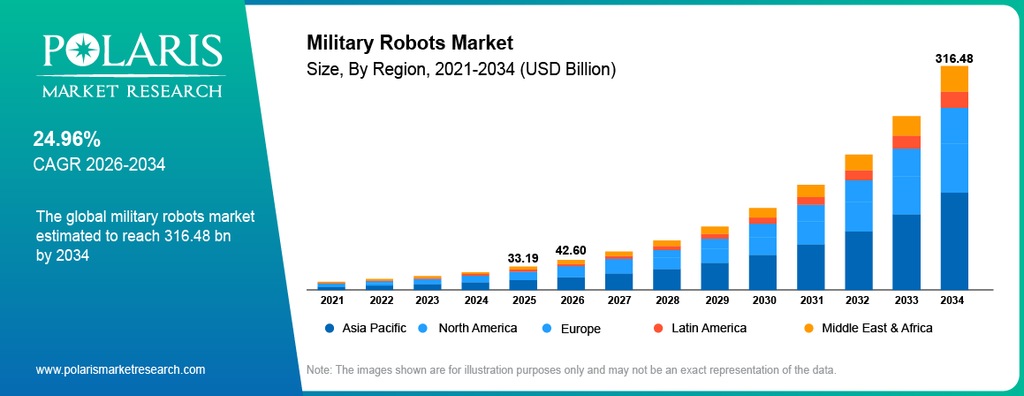
In April 2026, Ukraine’s Ministry of Defence set a target of 25,000 unmanned ground vehicles for the first half of the year. By July, its procurement agency had contracted more than 22,000, all of them built domestically. Few numbers capture the changing military robots market as clearly. What was once a showcase of prototypes and demonstrations has become a question of production lines and delivery schedules. Polaris Market Research values the sector at USD 33.19 billion in 2025 and projects USD 316.48 billion by 2034, a 24.96% CAGR. The more useful question is who is positioned to supply it.
From Trials to Funded Programs
For years, robotic systems lived in experimentation budgets. That is changing because armed forces now have operational evidence. Ukraine’s forces logged more than 16,600 logistics and evacuation missions with ground robots in June 2026, and the Defense Ministry reports more than 25,000 in August, 3.3 times the January level.
The logic is simple. Resupply runs and casualty evacuation are dangerous, repetitive jobs, and robots take soldiers out of exposed terrain. Airborne platforms still hold the largest platform share at 45.84%, anchored by surveillance. Yet land robots are projected to grow fastest, at a 27.42% CAGR, and logistics and casualty evacuation leads applications at 29.18%.
Washington is moving the same way. The U.S. Army selected American Rheinmetall as prime contractor for Project Sustainment, an 18-month effort on autonomous, hybrid-powered resupply robots. The Marine Corps awarded the company USD 7.28 million for 12 Mission Master SP vehicles and five autonomy kits. The Pentagon’s planned Autonomous Warfare Command, due to stand up in late 2027, signals institutional commitment.
Supervision, Not Driving
The technology shift matters as much as the volume. Human-in-the-loop systems still hold 55.61% of the market, but human-on-the-loop designs are forecast to grow at 26.93% annually. In practice, one soldier supervises several machines, often by voice or goal-setting, rather than steering each one.
What the Military Robots Market Means for Business
The opportunity extends well beyond vehicle makers. As autonomy separates from the chassis, software specialists, power-system suppliers and interface developers can win a place in the same program. Project Sustainment pairs a Harbinger hybrid chassis, Forterra autonomy and a Primordial Labs voice interface. The Harbinger platform is reported to offer more than 500 miles of range and 350 kilowatts of exportable power, which turns a cargo carrier into a mobile generator.
Pricing is diverging. The Marine Corps contract works out to roughly USD 607,000 per vehicle including kits, support and training, while Ukraine buys much cheaper domestic robots in far greater numbers. Suppliers must decide whether to compete on capability or on volume.
The obstacles are real:
- Electronic warfare: jamming and electronic attack threaten communications and navigation.
- Supply chains: even domestic production depends on specialized components, including Chinese inputs.
- Physical security: Estonia blamed Russia for an arson attack on Milrem Robotics in 2026.
- Market access: combat validation, consortium membership and foreign-investment reviews all shape who can win contracts.
New entrants are also arriving from outside defense. GM Defense unveiled a Silverado-based unmanned ground vehicle in October, with a demonstrator targeted for June 2027.
Regional Dynamics: Scale Versus Urgency
North America held 38.64% of the market in 2025, reflecting deep defense budgets, established primes and a growing pipeline of autonomy programs. Europe, however, is projected to grow fastest at 25.82%. Proximity to Ukraine’s war has turned ground robots into an operational need, and the roughly 300 manufacturers in Ukraine’s Brave1 cluster show how demand can seed a domestic industrial base almost overnight.
Asia Pacific accounted for 22.78%, with South Korea’s LIG Nex1 buying 60% of U.S. legged-robot maker Ghost Robotics. The Middle East and Africa held 5.84%, but the UAE’s EDGE Group has been Milrem’s majority owner since 2023, showing that influence can come through capital as well as procurement. Latin America, at 4.58%, remains early. For suppliers, the lesson is that regions buy for different reasons: modernization in the United States, urgency in Europe, and strategic investment in the Gulf.
Competitive Landscape: Buying the Maker, Not Just the Machine
Competition increasingly runs through ownership, partnerships and manufacturing capacity. Rheinmetall, Milrem Robotics, Ghost Robotics and Forterra anchor named ground-robot programs, while primes such as General Dynamics, Textron and Northrop Grumman compete across unmanned systems.
Deal-making shows where strategy is heading. In September, Swarmer agreed to acquire Ratel Robotics for up to USD 224 million, pairing autonomy software with combat-proven vehicles. ARX Robotics and Roboneers formed a joint venture aimed at tens of thousands of units a year, and Babcock signed an agreement with Ark Robotics to explore UK manufacturing. Sea Machines won a five-year special operations contract for autonomy kits that can be fitted to existing vessels. Differentiation now rests on integration and industrial scale as much as on any single robot.
What Comes Next
Manufacturing capacity, modular autonomy and through-life support will likely decide the next phase. Naval applications such as mine countermeasures are still emerging, and the Pentagon’s GroundBreaker 1 demonstration aims to give vendors a faster route into its Drone Marketplace.
Highly autonomous systems remain the smallest segment. Electronic-warfare resilience, rules of engagement and the policy debate over autonomy in lethal roles all limit adoption, so human oversight is likely to remain central.
Conclusion: The Bigger Business Picture
The headline growth rate understates the real transformation. Militaries are no longer asking whether robots work; they are asking how many they can field, how fast, and from whom. That favors suppliers who can combine proven performance with industrial scale, secure supply chains and adaptable autonomy. For businesses watching the military robots market, the signal is that the winners may be the ones who make robotics repeatable, not the ones with the most impressive prototype.